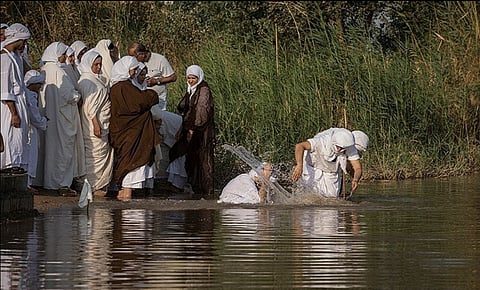


The globe marks World Water Day on March 22 every year. But for a unique sect located in southern Iraq and neighbouring parts of Iran, every moment of their lives is regulated by the use of water. This is also the reason why they today are dealing with ‘cultural wounds’ as the rivers they depended on for millennia, have dried up and there is no water left for their rituals.
The Mandaean community has traditionally traced its lineage to John the Baptist, who is also a key figure in Christianity and Islam. They have traditionally lived along the banks of the Euphrates, Tigris and Karun rivers in Iraq and Iran, where they perform crucial baptisms, known as Masbuta.
But why does this group place so much importance on water?
The importance of water in Mandaean life comes from their theological concepts. British cultural anthropologist, orientalist and novelist E S Drower, who studied the Mandaeans, explained them in her 1937 work, The Mandaeans of Iraq and Iran: Their Cults, Customs, Magic, Legends, and Folklore.
“The core or nucleus, of the Mandaean religion, through all vicissitudes and changes, is the ancient worship of the principles of life and fertility. The Great Life is a personification of the creative and sustaining force of the universe, but the personification is slight, and spoken of always in the impersonal plural, it remains mystery and abstraction…” she writes.
‘The Great Life’, the translation in English of the words Hayyi Rabbi, is the supreme God for the Mandaeans, from whom everything emanates.
“The symbol of the Great Life is ‘living water’, that is flowing water, or yardna. This is entirely natural in a land where all life, human, animal, and vegetable, clings to the banks of the two great rivers Tigris and Euphrates. It follows that one of the central rites is immersion in flowing water,” writes Drower.
In his 2024 article, Probing the Relationships Between Mandaeans (the Followers of John the Baptist), Early Christians, and Manichaeans, Iraqi-Australian Mandaean priest and professor Brikha Nasoraia seconds this when he says that the geography of the Mandaean faith had a great influence on its theological precepts.
“Mandaeism, by comparison, has roots from John the Baptist rather than Jesus, although it is also important to recognize that this baptizing movement emerged in part as a survival of a very old indigenous ethno-religious grouping from Mesopotamia, its followers eventually settling in Mesopotamia’s middle and southern regions. Indeed, much of the Mandaeans’ thought and practice, especially their rituals of water ablution, have deep origins going back to Sumer, Akkad and Babylonia, reflecting regionally wide influences from right across the Fertile Crescent,” he writes.
Nasoraia adds that “Traditionally, the Mandaeans have always conceived their manner of life to necessitate dwelling on the banks of the rivers and wellsprings, especially the Euphrates and Tigris Rivers (flowing out of highland Turkey/Kurdistan through Iraq), the Karun (of Iran), and the Jordan (descending in the Levant from Lebanon and Syria, and flowing between Israel/Palestine and the state of Jordan). A well-known social fixture in the Fertile Crescent for the last two millennia, the Mandaeans have needed to live close to the fresh running water where they can perform their daily baptismal sacraments, which have implications for every little feature of their lives.”
Drower also explains that besides living water, “the second great vivifying power is light, which is represented by personifications of light (Melka d Nhura and the battalions of melki or light spirits), who bestow such light-gifts as health, strength, virtue, and justice. In the ethical system of the Mandaeans, as in that of the Zoroastrians, cleanliness, health of body, and ritual obedience must be accompanied by purity of mind, health of conscience, and obedience to moral laws…”
She then points out that “…This dual application was characteristic of the cults of Anu and Ea in Sumerian times and Bel and Ea in Babylonian times, so that, if Mandaean thought originated or ripened under Iranian and Far Eastern influences, it had roots in a soil where similar ideals were already familiar and where ablution cults and fertility rites had long been in practice.”
Besides Masbuta, a mandatory triple immersion performed on Sundays for purification, and during weddings and other significant life events, often conducted by a priest, the Mandaeans also perform other water-based rituals like Rishama and Tamasha. These are essentially purification rituals involving washing with river water to cleanse oneself from daily impurities.
Today though, the Mandaean community is a shell in its former homelands of southern Iraq and southwestern Iran. The 2003 US Invasion of Iraq scattered the 60-70,000-strong community across the region and across the world in the United States, Australia and European countries.
Writing in 2015, the Mandaean Human Rights Group noted that “Only 6,000 remain in Iraq meaning that 90% of Mandaeans are now refugees. The Mandaean community has therefore suffered more displacement than other groups in Iraqi society.”
An article by the United Nations Environment Programme in 2018 highlighted the plight of the Mandaeans.
“…In largely desert countries, like Iraq, worsening sandstorms and diminishing grass cover have caked the rivers with dust and saddled water treatment facilities with a new range of woes.
“Never before, though, it seems, has poor water quality imperiled an entire religion. Already threatened by jihadists and criminal gangs, who damn them as heretics and target them for their historic role in the gold trade, the Mandaeans’ numbers have fallen from 100,000 to less than 10,000 in Iraq since 2003. For those who remain, pollution’s assault on one of the central tenets of their faith has added final insult to injury,” it read.
These are almost apocalyptic times for this group. With climate change and dams being built upstream on the Tigris and Euphrates, as well as industrial pollution, water inflows have drastically reduced.
With no flowing water, the Mandeans cannot practice their baptisms and other rituals. The global and regional water crisis in West Asia is thus an existential threat to the community.
As an article last year by Zainab Mahdi noted: “The Mandaeans’ plight serves as a powerful reminder that climate change impacts more than just environmental resources; they threaten the very fabric of Iraq’s diverse communities. Like other Indigenous communities around the world, the Mandaeans view water not merely as a physical necessity but as an extension of their ancestral practices. Disrupting these connections creates cultural wounds that extend far beyond ecological damage.”
