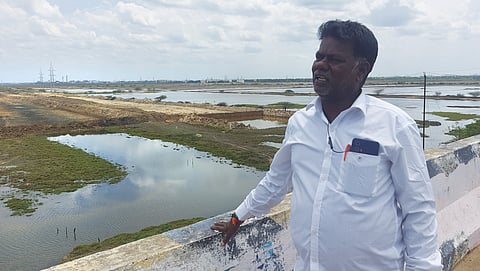


"It feels like history is repeating itself,” says P Prabhakaran. Pointing to the village of Karikattu Kuppam, Prabhakaran, a social worker based in Chennai, tells Down To Earth (DTE), “This village was devastated by the December 2004 tsunami, leaving 1,320 fishers without a home. They spent two decades getting back on their feet, but now face new threats.” Some 6 km away, in Kovalam village, D Mahendran, who comes from a long line of fishers, fears that the only livelihood he knows will cease in a few months.
Prabhakaran and Mahendran’s concerns stem from the Mamallan reservoir, being constructed on the Kovalam-Nemmeli wetland in Tamil Nadu. Former chief minister M K Stalin laid the foundation stone for the Rs 471-crore reservoir on January 19. Located 32 km from Chennai between East Coast Road (ECR) and Old Mahabalipuram Road (OMR), the pro-ject will create a freshwater reservoir on 2,023 hectares (ha) of the 3,440-ha wetland. Work on the first phase, covering 1,770 ha, has begun.
According to the Water Resources Department, Chennai requires 1,100 million litres of water daily, but current supply is 700-800 million litres. With a storage capacity of 1.65 thousand million cubic feet or TMC (1 TMC is 28.32 million cubic metres), the reservoir is expected to supply drinking water across 12 villages, urban and semi-urban areas.
However, since announcement, the project has faced intense opposition from local fishing communities, environmentalists and scientists across the state. Concerns are strongest among 13 fishing villages around the wetland area who rely on the saline waters, including Karikattu Kuppam and Kovalam.
The Kovalam-Nemmeli wetland has two connections to the Bay of Bengal: the Kovalam estuary in the north and Kokilamedu in the south…
This article is originally published in the November 1-15, 2026 print edition of Down To Earth
