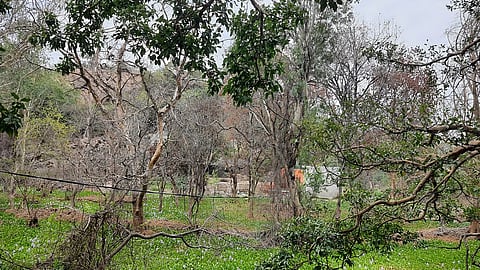


Environmentalists allege nearly 1,000 trees have dried up near Faridabad’s Badkhal Lake after coming into contact with treated sewage water released into the lake.
The water is supplied from a 10 MLD sewage treatment plant under a Smart City project to recharge the lake.
Residents of nearby Badkhal village have raised concerns that contaminated lake water may be seeping into groundwater.
Smart City officials say the treated water meets prescribed norms, but experts have called for fresh testing of lake water, soil and groundwater.
Nearly 1,000 trees have dried up near Badkhal Lake in Faridabad after coming into contact with treated sewage water stored in the lake, local environmentalists have alleged. The water, released into the lake from a sewage treatment plant (STP) as part of a Smart City project, has also raised concerns over possible groundwater contamination in nearby Badkhal village.
Faridabad Smart City Limited has installed a sewage treatment plant with a capacity of 10 million litres per day in Sector 21. Treated water from the plant is discharged into Badkhal Lake for recharge. The lake is currently filled with this water, which has reached the nearby Parson Temple forest area in Ankhir village.
Environmentalists and residents allege that the water is black, foul-smelling and contaminated. They say it has caused hundreds of medicinal and fruit trees in and around the Parson Temple and nearby Bharmal Temple complexes to dry up due to increased acidity and changes in pH levels.
Kailash Bidhuri, a trustee of Save Aravalli and an advocate, said he had complained several times about the quality of the water, but no effective action had been taken.
“We have been complaining from the beginning that the water is not clean, but the officials did not listen to us,” he said.
Bidhuri alleged that at least 1,000 trees had died after being exposed to the water. He said these included tamarind, banyan, khirni, bamboo and pilkhan trees, along with fruit trees such as mango, jamun and guava.
He said the area also had several other fruit and medicinal trees, including litchi, sandalwood and date palm, some of which had been brought by devotees from other parts of India and abroad.
Residents have also raised concerns that the lake water may be seeping into groundwater.
A young resident of Badkhal village, who did not want to be named, said people in the village had stopped drinking groundwater because of concerns over contamination. He alleged that the problem began after the lake was filled with treated sewage water.
Environmental journalist Chandrakant Yadav, who has been following the issue in Faridabad, said the matter had been brought to the attention of Haryana’s Forest and Environment Minister Rao Narbir Singh. According to Yadav, the minister has assured a detailed investigation by senior officials and said strict action would be taken if any fault was found in the quality of the sewage treatment plant water.

Sanjeev, executive engineer with Faridabad Smart City Limited, said the water released from the sewage treatment plant met prescribed norms. “The water from the STP is as per the norms. The devices installed at the STP give readings 24 hours a day,” he said.
He said the lake water may appear black because of water hyacinth. He also blamed washing, bathing and garbage dumping in the lake for worsening the water quality.
According to him, the treated water is tested from time to time. He said fresh testing would be carried out if residents had complaints.
Water experts said the condition of the lake water should be independently assessed.
Sushmita Sengupta, senior programme manager of the water programme at the Centre for Science and Environment, said the colour and foam of the water being released into the lake suggested that it may not have been properly treated.
She said high total dissolved solids could harm trees. Chemicals released from industries could also damage vegetation if they were not adequately treated before entering the sewage system.
Environmentalists said the issue highlights the risks of using treated wastewater for lake recharge without proper monitoring and safeguards.
They have called for urgent testing of the lake water, soil and groundwater, as well as an assessment of the tree deaths in the affected temple forest areas.