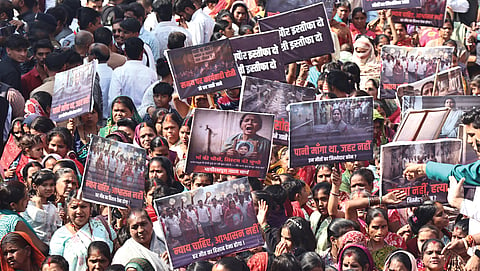


Arun Prajapat knew trouble was brewing, but did not expect it to arrive so suddenly and upend his life. On December 28, 2025, while working at a construction site, he received a call from his mother. The piped water in their home, she said, smelled foul and was no longer drinkable. It was time, she insisted, to buy a filter. By the following day, her body began to fail her. “She complained of severe abdominal pain and nausea. There was little time to understand what was happening. After two bouts of diarrhoea and vomiting, she died before we could reach a hospital,” Prajapat recalls. In the days that followed, the illness spread across Bhagirathpura, a congested, neighbourhood in Madhya Pradesh’s Indore city. Residents estimate that 3,000 people suffered vomiting, diarrhoea, dehydration and weakness, with 450 requiring hospitalisation. By January 21, as many as 25 succumbed to the illnesses.
Laboratory tests by Mahatma Gandhi Memorial Medical College in Indore detected pathogenic organisms in the samples of piped water, such as Vibrio cholerae, faecal coliform and Escherichia coli, which establishes that sewage had seeped into the potable-water system, triggering the diarrhoeal outbreak...
Subrata Chakraborty, director of the water programme at the Centre for Science and Environment (CSE), a research and policy advocacy organisation in Delhi, says Indore-like incidences highlight that engineering guidelines for laying and maintaining pipelines are routinely ignored. In India, two manuals guide city-level engineers in planning and designing sewer and drinking-water lines. The first, Manual On Water Supply And Treatment Systems (Drink From Tap), March 2024, published by the Central Public Health and Environmental Engineering Organisation (CPHEEO) under the Ministry of Housing and Urban Affairs, lays out standards for pipeline installation. It emphasises horizontal and vertical separation of drinking water lines from existing or prospective sewers or drains to protect against contamination. Water main should be laid at least 3 metres (m) horizontally from sewers or drains; vertically, the bottom of the water main should be at least 0.5 m above the top of any lateral sewer, storm drain or sanitary sewer. Where ideal conditions cannot be met, it recommends specialised casings.
The second, Manual on Sewerage and Sewage Treatment Systems (published by CPHEEO in 2013), advises that sewers should always run below water lines. It specifies a minimum lateral offset equal to half the width of a manhole plus 30 cm and recommends encasing sewers where adequate separation is not possible. Complementing these, IS Code 1742:1983 (Code of Practice for Building Drainage) mandates a minimum vertical distance of 0.3 m and a horizontal separation of 3 m between water and sewer lines to reduce the risk of contamination. Chakraborty says these standards exist to prevent precisely the kind of sewage-water mixing that caused outbreaks in Indore, yet they are frequently overlooked during urban development.
The National Green Tribunal also highlights the problem. “Across multiple urban centres, drinking water pipelines and sewerage lines are laid in close proximity, often intersecting or running parallel to each other. In several instances, drinking water pipelines are laid below sewer lines or drains, increasing the risk of contamination in the event of leakage, pressure fluctuations or pipeline damage. Intermittent water supply systems further aggravate the situation by creating negative pressure within pipelines, thereby facilitating ingress of contaminated water,” notes its January 15 order...
This article is part of the cover story What lies beneath published in the February 1-15, 2026 print edition of Down To Earth
