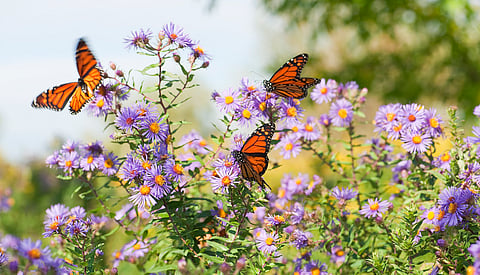


There has been a 64 per cent increase in the presence of the Monarch butterfly in Mexican overwintering forests during the 2025-2026 season, Mexico’s Ministry of Environment and Natural Resources (Semarnat) and the National Commission of Natural Protected Areas (Conanp), in partnership with WWF Mexico, announced on March 18. This season, the colonies occupied 2.93 hectares (ha) of forest, compared to the 1.79 ha recorded in the previous season.
The increase in occupied area was due to a greater number of eggs and larvae being recorded during reproduction in the United States, because the spring and summer were less dry than in 2024, according to a statement by WWF Mexico. In addition, there was less drought during the migration to Mexico, which led to a high presence of flowering plants that provided nectar for the Monarchs.
During the 2025-2026 hibernation season, nine Monarch butterfly colonies were recorded: three in Michoacán and six in the State of Mexico. The area occupied by seven of these colonies corresponds to data obtained during the second half of December 2025, while information on the remaining two colonies comes from records made in January 2026.
Five of the colonies (2.27 ha) were found to be located within the Monarch Butterfly Biosphere Reserve (MBBR), while four (0.66 ha) were established outside of it.
The second lowest area occupied by Monarchs in the last 30 years was recorded in 2023-2024 with 0.9 ha of forest, while the lowest historical occupancy occurred in 2013-2014 with 0.67 ha and the highest in 1996-1997 with 18.19 ha. The 2.93 ha occupied this season indicate that the Monarch population recovery trend continues for the second consecutive year and represents significant short-term growth.
Regarding the analysis of changes in forest cover in the core area of the MBBR, between February 2024 and February 2025, an impact of 2.55 ha of forests was recorded, representing a reduction of 32 per cent compared to the 3,728 ha affected the previous year.
For this last period, 0.579 ha were affected by a fire, 0.117 ha by natural causes (drought) and 1.854 ha by illegal logging, which was also reduced compared to the previous analysis.
“One of the greatest achievements of this work is that illegal logging in the core zone of the Monarch Butterfly Biosphere Reserve has been practically eradicated since 2008. This means that the forests that represent the fundamental habitat for the Monarch butterfly's hibernation are being protected and conserved; this is an example of how we can bring nature back,” commented Director General of WWF Mexico, María José Villanueva.
In her address, the head of Semarnat, Alicia Bárcena Ibarra, stated, “The Monarch butterfly is the symbol of the trilateral relationship between Mexico, the United States, and Canada. Its conservation is a collective commitment that we must maintain for the future. The butterfly teaches us that every action counts, and however small it may be, it contributes to restoring this peace with nature.”
