
Subscribe

Researchers have discovered a vibrant and healthy stretch of coral reef thriving in the northeast of Kalpeni island in the Lakshadweep Archipelago.
The discovery offers fresh hope for coral conservation in Indian waters, especially with the ongoing fourth global mass coral bleaching event.
From 1 January 2023 until 30 September 2025, bleaching-level heat stress had impacted almost 84.4 per cent of the world’s coral reef area and mass coral bleaching, documented in at least 83 countries and territories.
The Global Tipping Points Report in 2025 reveals the earth to be already at 1.4 degrees Celsius of long-term warming. Warm water coral reefs are on the verge of crossing their thermal tipping point and entering a new state of long-term decline, risking lives of millions of people.
Also termed as ‘rainforests of the oceans’, coral reefs support about 25 per cent of all marine life, acting as vital, biodiverse ecosystem providing shelter, breeding grounds, and feeding areas for reef fishes, invertebrates, and many other marine organisms.
The reef structure also plays a crucial role in protecting shorelines. Coral frameworks help reduce wave energy, prevent coastal erosion, and contribute to sediment formation, which supports the stability of atolls like those in Lakshadweep.
Idrees Babu, scientist with the Department of science & Technology, Government of India, was part of the research team that discovered the reef. He claimed that the new discovery is a hope for corals amid the gloom of mass bleaching. The newly discovered reef is a live laboratory and research treasure for scientists, he added.
“We found about 35 species of corals in the reef that stretches for nearly 1.8 kilometres and covers approximately 12.99 hectares—making it one of the more continuous and healthy reef patches seen in the region in recent years,” he said.
Babu added that the newly documented reef area shows strong live coral cover and could become a priority site for protection and long-term scientific monitoring. “It holds national significance at least as it can be a hotspot for coral biodiversity conservation and the learnings can help restore reefs in other parts of the country,” Babu told Down To Earth.
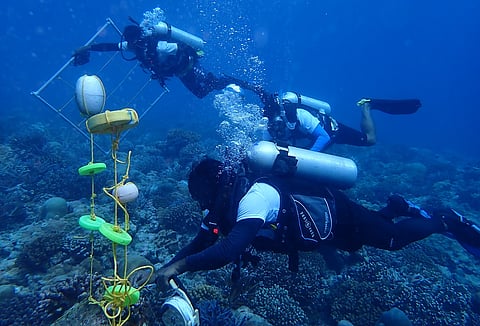
The reef was observed during a marine biodiversity survey conducted by the Research and Environmental Education Foundation (REEF), with support from Baranna Dives and was one of the 24 reefs documented during field activity.
Babu said Lakshadweep, like other coral reefs in the world, has experienced coral stress from rising sea temperatures, marine heat waves, repeated coral bleaching events, climate change, and increasing human pressures. In this context, the team of scientists involved in the discovery said finding such a continuous stretch of healthy coral cover near Kalpeni is both rare and encouraging.
“While the islands of Lakshadweep are naturally surrounded by coral reefs, large areas with strong live coral cover have become less common due to repeated bleaching in the Indian Ocean region,” a statement from the researchers said.
Babu said the site offers an excellent opportunity for long-term ecological monitoring. As many coral reefs around the world are declining, areas with strong live coral cover can serve as important reference points for studying resilience and recovery.
“Continuous scientific observation at this reef can help experts track coral health over time, study recovery after bleaching events, identify coral species that show greater resistance to heat stress, monitor changes in fish and invertebrate populations, and develop conservation strategies suitable for atoll ecosystems,” he said adding, such long-term data can play a crucial role in strengthening climate resilience research and guiding science-based management plans for Lakshadweep and other reef regions.
The researchers said protecting the newly recorded reef should become a priority as they resemble a living example of coral endurance.
At a time when many coral reefs worldwide are under severe stress, the discovery of this promising coral cover near Kalpeni Island brings hope. It proves that healthy coral ecosystems still exist and can guide sustainable management and conservation planning, he said.
“The reef is a symbol of resilience, showing that even in the present era of climate change, strong coral systems can survive and continue to support marine biodiversity,” Babu added.
The researchers however warn that without careful management, monitoring and community involvement, such ecosystems remain vulnerable.
Continuous scientific observation at this reef can help experts track coral health over time, study recovery after bleaching events, identify coral species that show greater resistance to heat stress, monitor changes in fish and invertebrate populations, and develop conservation strategies suitable for atoll ecosystems, Babu noted.
Such long-term data can play a crucial role in strengthening climate resilience research and guiding science-based management plans for Lakshadweep and other reef regions, he said.
Corals are among the oldest living organisms on Earth. Their ancestors existed more than 500 million years ago, even before dinosaurs appeared. Over millions of years, they have survived several mass extinction events due to their strong adaptability, unique partnership with microscopic algae, and diverse reproductive methods.
“Safeguarding such sites will not only strengthen conservation efforts in Lakshadweep but also contribute to a broader global understanding of coral resilience in a changing climate,” Babu said.
