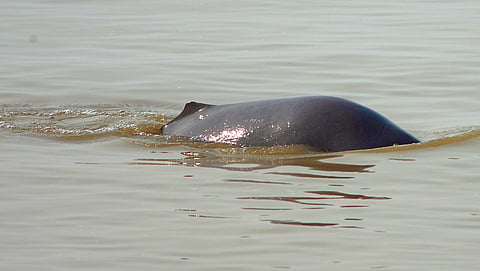


Members of riparian communities along the Beas river in Punjab often recount an interesting aspect about the Indus river dolphin, locally known as the bhulan (the one with long lips, in this case elongated snout). The dolphins were frequently observed surfacing in deeper or more dynamic stretches of the river, and these sightings were interpreted as the animals guiding people through potentially hazardous waters.
The dolphin, one of the world’s most endangered freshwater cetaceans (aquatic mammals which include whales, dolphins and porpoises) and a flagship species of the Indus river system, is thus culturally viewed as a “guardian of the river”. It is believed to keep the waters of the Beas “alive” and “breathing.” Over generations, local knowledge systems have described the dolphin as an intelligent and benign species, reinforcing the belief that harming it would disturb the balance of the river ecosystem.
The bhulan was once distributed across the Indus and its tributaries in Pakistan and northwestern India. But its range has drastically contracted due to flow regulation, loss of connectivity, pollution, climate change and entanglement in fishing gears.
For several decades, the species was presumed extinct in the Indian part of its range. In 2007, however, a small population of Indus river dolphins was rediscovered in the Beas, reigniting conservation interest and action. Subsequent surveys conducted jointly by the Punjab Forest Department, Wildlife Institute of India (WII) and World Wildlife Fund for Nature-India (WWF-India) confirmed a breeding population inhabiting a 70-km stretch of the Beas, particularly between Beas bridge and Harike. This is the easternmost limit of its distribution where the species is legally protected as a Schedule I species under the Wild Life (Protection) Act, 1972. In 2018, recognising the ecological importance of this population and its habitat, the Government of Punjab declared the Beas River Conservation Reserve (BRCR)—the largest riverine conservation reserve in the country under Section 36A of the Wild Life (Protection) Act, 1972.
The Indus river dolphin is functionally blind. It has extremely reduced eyes without lenses. Instead of vision, it relies entirely on echolocation to navigate, hunt and avoid obstacles in the highly turbid waters of the Beas. It has a remarkable trait of swimming predominantly on its side. This allows it to use its long, sensitive snout to probe the riverbed for prey. Side-swimming is extremely rare among cetaceans and is a signature feature of this species. This freshwater river dolphin lives largely solitary or in very small groups (typically mother-calf pairs). Braided river channels of the Beas are its most preferred habitat.
The Department of Forests and Wildlife Preservation, Punjab, in partnership with WII, WWF-India and other academic institutions, has invested in scientific studies on dolphin ecology, habitat dynamics and prey base assessment. A network of trained Dolphin Mitras, local volunteers and fishers residing along BRCR, was established to assist in daily monitoring and reporting of dolphin sightings, habitat conditions, and potential threats. The network now functions as an early-warning system for any dolphin sightings, distress, stranding or mortality events. This community-based model of conservation has become a hallmark of Punjab’s approach, blending citizen science with professional wildlife management.
This article was originally published as part of the December 16-31, 2025 print edition of Down To Earth