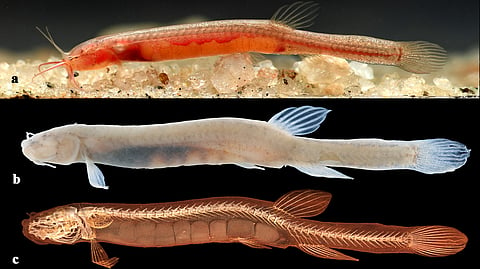


Scientists have discovered a tiny blind freshwater fish with no skull roof in a dug-out well in Assam’s Goalpara district.
Named Gitchak nakana, the 20.8mm fish has been described as a new genus and species, and the first aquifer-dwelling fish recorded from Northeast India.
Researchers collected 13 specimens from a single well, but found none in neighbouring wells, highlighting how little is known about underground freshwater habitats.
Molecular analysis suggests the fish belongs to an ancient lineage that split from its closest relatives between 21.4 million and 45.5 million years ago.
A tiny, blind freshwater fish with a translucent body, no visible eyes and no skull roof has been discovered in a dug-out well in Assam, giving scientists a new genus and species from India’s little-known underground waters.
The tiny bottom-dwelling fish, named Gitchak nakana, was found in a village in Goalpara district, at the foothills of the Shillong Plateau near the Brahmaputra valley. The findings were published in the journal Scientific Reports in February 2026. The species name comes from the Garo words na·tok, meaning fish, and kana, meaning blind, referring to the absence of eyes.
Researchers said the discovery is significant because it opens up a new location for the study of unknown subterranean fauna in Asia. In India, subterranean fish have previously been recorded from Kerala and Meghalaya.
“This new genus and species of miniature, pigmentless and blind cobitid loach was collected on three occasions from the same well,” the study said. It described the fish as the first phreatobitic, or aquifer-dwelling, fish from northeast India and the first subterranean cobitid loach (underground freshwater fish) from the region.
Caves on the Shillong Plateau are already known to host several blind and pigmentless subterranean fish, including two loaches and Neolissochilus pnar, the world’s largest known subterranean fish. But Gitchak nakana was found not in a cave, but in groundwater accessed through a well.
Researchers collected 13 specimens from one open dug-out well. The fish has not been found in neighbouring wells despite attempts to locate it. The study said the discovery was serendipitous. Aquifer-dwelling fish are rare among subterranean fishes and are usually found by chance, often when water is pumped from aquifer-fed wells. Phreatobitic species are rare among subterranean fishes, and of the 272 valid species only around 23 come from groundwater aquifers, the authors of the paper wrote.
Scientists said the habitat itself is unusual. “The entire geological setting of the type locality is so far unique for phreatobitic fish species. Situated in a highly geologically dynamic area, the alluvial deposits of the bed of a tributary of the Brahmaputra, this type of habitat is not expected to be stable for longer periods of geological time,” it said.
The fish was found in alluvial deposits linked to a tributary of the Brahmaputra, in a geologically dynamic area. Such habitats are not usually expected to remain stable for long periods.
The fish grows to a maximum standard length of just 20.8 millimetres. It has no distinct body colour and its translucent body appears blood-red. It has no externally visible eyes, though there is a tiny black spot in the orbital region of the head.
Like many subterranean species, it appears to rely on non-visual senses. The fish has four pairs of long barbels — nasal, rostral, maxillary and mandibular — densely covered in taste buds, which may help it navigate and find food in darkness.
One of the fish’s most striking features is the complete absence of a skull roof. The study said the left and right frontal and parietal bones are restricted to the sides of the skull, leaving a large opening covered only by skin.
The absence of a skull roof is rare among bony fishes because of its role in protecting the brain. Researchers said similar features have been reported in a few highly miniaturised fish like Paedocypris, Danionella and Sundadanio, where adult animals retain larval traits because of shortened development.
Other unusual features include a shortened ethmoid region, elongated gill-cover supports and a large swim bladder capsule extending further back into the body than in related loaches.
Molecular analysis suggests Gitchak nakana belongs to an ancient lineage that separated from its closest relatives between 21.4 million and 45.5 million years ago.
This raises a puzzle because the alluvial sediment where the fish was found is estimated to be less than one million years old. The authors said similar aquifer habitats may have existed in the area for a much longer time. Another possibility is that the lineage once had surface-dwelling ancestors that entered subterranean aquifers more recently.
“The neighbouring rocks, the Assam-Meghalaya Gneissic complex, are of Proterozoic age, and could have been a potential source of sediments for the alluvial deposits created by the Brahmaputra and its tributaries in the area in which Gitchak occurs. An alternative explanation for the mismatch of the age of Gitchak nakana and that of its habitat is that its lineage included epigean ancestors that only entered the subterranean aquifer habitat in geologically more recent times,” the paper said.
