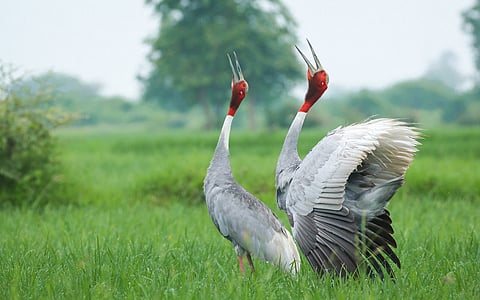


The Bombay Natural History Society (BNHS) has announced a nationwide survey to estimate the population of Sarus Cranes on October 10 and 11, 2026. Birders across the world will celebrate October 10 as a World Migratory Day.
BNHS has made an appeal to various stakeholders including State Forest Departments, research institutions, conservation organisations, local communities, farmers, colleges/universities and citizen scientists to visit nearest Sarus Crane habitats and participate in All-India Sarus Crane Survey on 6am to 6pm on October 9 and 10. BNHS has requested birders to share their count and observations on <saruscranesurvey@gmail.com>
Kishor Rithe, Director of BNHS said that “Launching a synchronised All India Sarus Crane Survey will allow us to track their numbers, uncover critical strongholds, and deploy the precise science needed to protect these impressive birds and the landscapes they rely on”.
P Sathiyaselvem, Dy. Director BNHS, who is heading the BNHS Central Asian Flyway Programme shared detailed information about the survey. He stated that “A scientifically robust national dataset established through this all India Sarus Crane Survey would enable to establish a national population baseline, identify Sarus Crane strongholds and priority landscapes, map important breeding, feeding, roosting and congregation sites, prioritise wetland restoration and habitat management, identify possible power-line collision and electrocution areas, guide Sarus-friendly agricultural practices, strengthen community-based conservation, develop evidence-based national and state conservation plans and to integrate Sarus conservation with wetland, agricultural and landscape-level policies. The value of a national survey is therefore not simply obtaining a number. It is establishing a scientifically comparable baseline against which future population change can be measured.”
Sarus Crane (Antigone Antigone) is one of India’s most iconic wetland-associated birds and the world’s tallest flying bird. Standing about 1.5 metres tall, the species is deeply embedded in the cultural and ecological heritage of the Indian subcontinent. Revered in Indian culture as a symbol of lifelong devotion and marital fidelity, the bird plays a vital ecological role. It is also the only resident breeding crane species in India. It is listed as globally threatened vulnerable under the IUCN Red List. It has been included in CITES Appendix II and protected under Schedule I of India’s Wild Life (Protection) Act. 1972 on par with tigers in the country.
“The Sarus is much more than a charismatic bird. Its continued presence depends upon a functioning mosaic of wetlands, marshes, shallow water bodies, grasslands and agricultural landscapes. Protecting Sarus habitat therefore contributes simultaneously to the conservation of wetlands, agricultural biodiversity and a range of other species dependent on these ecosystems,” a statement by BNHS noted.
The iconic Sarus Crane is a vital indicator of healthy wetlands and agricultural ecosystems. Historically, the Indian Sarus Crane had a considerably wider distribution across the Indian subcontinent. It occurred extensively across the Gangetic plains and adjoining regions, including areas of Uttar Pradesh, Bihar, Rajasthan, Gujarat, Madhya Pradesh, West Bengal and Assam. Historical accounts also indicate a much wider distribution towards central and eastern India.
Today, the species has disappeared from, or become extremely scarce in, several parts of its former range. The species is now restricted largely to agricultural and wetland pockets in Uttar Pradesh, Gujarat, Rajasthan, Madhya Pradesh, Haryana, and isolated populations in Maharashtra. While central and northern India remain strongholds for the species, southern populations are experiencing alarming declines. Over the past three generations, it is suspected to have suffered a rapid reduction in population size possibly exceeding 30 to 40 per cent.
The Sarus survives in a human-dominated landscape and consequently faces a complex combination of threats. Degradation of wetlands, changes in agricultural land use, usage of pesticides and agricultural chemicals, collision and electrocution in powerlines, human disturbance, poaching and collection of eggs and chicks, predation by wild and free-ranging dogs etc., are the threats reported by various studies in India.
India has a long history of Sarus Crane research and conservation. Various studies supported by both government, private and international partnerships have investigated the species’ ecology, land-use relationships, breeding biology, population characteristics and threats in important landscapes including Uttar Pradesh, Gujarat and Rajasthan. These studies have demonstrated the importance of wetlands embedded within agricultural landscapes and emphasised the need for cooperation between wildlife, agriculture, irrigation and other government departments for the protection and conservation of the Sarus Crane and its habitats.
“Sarus Cranes do not recognise administrative boundaries. Birds move between wetlands, agricultural landscapes and districts, and populations can be distributed across adjoining states. A coordinated, nationwide survey is urgently needed to understand the current status of the birds nationwide. A standardized All India Sarus Crane Survey will establish a crucial scientific baseline—mapping population trends, pinpointing high-priority habitats, and driving targeted conservation actions to safeguard this flagship species,” noted the statement by BNHS.
An earlier international assessment estimated the Indian Sarus population at approximately 8,000–10,000 birds, with a declining trend. However, these historical estimates cannot be directly compared with present-day state counts because survey methods, geographical coverage, survey seasons and counting effort have differed substantially over time. More recent state-level counts demonstrate that important populations remain. For example, Uttar Pradesh has conducted repeated state-wide counts and reported nearly 20,000 Sarus Cranes in 2024, demonstrating the importance of the state as a stronghold for the species. These apparently different population pictures underline an important scientific issue: India currently lacks a standardised, synchronised, nationwide Sarus Crane population assessment that can provide a comparable national baseline. The state of India’s birds report says that the long-term population trend of Sarus Crane declined by 76.84 per cent and the current annual trend of its decline by 4.33 per cent per year
“Therefore, BNHS calls upon various stakeholders including the Ministry of Environment, Forest and Climate Change, State Forest Departments, research institutions, conservation organizations, local communities, farmers, colleges/universities and citizen scientists to work together towards a coordinated All-India Sarus Crane Survey being organized on 10th and 11th October, 2026,” the statement concluded.
