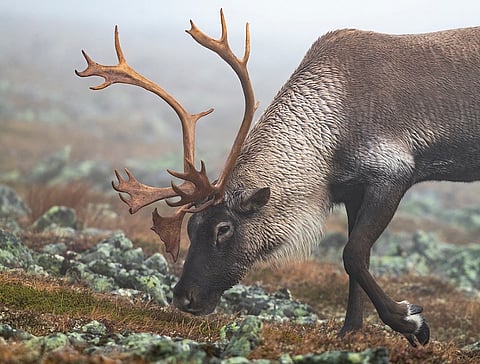


If lichen continues to decline across the Arctic, caribou populations could struggle to survive the winter, according to a study by researchers at the State University of New York College of Environmental Science and Forestry in the United States.
Chloe Beaupré and Elie Gurarie examined the relationship between winter forage, snow conditions, and caribou survival in their study titled Winter survival shaped by forage abundance and snow depth for a long‐distance migratory ungulate, according to a statement.
Caribou (called reindeer in Eurasia) are one of the few animals that can eat and digest lichen (also called ‘reindeer moss’). In winter, when other foods are scarce, caribou rely almost entirely on this resource. To understand how essential lichen is for caribou survival, the researchers analysed tracking data from the Western Arctic Herd.
Their analysis revealed that caribou living in areas with abundant lichen were up to nine times more likely to survive the winter than those in regions with sparse lichen. However, snow depth significantly affected access to this critical food.
“Caribou dig through snow in a behavior known as ‘cratering,’ but once snow exceeds about 50 centimeters, even high-lichen areas become inaccessible,” said Beaupré. “When snow is too deep for caribou to reach lichen, the survival advantage disappears.”
Using GPS telemetry data from 1,067 caribou winters between 2009 and 2024, the study found that higher lichen cover significantly improves survival, but only when snow conditions allow access.
“As Arctic conditions continue to change, both lichen availability and snow depth will play a critical role in determining whether caribou can survive the winter,” said Beaupré.
Beaupré and Gurarie collaborated with the National Park Service, University of Alaska Fairbanks, and University of Maryland on the study.
