

The Central Asian Conservation Network (CACN), a regional platform for non-profits, researchers, and conservation experts dedicated to transboundary conservation, has launched a new Central Asian Flyway Digital Hub, according to a recent statement by the organisation.
The aim is to strengthen the sharing of knowledge and information for the conservation of migratory birds across one of the world’s major migration routes.
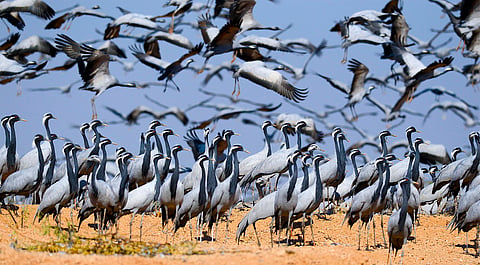
The Central Asian Flyway (CAF) connects breeding, stopover and non-breeding (northern wintering) areas across a vast region, linking countries from northern Eurasia through Central and South Asia. More than 600 bird species use the flyway, making cooperation and information sharing across national boundaries essential for their conservation.
The Digital Hub will bring together information on migratory bird species, important flyway sites, conservation projects, educational resources and opportunities for participation. It will also provide dedicated portals for recording bird collisions and sightings of marked birds.
“The Central Asian Flyway is a vast and complex system, and conservation depends on people and organisations being able to share knowledge and act collaboratively across borders. The Digital Hub is designed to bring core knowledge together and make it accessible to a much wider community,” said Taej Mundkur, Science & Policy Advisor CACN and Senior Advisor, Wetlands International.
According to the CACN statement, a major feature of the Digital Hub will be its collection of educational and awareness materials, designed to make the story of migratory birds accessible to children, teachers, communities, birdwatchers and the wider public.
The resources include publications, educational materials and children’s stories that explain migration, the importance of wetlands and other habitats, and the threats faced by migratory birds. One example is Selenge, the Little Goose and Her First Migration, which follows a Bar-headed Goose on her first migration and introduces readers to the amazing wetlands across the CAF.
“We wanted the Digital Hub to make information about migratory birds accessible beyond the scientific community. Educational materials can help children and communities understand these remarkable journeys and the importance of protecting the places birds depend on along the way,” said Khurshed Alimov, Co-chair, CACN.
The Digital hub will include a Bird Collision Reporting Portal, allowing observations of birds killed or injured through collisions with infrastructure such as power lines, wind turbines and other structures to be recorded and shared.
According to CACN, bird collisions can be difficult to understand at a regional scale because observations are often scattered among individual studies, organisations and field records. The new portal provides a common platform for documenting these incidents and building a broader picture of collision risks across the flyway.
“Individual collision records can provide valuable information when they are brought together. The portal provides an opportunity to build a stronger regional evidence base and help identify areas where further investigation or conservation action may be needed,” said the CACN’s Science Coordinator, Ramesh Kumar Selvaraj.
The Digital Hub will also feature a Ringing and Resighting Portal, providing a platform for recording observations of birds carrying metal rings, colour rings, leg flags, neck bands and other identifying marks.
Such observations can reveal connections between breeding, stopover and non-breeding areas and provide valuable information on migration routes and bird movements. A bird marked in one country and subsequently recorded in that country or in another country thousands of kilometres away can provide important evidence linking different parts of the flyway.
“A marked bird can connect people and places across the entire flyway. A single observation by a birdwatcher can become valuable information for understanding migration when it is properly recorded and shared,” said Jeremie Berlioux from the CACN.
India is an important part of the CAF and is home to several species of migratory birds especially during their annual journeys. Wetlands, grasslands, coastal habitats and other landscapes in India provide important feeding and resting grounds for birds travelling far off places like the Arctic.
The Digital Hub will also support initiatives that connect people and information across the flyway. One such initiative is Flyway Connect, being developed in collaboration with Bird Count India, which aims to strengthen connections between birdwatchers, researchers and conservation practitioners and improve the sharing of information on satellite tagged migratory birds and their movements.
“India is an important destination for migratory birds along the CAF. What happens to these birds in their non-breeding and stopover areas is closely connected to what happens elsewhere along their migration routes. Strengthening these connections is therefore essential for their conservation,” said Selvaraj.
According to experts, the true potential of the Digital Hub will lie in the sharing of knowledge and joint participation by researchers, organisations and members of the public.
“There is a great deal of valuable work taking place across the Central Asian Flyway, but information is often spread across different organisations and countries. The Digital Hub provides a space where people can discover this work, share resources and build new connections,” said Katherine Hall, Co-chair, CACN.
Alimov said: “We want people across the flyway to see the Digital Hub as a shared platform. Whether you are a researcher, teacher, birdwatcher, student or conservation practitioner, there are opportunities to learn from the information available and to contribute.”
The platform has been developed with support from WWF, Hong Kong and the Ornithological Society of the Middle East (OSME).
“Conservation of migratory birds cannot be achieved by one organisation or one country working alone. The Digital Hub is an important step towards creating a more connected community across the flyway, where information and experience can be shared across borders,” said Hall.
“This is a living platform that will grow with the contributions of people working across the flyway. Our hope is that it becomes a useful regional resource for conservation, education, research and public participation,” said Beriloux.
The Central Asian Flyway Digital Hub is available at cafnetwork.org.
