
Subscribe

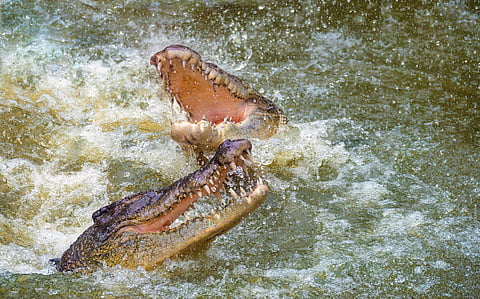
The range of the saltwater crocodile (Crocodylus porosus) once extended from the Seychelles archipelago in the Indian Ocean near the African mainland to Vanuatu in the South Pacific Ocean.
Researchers from the University of Potsdam, the Bavarian State Collections of Natural History (SNSB), the University of Bergen in Norway and the Natural History Museum of the Seychelles reached this conclusion after confirming that the crocodiles once found in the Seychelles were ‘salties’.
“Accounts from early expeditions to the Seychelles more than 250 years ago described crocodiles as common along the coasts of the archipelago. But after the first settlers established a permanent presence in 1770, the Seychelles crocodiles were completely wiped out within 50 years,” a statement on the University of Potsdam’s website notes.
The scientists examined the evolutionary history and distribution of the saltwater crocodile by analysing its DNA. They combined genetic data from modern samples with mitochondrial genomes from historical museum specimens of the genus Crocodylus, including material from the Seychelles crocodile, which disappeared around 200 years ago.
The results of the study showed the crocodiles on the Seychelles did not belong to a separate species. Instead, they represented the westernmost population of the saltwater crocodile.
“The result confirms an earlier hypothesis that had been based solely on external characteristics,” the statement noted.
Among all living crocodiles, the saltwater crocodile is the best adapted to life in the ocean. Special salt glands allow it to excrete excess salt and survive for long periods in seawater.
According to first author Stefanie Agne of the University of Potsdam, the genetic patterns suggest that saltwater crocodile populations remained connected over long periods and across great distances, pointing to the high mobility of this species.
To this day, the saltwater crocodile is one of the most widely distributed reptiles on Earth. Before the Seychelles population was exterminated, its range was even larger, stretching more than 12,000 kilometers from Vanuatu in the Pacific Ocean to the Seychelles in the Indian Ocean.
Mitogenomic Crocodylia phylogeny and population structure of Crocodylus porosus including the extinct Seychelles crocodile has been published in the journal Royal Society Open Science.
