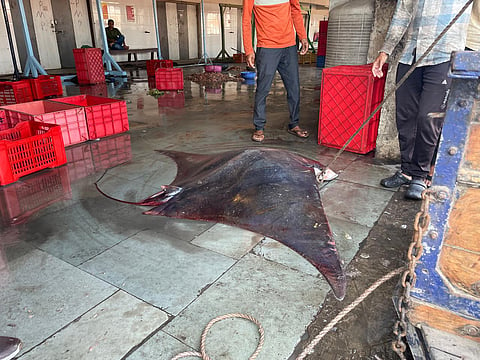


Picture yourself standing at a busy fish landing site in a coastal town just before dawn. Fishing boats are berthed on the jetty; the catch is being unloaded in a frenzy. Crates overflowing with sardines and mackerel slide down wooden planks onto the dock while traders, labourers, and fishers weave through the crowd. In one corner, a pile of discarded catch awaits sorting and sale.
Then something catches your eye.
Unlike the gleaming fish around it, this animal seems almost otherworldly. Its body is broad and flat. Its fins stretch out like enormous wings. Even lying motionless on the jetty, it commands attention. For a moment, you stop and stare in awe. This is a manta ray; one of the ocean’s largest and most graceful creatures.
It is impossible not to imagine it alive. Beneath the waves, manta rays appear to fly through the sea, gliding effortlessly on wings that can span more than seven metres. Gentle giants that feed on tiny plankton, travel vast distances across tropical oceans and inspire wonder in everyone fortunate enough to encounter them.
But here, at the landing site, the story is different.
The manta ray before you is lifeless. Its gill plates are being removed for sale, and within minutes little will remain to hint at the magnificence of the animal it once was. The contrast is striking: a creature that seems built for endless movement across the open ocean reduced to a commodity on a crowded dock.
In that moment, one question lingers: how can we change this story so that future generations encounter manta rays alive in our oceans, rather than lifeless at our landing sites?
Manta rays belong to the genus Mobula and are the largest rays in the ocean, found across tropical and subtropical waters worldwide. They capture food by filtering water through specialised structures, such as gill plates to sieve plankton, small crustaceans, and fish eggs. Manta rays grow slowly, mature late in life, and typically produce only a single young one every two to five years (Dulvy et al., 2014; Stevens et al., 2018). With this slow reproduction rate, loss of adult individuals in their population can take decades to recover, if it recovers at all (Dulvy et al., 2014).
Manta rays feed on plankton populations and serve as a visible indicator of healthy ocean habitats (Baum and Worm, 2009). They play an important role in transporting nutrients as they move between offshore and coastal waters, helping support productive ocean food webs (Stewart et al., 2018). Globally, manta ray watching tourism has been estimated to generate well over a 100 million USD in revenue each year, sustaining coastal livelihoods in places where a single living manta is worth far more, over its lifetime, than one that is caught and sold (O'Malley et al., 2013).
Along India’s coasts, manta rays are an integral part of marine biodiversity but are increasingly threatened by incidental capture in small-scale fisheries. Protecting these oceanic giants helps conserve healthy oceans, supports sustainable fisheries, and strengthens India’s commitment to marine conservation (Akhilesh et al., 2014; Marshall et al., 2022).
Bycatch
Bycatch remains one of the greatest threats to manta and devil rays in India. Unlike targeted fisheries, these accidental captures often go undocumented, masking the true scale of mortality. Globally, an estimated 264,000 mobulid rays are caught each year, with the majority of mortality occurring in small-scale fisheries (Cuevas-Zimbrón et al., 2025). Studies from India’s major fish landing centres have reported frequent landings of mobulid rays, including juveniles and gravid (pregnant) females, highlighting the vulnerability of their populations (Akhilesh et al., 2014; Mohanraj et al., 2009; Jabado & Ebert, 2015). It is one of the world’s major hotspots for mobulid mortality, with an estimated 52,570 of mobulid rays caught annually in small-scale fisheries and a further 20,444 (±7,664) individuals caught in large-vessel fisheries that is about 30.5 per cent of global catch (Laglbauer et al., 2026). Strengthening bycatch monitoring, improving species identification at landing sites, and promoting safe release practices are therefore essential to securing the future of these gentle giants in Indian waters.
International trade
Over the past two decades, international demand for dried mobulid gill plates marketed in Asia as a traditional medicine product has fueled targeted fishing and increased the number of mantas caught incidentally (Croll et al., 2016; O'Malley et al., 2017). Globally, mobulid meat is consumed in at least 35 countries, while gill plates are harvested in 14 countries and traded through international markets, primarily to China and Hong Kong (Hilton et al., 2024). In India, manta and devil rays are utilised for multiple products, including meat, which is sold fresh, dried or salted for local consumption, skin for leather products, cartilage, liver oil and gill plates for export. Although both manta ray species have been listed under Appendix II of the Convention on International Trade in Endangered Species of Wild Fauna and Flora (CITES) since 2013, requiring all international trade to be legal, sustainable and traceable, illegal and poorly regulated trade continues to persist. Recent assessments indicate that India remains an important source country in the international mobulid trade, supplying both domestic markets and export chains despite strengthened regulations (Hilton et al., 2024).
Pollution
Marine pollution, particularly plastic debris, chemical contaminants and abandoned fishing gear, poses an increasing threat to manta rays. As filter feeders, mantas can inadvertently ingest microplastics while feeding on plankton, which may affect their health, nutrition and reproductive success. Ghost nets and discarded fishing gear can also entangle individuals, causing injury, impaired movement or death (Germanov et al., 2019; Strike et al., 2022).
Climate change
Rising sea temperatures, ocean acidification and changing ocean currents are altering the distribution and abundance of plankton, the primary food source for manta rays. Climate-driven changes in ocean productivity may also disrupt seasonal aggregation sites that mantas have relied upon for generations, with implications for feeding, breeding and population connectivity (Stevens & Froman, 2019; Stewart et al., 2018).
Global status
Manta and devil rays are listed on the IUCN Red List, with the oceanic manta ray classified as Endangered (Marshall et al., 2022) and the spinetail devil ray similarly assessed as Near Threatened (Walls et al., 2022), reflecting steep population declines driven largely by overfishing. All mobulid species are listed under Appendix II of the Convention on International Trade in Endangered Species of Wild Fauna and Flora (CITES, 2016), and under the Convention on the Conservation of Migratory Species of Wild Animals (CMS, 2017), both of which require international cooperation to manage their trade and protect their migratory routes. Researchers worldwide are using satellite tagging and genetic studies to better understand where manta rays travel, breed, and feed, building the evidence base needed for effective, science-driven protection.
Important Shark and Ray Areas (ISRAs)
Important Shark and Ray Areas (ISRAs) are key marine habitats identified through scientific evidence to help guide the conservation of sharks and rays. These designations help inform marine spatial planning and give governments a clear, evidence-based map of where conservation action will have the greatest impact. Because manta rays migrate across national boundaries, often moving between the waters of several countries within a single year, ISRAs are especially valuable in coordinating protection across jurisdictions that might otherwise act in isolation.
What can India do to better protect Mantas?
India’s coastline, stretching along both the east and west coasts, is home to 11 mobulid ray species, including two manta rays and nine devil rays, making it one of the most important regions for this group in the Indian Ocean (Akhilesh et al., 2014; Weigmann, 2016). India provides the highest level of legal protection to both manta ray species - the Giant Oceanic Manta Ray (Mobula birostris) and the Reef Manta Ray (Mobula alfredi) under Schedule I of the Wildlife (Protection) Act, 1972. The recently identified Kommu Teku Important Shark and Ray Area off the Andhra Pradesh coast has been recognised as a globally significant aggregation site for these threatened rays (IUCN SSC Shark Specialist Group, 2024), but questions about seasonal occurrence, habitat use, and fisheries interactions remain unanswered.
WWF-India is moving ahead with efforts to work with fishing communities, government departments, and research institutions to conduct proper habitat mapping and reduce bycatch of manta rays. With stronger regulations in place, we are working to ensure compliance through building community stewardship.
Manta rays ask very little of the ocean and offer a great deal in return: healthier ecosystems, more resilient fisheries, and a living symbol of marine biodiversity that can be shared rather than consumed. Protecting them means investing in better monitoring, supporting fishers who safely release rather than retain, and closing the gaps in exploitation that keep these populations under pressure. On this World Shark and Ray Awareness Day, the choice is whether future generations will only read about manta rays or still have the chance to watch one glide overhead.
Rebecca Lewis is Associate Coordinator-Oceans & Coasts and Wildlife Trade Control Program, WWF-India
N Pravin Kumar is Senior Programme Coordinator-Ocean & Coast Division, WWF India
Views expressed are the authors’ own and don’t necessarily reflect those of Down To Earth