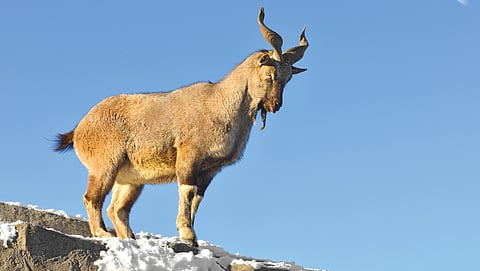


Mountain goat Kashmir markhor faces extinction in India due to habitat threats and poaching.
Conservation efforts are underway, with the Kazinag range as its last stronghold.
Despite challenges, initiatives like national park designations and community collaborations aim to protect this ecologically significant species.
One of the most striking sights in the wilds of the Kashmir Valley is the Pir Panjal — or the majestic Kashmir markhor, leaping over steep cliffs, from one rocky ledge to another. The mountain ungulate is among the largest wild goats in the world, weighing about 100 kg and sporting long, spiralling corkscrew horns and a flowing ruff on the chin, neck and shoulders.
With brown coats, remarkable agility and a stocky build, they seem almost an extension of the mountain itself. To escape predators and any other danger or disturbance, females with young navigate slopes of almost 90 degrees — terrain that is sometimes hard to imagine.
As many as three subspecies of markhor roam the Hindu Kush-Himalayan region, each distinguished by the twist of its horn. The Kashmir markhor was thought long extinct in India. But a 2004 state-wide survey by charitable group Wildlife Trust of India (WTI), in collaboration with Jammu and Kashmir Department of Wildlife Protection and the Nature Conservation Foundation, suggested otherwise.
It found the species teetering on the brink of local extinction, with 300 to 350 animals surviving across its historical range, from the Banihal Pass in the Pir Panjal to the Shamshabari range north of River Jhelum. Today the Kazinag range remains its last stronghold in India, though smaller, fragmented populations persist in Hirpora wildlife sanctuary in Shopian and in the Tattakuti wildlife sanctuary and Khara Gali Conservation Reserve in Poonch.
The survey also underscored the urgency of conserving the species of considerable ecological significance. Markhors are mixed feeders — grasses, herbs, shrubs, leaves and twigs all feature in their diet — and help prevent overgrowth and maintain healthy soils. A healthy population signals a healthy mountain ecosystem: as key prey for predators like snow leopards common leopards and wolves, they are integral to high-altitude food chains.

However, unplanned development, heavy livestock grazing and poaching pose mounting threats. The Hirpora population is under intense pressure from grazing and from a highway built some 15 years ago. The Poonch populations, meanwhile, have suffered from heavy poaching in the past, exacerbated by gaps in wildlife staffing and infrastructure.
A study published in the Journal for Nature Conservation in August 2025 noted that “Markhor Capra falconeri is a range-restricted mountain ungulate and livestock has been identified as one of its major threats across the main distribution range.” Detailed research remains scarce, but markhor and domestic goats appear to have a high dietary overlap.
Their breeding season, in May and June, coincides with the annual influx of livestock, when temperatures rise and vegetation emerges after the winter melt. Between May and September, Kazinag alone receives some 15,000 sheep and goats, accompanied by herders and watchdogs during the only growing period of the year. Such numbers place heavy pressure on habitat and forage; the near-constant presence of people and dogs further disturbs these shy mountain goats.
Even so, conservation efforts are gathering pace. The state’s wildlife protection department, together with WTI, has in recent years secured meaningful gains: The designation of a national park in the Kazinag range dedicated to the markhor, the extension of the Hirpora wildlife sanctuary and the formal notification of the Tattakuti wildlife sanctuary for the species.
WTI continues to monitor key sites and work with local communities and herders to reduce threats. Its surveys indicate that the population has declined further in recent years, with only 200 to 300 animals remaining, and the Hirpora population on the edge of local extinction. Conservation efforts need to be strengthened substantially to secure at least one more viable population in Pir Panjal, alongside the Kazinag stronghold, if the species is to survive in the long term.
This article was originally published as part of the December 16-31, 2025 print edition of Down To Earth