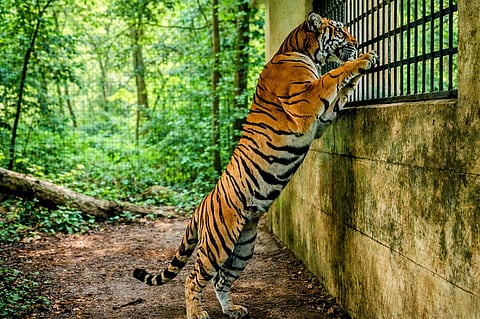


High in the forests of the Periyar Tiger Reserve (PTR), near the ancient Mangala Devi temple that stands quietly on the Kerala-Tamil Nadu border, a patrol team of forest watchers was moving through thick undergrowth in November 2020 when they noticed something unusual beneath a layer of fallen leaves. At first, it appeared to be just another small movement on the forest floor. But as the guards approached carefully, they realised it was a tiger cub lying alone. The cub was a female, barely two months old. She tried to stand but stumbled almost immediately. One hind leg appeared weak. Her eyes looked cloudy and unfocused. The dense forest around the temple, usually alive with the sounds of birds and insects, felt suddenly tense. More troubling than the cub’s fragile condition was the absence of her mother. In tiger country, a cub without its mother is rarely expected to survive.
The patrol team did not rush to intervene. Experienced forest watchers understand the habits of tigresses. Mothers often hide their cubs in dense vegetation before leaving to hunt, returning hours later with food. Removing a cub prematurely could mean separating it forever from its mother. The guards, therefore, stepped back and began monitoring the area. Camera traps were installed around the spot to record any movement. They waited patiently, hoping the tigress might return. Hours passed. A full day followed. Then another. The forest remained silent. The tigress never came back.
It gradually became clear that the cub had been abandoned. Weak, partially blind, and unable to move properly, she would not survive another night in the forest where starvation, predators, and exposure awaited. The forest watchers gently picked up the cub and carried her down the slopes of the Mangala Devi hills. What began as a routine patrol near an old temple had unexpectedly turned into a rescue operation that would soon draw the attention of wildlife officials across Kerala.
Veterinarians working with the Kerala Forest Department examined the cub soon after she was brought out of the forest. Their findings confirmed how precarious her condition was. The cub was severely underweight and dehydrated. The weakness in her hind leg made it difficult for her to walk properly. But the most serious problem lay in her eyesight. Both eyes were affected by cataracts, leaving her vision blurred. For a predator that depends on sharp vision to stalk prey, such impairment can become a death sentence in the wild. The official administrative record would later describe the discovery in restrained bureaucratic language: “An abandoned, two months old female tiger cub was found at Mangaladevi in Thekkady Range of PTR on 23/11/2020.” Yet the frail animal lying before the veterinarians told a far more urgent story.
Forest officials named the cub Mangala, after the Mangala Devi hills where she had been discovered. In the days that followed, veterinarians began a careful programme of treatment and recovery. Antibiotics were administered to prevent infection. Her diet was gradually stabilised so that her weakened body could regain strength without stress. Physiotherapy exercises were used to improve the weakness in her hind leg. Slowly, the cub began to respond. She gained weight and her movements became steadier. Within weeks, she was able to stand more confidently and began exploring the small space around her enclosure. For the officers watching her recovery, Mangala soon became more than a rescued cub. She represented a fragile possibility that human intervention might restore a life the forest had nearly lost.
Saving Mangala, however, was only the beginning. The more difficult question confronting the Kerala Forest Department was whether the cub could eventually return to the wild. Wildlife conservation principles strongly favour rewilding whenever possible. Keeping large predators permanently in captivity is usually considered the last option. But rewilding a tiger cub without its mother is extremely challenging. In the wild, tiger cubs spend nearly two years with their mothers learning essential survival skills. They learn how to stalk prey through dense vegetation, how to identify vulnerable animals in a herd, how to establish territory, and how to avoid human beings. Without these lessons, a tiger released into the forest may struggle to survive.
To guide Mangala’s rehabilitation, the Kerala Forest Department followed protocols laid down by the National Tiger Conservation Authority. A technical committee of veterinarians and wildlife experts was formed to monitor her progress and assess whether she could eventually be released. Their approach was ambitious. Mangala would be raised in conditions designed to resemble the natural environment as closely as possible while limiting direct human contact.
For this purpose, the forest department created a specialised rehabilitation enclosure within the PTR itself. Known as the Animal Hospice and Palliative Care Unit, the facility covered nearly three hectares of forest near the Jungle Inn area in Thekkady. The enclosure retained natural vegetation, trees, and forest terrain so that the cub could grow in surroundings similar to her natural habitat. Official proceedings later explained that the enclosure had been created “to try to treat, relocate, rehabilitate and re-wild the cub inside Periyar Tiger Reserve.” Mangala was moved there in July 2021.
Inside this forested enclosure, Mangala grew up under careful but distant supervision. Direct human interaction was deliberately minimised. Food was provided without face-to-face contact, and cameras monitored her movements continuously. As she matured, prey animals were occasionally introduced into the enclosure so that she could practise hunting behaviour. Forest officials hoped that the instincts embedded deep within a tiger’s biology would gradually guide her towards independence.
Periyar offered an ideal landscape for such an experiment. Spread across nearly 925 square kilometres, the reserve remains one of India’s most successful conservation areas. Its forests sustain a thriving prey base of sambar deer, spotted deer, wild boar, and gaur. Tigers here have benefited from strong protection measures and extensive forest cover. Current estimates suggest that around 40-43 tigers inhabit PTR, moving across valleys that connect to larger forest corridors of the Western Ghats.
Across Kerala, tiger numbers have steadily increased over the past decade. Recent assessments indicate that the state now supports around 213 tigers, distributed across landscapes such as the Wayanad forests, the Nilambur region of Malappuram, the Parambikulam Tiger Reserve, and the southern forest ranges connected to Periyar and the Agasthyamalai hills. Together, these forests form a crucial section of the Western Ghats tiger corridor linking populations across Kerala, Karnataka, and Tamil Nadu.
Within this broader success story of conservation, Mangala’s life unfolded quietly over the next few years. The fragile cub gradually transformed into a powerful young tigress. Camera trap images showed a healthy animal with the muscular build typical of her species. Forest officers who had followed her recovery from the beginning often felt a quiet pride in watching her grow.
Among them was range officer V C Sebastian, who had closely supervised Mangala’s care for years. “We tried to give her as natural a life as possible,” Sebastian said. “From the day she was found as a helpless cub, the entire team treated her as part of the forest. Our hope was always that one day she would return to the wild.”
Yet even as Mangala matured, the medical problem that had troubled her since infancy remained unresolved. Her eyesight continued to deteriorate. Veterinary examinations confirmed that both eyes were affected by severe cataracts. The condition was further complicated by lens luxation, a disorder in which the lens inside the eye shifts from its normal position. The expert committee monitoring her case recorded the concern clearly: “The present status of the eye condition shows no improvement in its clinical condition, namely bilateral cataract with lens luxation.”
The possibility of surgery was examined but soon dismissed. Operating on a large carnivore carries enormous risks. Post-operative care would be extremely difficult once the animal returned to a semi-wild environment. The official order summarised the dilemma bluntly: “The only solution left is surgery of the eyes, but surgery and anesthesia are not feasible options as post-operative care is difficult in wild or semi-wild felines.”
There was another complication as well. Despite the forest department’s efforts to minimise contact, Mangala had inevitably grown up in proximity to humans. Wildlife experts feared that she might have developed a degree of human imprinting — a behavioural condition in which animals lose their natural fear of people. Releasing such an animal into a landscape where pilgrims visit the Mangala Devi temple, where forest guards patrol regularly, and where tribal communities move through forest areas could create dangerous encounters.
After reviewing all these factors, the expert committee reached a unanimous conclusion. Mangala could not be released into the wild.
In March 2026, Kerala’s Chief Wildlife Warden Pramod G Krishnan issued a formal order directing that the tigress be relocated to the Thrissur Zoological Park. The order recorded the committee’s conclusion clearly: “The Committee unanimously concluded that re-wilding could not be recommended for the said animal and the animal has to be raised in captivity.” Reflecting on the difficult choices that conservation sometimes demands, Krishnan later said, “The aim of wildlife protection is not simply to keep animals inside forests. It is about ensuring that both wildlife and people remain safe.”
Mangala will now be transported under veterinary supervision to the Thrissur Zoological Park at Puthur, a new facility spread across more than 300 acres designed to replace the old Thrissur zoo. Built as a landscape-style park, it features large natural enclosures, forest vegetation, and advanced veterinary facilities. Animals that cannot survive in the wild are housed in environments that attempt to replicate their natural habitats.
For Mangala, the park will become a permanent sanctuary. She will live in a forest-like enclosure where her impaired eyesight will not threaten her survival.
In the end, the forest could not reclaim her. But it did something equally important. It refused to let her die.