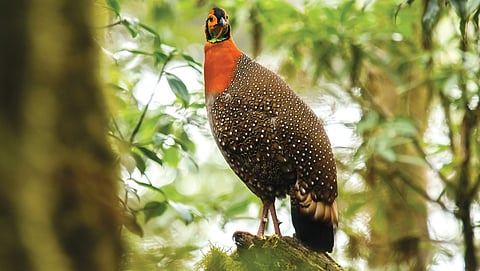


High in the cloud-draped forests of the Eastern Himalayas, the mist is occasionally shattered by a riot of colour, with the fleeting appearance of one of Asia’s most elusive birds—Blyth’s tragopan. The male pheasant is a living tapestry.
Its upper body is a deep brown washed with red and dusted with maroon-and-white ocelli. The breast glows bright crimson, edged beneath the chin by a crisp black half-collar. Sandy-grey plumage covers the lower breast, giving way to flanks and thighs mottled in black, buff and splashes of red. Its face is an unmistakable orange-yellow, framed by a black crown and collar. The rest of the head, neck, upper back and shoulder feathers burn with a vivid scarlet sheen, while a patch of yellow facial skin and a grey belly distinguish it from India’s other tragopans—western, satyr and Temminck’s.
During the breeding season, the forest resonates with the male’s deep, moaning call: ohh… ohhah… ohaah… delivered in a slow, rhythmic sequence. When displaying, the male transforms into a near-mythic creature—raising two pale blue horns from the crown and inflating a brilliantly coloured throat lappet in a spectacular show. By contrast, which is typical among pheasants, the female is softly patterned in pale grey-brown and faintly spotted, designed to vanish against the forest floor. She is also smaller, measuring about 59 cm compared with the male’s 65-70 cm.
The pheasant’s range stretches in a broken arc from Bhutan across Arunachal Pradesh, Nagaland, Mizoram and Manipur, into northern Myanmar and further into southeastern Tibet and northwestern Yunnan in China, where it inhabits lush slopes draped in rhododendron and broadleaf woodland, thickets of bamboo and dense undergrowth. It moves with the seasons, descending to 1,400 metres in winter and climbing to 3,300 metres in summer. Though most sightings come from mid-elevations, heavy snowfall can push them downhill in search of food. Blyth’s tragopan is still common in some intact forests, particularly in the Dihang-Dibang Biosphere Reserve of Arunachal Pradesh, yet it remains rare throughout much of this vast realm. Despite the male’s bold plumage, the species is famously wary. Tragopans are typically solitary or found in small groups of four or five. When startled, they vanish instantly into cover. In protected forests they may step out at dawn or dusk to forage in glades and along shaded slopes.
In much of northeast India, large birds have long been prized for food, feathers and tradition, and the tragopan has not escaped this fate. Even in Arunachal Pradesh, where extensive forests still survive, the species faces mounting threats. Massive hydroelectric projects bring roads, settlements and fragmentation. Shifting cultivation, or jhum, still common in the region, further reduces undisturbed broadleaf forests, the habitat the tragopan relies on most.
Small wonder, despite the highest degree of legal protection—Blyth’s tragopan is listed in Schedule I of the Wild Life (Protection) Act, 1972, and in Appendix I of Convention on International Trade in Endangered Species of Wild Fauna and Flora (CITES)—the shy pheasant is listed as Vulnerable by BirdLife International and the International Union for Conservation of Nature (IUCN) Red List of Threatened Species. Only a fewer than 10,000 individuals are thought to survive in scattered pockets across key protected areas. In Nagaland, two small wildlife sanctuaries and a community reserve also shelter a few individuals.
To safeguard the Blyth’s tragopan, it is vital to survey known and potential habitats in northeast India, involving forest departments and local communities to identify new areas for protected status or community conservation. It is also important to support community-led conservation and ecotourism, building on successful models, and regular monitoring of populations across the species’ range. Awareness campaigns emphasising its protected status and strict enforcement against poaching and open bird-market trade are also crucial.
Blyth’s tragopan is more than a dazzling forest bird; it is an indicator species for some of Asia’s most biodiverse and least-explored mountain ecosystems.
This article was originally published as part of the December 16-31, 2025 print edition of Down To Earth