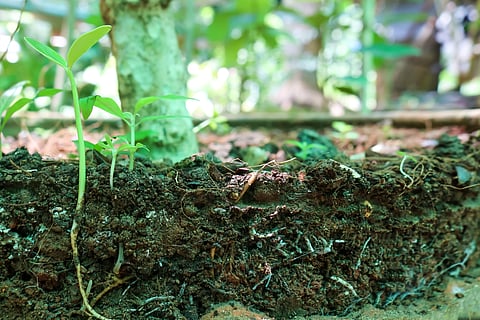


The loss of soil biodiversity is among the most deteriorating soil threats globally, although confidence in the trend remains low, according to the latest global assessment of the world’s soils by the Food and Agriculture Organization of the United Nations.
Released last week at the 17th Conference of Parties (COP17) of the United Nations Convention to Combat Desertification (UNCCD) in Ulaanbaatar, Mongolia, the landmark Status of the World’s Soil Resources 2026 report builds on its inaugural 2015 edition. It has been prepared under FAO’s Global Soil Partnership and the Intergovernmental Technical Panel on Soils.
The report assesses the status of major threats to soil function, bringing together scientific evidence and expertise from 75 countries. Across 16 chapters, it identifies these threats, their drivers, sustainable soil management options, barriers and facilitators to adoption, and evaluates how regions are implementing these measures.
The asessment identifies the loss of soil biodiversity as one of the main threats to soil function. It ranks fourth in severity among seven major threats, after soil erosion, loss of soil organic carbon and nutrient mismanagement. The other threats are salt accumulation, soil pollution and soil sealing due to urban expansion.
Soil biodiversity refers to ‘the variety of life belowground, from genes and species to the communities they form, as well as the ecological complexes to which they contribute and to which they belong, from soil micro-habitats to landscapes’.
This living ecosystem includes soil bacteria, fungi, archaea, protozoa, nematodes, earthworms, arthropods and other organisms. Together, they drive decomposition, nutrient cycling, carbon transformations, soil aggregation, plant–microbe interactions and disease regulation.
Soils contain 59 per cent of the planet’s biodiversity. Soil biodiversity is explicitly linked to Sustainable Development Goal 15 on life on land, and also has implications for other goals, including SDG 2 on zero hunger, SDG 3 on good health and well-being, SDG 6 on clean water and sanitation, and SDG 13 on climate action.
The report therefore gives greater visibility to soil biodiversity and notes its growing recognition as a key component of overall soil health.
Habitat modification or loss is identified in the assessment as the greatest threat to soil organisms, driven primarily by the conversion of forests and grasslands to agriculture.
In agricultural landscapes, intensive practices that rely on irrigation, heavy machinery and increased use of fertilisers and pesticides significantly alter soil habitats. Mechanical disturbance reduces the biodiversity of larger soil organisms such as earthworms, while fertilisation can negatively affect soil biodiversity by increasing soil acidity.
To halt soil biodiversity loss and advance SDG 15, the report highlights the need to manage optimal soil pH, include organic fertilisers such as manure, adopt reduced tillage or no-till practices and reduce pesticide use.
It also draws from recommendations in FAO’s 2020 State of Knowledge of Soil Biodiversity report, including the adoption of sustainable soil management practices to minimise soil biodiversity loss, the inclusion of biological indicators of soil health alongside physical and chemical indicators, and the use of standardised sampling and analytical protocols.
Knowledge of soil life has expanded substantially since 2015. There are now global maps of microbial, nematode and earthworm distributions, as well as a much wider understanding of the soil microbiome. Yet no region or subregion is in a favourable condition when it comes to adopting sustainable soil management practices to address soil biodiversity loss, the assessment finds.
Adoption trends for sustainable soil management practices intended to address soil biodiversity loss are either deteriorating or variable across all regions — Asia, Europe and Central Asia, Latin America and the Caribbean, North East and North Africa, North America, sub-Saharan Africa and the South-West Pacific. The state of adoption ranges from very poor to fair.
The pressures altering soil biological communities differ across regions. They include land-use change, intensive agriculture, pollution, pesticides, deforestation, urbanisation, climate change and soil disturbance.
Data and monitoring related to soil biodiversity also remain limited. Some regions lack soil biodiversity data, including all countries of the Western Balkans. Others are considering soil biology monitoring initiatives, such as the Norwegian Agricultural Soil Monitoring Programme and the Finnish Agricultural Soil Monitoring Programme. Some countries, including Ukraine, lack biological indicators in their soil monitoring programmes.
In Asia, the observations note that the importance of soil biodiversity remains less studied. Population growth, high deforestation, conversion of agricultural land and frequent natural disasters pose a high threat to biodiversity in South Asia. In India, diverse land use and increased soil salinity are identified as factors affecting soil biodiversity.
A recent report by Delhi-based think tank Centre for Science and Environment, Improving Soil Biological Health: The Role of Biological Components and Monitoring Approaches, also made the case for focusing on the biological health of soils. It argued that soil health needs to be assessed more holistically, rather than through excessive dependence on chemical-centric management. It also called for soil biology to be brought into routine national soil-health monitoring in India.
At a May 2026 webinar on the issue, experts echoed the need for urgent attention to soil biological health, describing it as a blind spot in Indian agriculture.
Beyond soil biodiversity, the report presents a broader warning: the current management of the world’s soil resources remains unsustainable.
More than half of the regional and sub-regional assessments show poor soil management. Adoption of sustainable soil management practices is deteriorating in 58 per cent of assessments and improving in only around 10 per cent, reflecting a critical implementation gap.
The FAO report’s way forward is ultimately about moving from knowledge to implementation. It calls for stronger soil governance and legal frameworks; better education, extension and knowledge exchange; harmonised soil information, indicators and assessment to improve soil and sustainable soil management monitoring; stronger incentives for adoption on the ground; and inclusive, multidisciplinary decision-making.
Soil management remains largely unsustainable worldwide, with the adoption of sustainable soil management practices still at alarmingly low levels.
Interlinked soil threats drive a degradation cascade, demanding integrated solutions.
Scientific knowledge and proven practices for sustainable soil management have expanded greatly, but this knowledge is not being applied at scale.
When sustainability delivers quick results, farmers act. But to secure long-term benefits that serve wider society, policy support becomes essential.
Even the best sustainable soil management strategies falter without the right combination of information, engagement and governance support.