
Subscribe

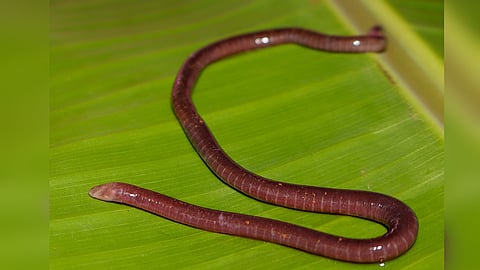
Scientists have described a new legless amphibian, Gegeneophis chandgadi, from backyard leaf litter in Buzawade village in Maharashtra’s Western Ghats.
The species is a caecilian, a group of elusive, limbless amphibians that spend much of their lives underground and are often mistaken for earthworms.
The species has been named after the Chandgadi dialect of Marathi, spoken predominantly in and around the Chandgad region.
Researchers say the discovery highlights the hidden biodiversity of agricultural and residential landscapes, and the need for more surveys in the northern Western Ghats.
Unlike many newly discovered species found in remote wilderness, scientists have described a new legless amphibian from backyard leaf litter beneath wooden piles in a village in the Western Ghats of Maharashtra.
The species, named Gegeneophis chandgadi, is a caecilian — a group of elusive, limbless amphibians that spend much of their lives underground. It was found in a rural landscape during the monsoon in August 2025. The findings were published by the Zoological Survey of India.
Members of the genus Gegeneophis, commonly known as blind caecilians, spend almost their entire lives underground. The species has been named Chandgadi after the Chandgadi dialect of Marathi, which is spoken predominantly in and around the Chandgad region.
The amphibian was discovered in the backyard of lead author Sahil Shikalgar, a resident of Buzawade village in Chandgad taluka of Kolhapur district, beneath decaying logs, organic waste and bamboo leaf litter.
Local residents said the limbless creatures are often unearthed during routine garden work and mistaken for large earthworms. Villagers also said free-ranging domestic chickens regularly scratch up the soil and feed on young caecilians. Scientists said the species appears capable of persisting in human-modified agroecosystems, provided rich organic matter remains available and heavy pesticide use is avoided.
“Gegeneophis is a fascinating yet highly elusive group of amphibians, restricted to peninsular India and showing a remarkable concentration of species in the Northern Western Ghats,” said K P Dinesh, senior scientist at the Zoological Survey of India.
“Since these blind caecilians spend almost their entire lives underground, even experienced field biologists can find it challenging to distinguish them from earthworms and blind snakes. The high diversity of Gegeneophis within a relatively small geographical area makes identification particularly challenging; combining body annuli counts with geographical location can therefore be a valuable practical tool for recognising these hidden amphibians,” he added.
The findings said Gegeneophis chandgadi belongs to the family Grandisoniidae and is an “annulocylix” caecilian, characterised by a distinctly ringed, cylindrical body.
In appearance, the species has a dark flesh-coloured to dark brown upper body, a light pinkish head and a translucent pinkish belly through which internal organs can be faintly seen. Adults measure 105mm to 185mm in total length and have a slender, tailless body.
The species has 132 to 135 primary annuli, or grooves wrapping around the body. Secondary annuli appear only towards the posterior half of the body, starting between the 105th and 112th primary ring.
Genetic analysis placed G chandgadi as a sister lineage to an unknown lineage from the Amboli region of Maharashtra and to Gegeneophis mhadeiensis from Goa. The genetic distance between the new species and the undescribed Amboli lineage was 1.9 per cent to 2.1 per cent, while the distance from G mhadeiensis was 4 per cent.
India has documented 41 caecilian species among 458 amphibian species, including 12 species of Gegeneophis. Of these, 11 are endemic to the Western Ghats. With the addition of G. chandgadi, seven species of Gegeneophis are now reported from the northern Western Ghats.
More importantly, molecular analysis indicates that four additional lineages from the region could represent undescribed species. The researchers therefore identify 11 Gegeneophis lineages in the region and describe the northern Western Ghats as a hotspot of diversity for the genus.
The distribution of these animals is also remarkably compact. The closest known related species, G danieli, occurs about 17 kilometre from the type locality of G chandgadi, while G mhadeiensis is about 40 km away. Researchers said this spatial proximity, combined with the species’ patchy distribution, underlines the need for detailed surveys in the region.
Because the species is currently known only from its immediate type locality around Buzawade village, researchers recommend classifying Gegeneophis chandgadi as Data Deficient under the International Union for Conservation of Nature Red List criteria until further surveys establish its wider range and population health.
“Globally, 41 per centof amphibian species are threatened with extinction, while India’s caecilians remain poorly studied. The discovery of Gegeneophis chandgadi highlights the hidden biodiversity beneath our feet and underscores the importance of field exploration and scientific documentation of these elusive, subterranean amphibians,” said Dhriti Banerjee, director, Zoological Survey of India in a press statement.
“If we fail to identify species in time, we risk ‘silent extinction’, where organisms disappear before science even knows they existed,” said N P Gramapurohit of the Department of Zoology, Savitribai Phule Pune University, Pune, who was part of the study.
“The Chandgad landscape demonstrates that biodiversity research need not be restricted to protected forests. The presence of this species around human habitation highlights the importance of studying agricultural and residential landscapes as well,” he added.
Dinesh said the study suggests that the northern Western Ghats may be home to more undescribed species of Gegeneophis, underlining the need for continued exploration and detailed taxonomic studies in the region.
