
Subscribe

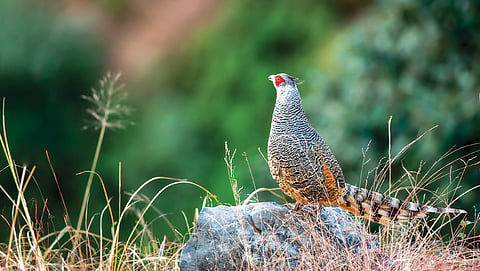
Chir-a-pir chir-a-pir chir chir-chirwa chirwa and chewewoo. This unmistakable call, loud and sharp, once echoed across the steep valleys of western Himalayas, earning the pheasant its local name, “chir”, and its English name, the “cheer” pheasant. But this call is becoming increasingly faint.
BirdLife International and the International Union for Conservation of Nature (IUCN) classify the cheer pheasant as Vulnerable, a reflection of its small and naturally fragmented populations. Today, the species clings to scattered patches of Himalayan grassland, from northern Pakistan through Kashmir, Himachal Pradesh and Uttarakhand, to central Nepal. It favours steep, rocky hillsides studded with scrub, stunted trees and grassy slopes between 1,200 and 3,350 metres.
The cheer pheasant’s nest is a simple ground scrape, tucked beneath undergrowth or sheltered by rocks. And the bird exhibits high natal philopatry—individuals often return to, or remain near, the area where they were born to breed. The pheasant therefore depends on early successional grasslands created by traditional grass cutting and burning—practices that historically maintained open slopes rich in seeds, roots, berries and insects. But when these practices intensify, they can turn destructive. At the same time, its habitats are being squeezed by human and livestock pressures, hunting and rapidly changing land-use patterns.
Although cheer pheasants are not especially valued as food, their proximity to settlements makes them easy targets. The very grasslands they depend on are often closest to villages, exposing them to hunting and constant disturbance. In some protected areas, the cessation of grass cutting has allowed grasslands to grow into dense forest, making them unsuitable for the species. The pheasants also use regenerating conifer and broadleaf forests, especially where juniper and rhododendron open into grassy patches. But their reliance on disturbed, low-intensity landscapes complicates conservation efforts.
The breeding season, which begins in April and continues through June, occasionally extending into September, coincides with the wildfire season in the western Himalayas. Frequent fires during the breeding season destroy nests and chicks of this exclusively ground-dwelling bird. Even where hunting is limited, low recruitment can cause small, isolated populations to vanish within a few years. The conversion of grasslands to permanent agricultural terraces and the afforestation of mid-altitude slopes further shrink the species’ already restricted habitat.
The cheer pheasant enjoys the highest level of legal protection—Schedule I of India’s Wildlife (Protection) Act, 1972, and Appendix I of Convention on International Trade in Endangered Species of Wild Fauna and Flora (CITES)—and is safe-guarded across India, Nepal and Pakistan. It occurs in several protected areas throughout its range, though many of its key habitats lie outside reserve boundaries. To secure the species’ future, it is important to conduct demographic studies focused on survival, dispersal and natal philopatry, investigating movement patterns to understand connectivity among populations, strengthening anti-hunting enforcement, expand community awareness and use the species as a flagship for habitat management and community-led conservation. An equally important step is to develop a coordinated cheer pheasant action plan across all range states.
This article was originally published as part of the December 16-31, 2025 print edition of Down To Earth