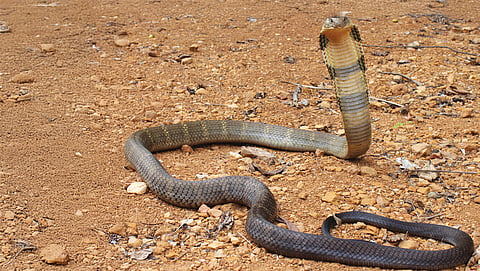


Snakes stir some of humanity’s most primal fears. The very word “snake” evokes images of fanned-out hoods and flickering, forked tongues. The fear of being bitten and of venom coursing through the bloodstream, is real. India is a global snakebite hotspot, accounting for nearly half of the world’s snakebite deaths (81,000-138,000 annually). The World Health Organization classifies snakebite as a “neglected tropical disease,” and with good reason. Yet these reptiles need protection as much as any other species. And chief among them is the iconic king cobra—the world’s largest venomous snake that can grow up to six metres long.
Surprisingly, not much is known about this giant— its identity, its ecological role, even the threats it faces— revealing just how little we truly understand about one of the planet’s most extraordinary predators.
The fact is that despite its name, the king cobra is not a true cobra but a distinct genus of its own. From 1836 to 1961, it has been varyingly classified and named by scientists from across tropical Asia. This is because factors such as age, size, sex and geographic variations produce dramatic differences in appearance of a species. Add a fragmented range across tropical Asia, and identifying true king cobra populations became a challenge.
An international team of researchers, including this author, had set out to examine king cobras across India and beyond, analysing genetics and external morphology. The results, published between 2021 and 2024, were striking: the king cobra is not one species, but four. The familiar king cobra, Ophiophagus hannah, ranges from India’s western Himalayas to central Thailand. Populations from southern Thailand, Indonesia and parts of the southern and central Philippines have now been reclassified as the Indonesian king cobra (Ophiophagus bungarus). Two more previously unnamed species were discovered during the study: one in India’s Western Ghats (Ophiophagus kaalinga) and the other on Luzon Island in the northern Philippines (Ophiophagus salvatana).
The Western Ghats population has been known to science for 170 years, yet it has only now received formal recognition and its own scientific name. Both newly described species bear names rooted in local dialects. Their most obvious distinction appear in their banding patterns—the number, colour and arrangement of bands running across their bodies.
This taxonomic clarification helps resolve a long-standing medical puzzle: antivenom developed from Thai king cobras often proved far less effective against Indian bites. The reason, it turns out, is simple—different species were hiding under the same name.
But while science has finally untangled the king cobra’s identity, understanding alone will not save it. The species is listed as Vulnerable by the International Union for Conservation of Nature (IUCN), protected under the Wild Life (Protection) Act, 1972, and included in CITES (Convention on International Trade in Endangered Species of Wild Fauna and Flora). Even so, habitat destruction, forest fragmentation and human persecution threaten king cobras across much of their range. A Red List Assessment published in 2012 on IUCN’s website states that despite a wide distribution range, Ophiophagus hannah has experienced local population declines of over 80 per cent over 10 years in parts of its range. While no population data is available, it can be estimated that the population size has declined globally by at least 30 per cent over an estimated three-generation period of 15-18 years.
It is important to understand that as apex predators, king cobras provide essential ecosystem services. They keep in check populations of other venomous snakes, including cobras, kraits and pit vipers, earning the genus name Ophiophagus, meaning “snake eater.” Their preference for preying on highly venomous species associated with high bite rates makes their ecological role all the more crucial. It is worth noting that, although no dedicated antivenom exists in India for king cobra bites, fatalities are rare. The species lives mostly in dense forests, far from human habitation, and is often mistaken for the more familiar Indian cobra (Naja naja).
Still, overcoming deep-seated fear and stigma remains a challenge. A better understanding of how people view snakes may be key to reducing the persecution that continues in most parts of its range.
This article was originally published as part of the December 16-31, 2025 print edition of Down To Earth