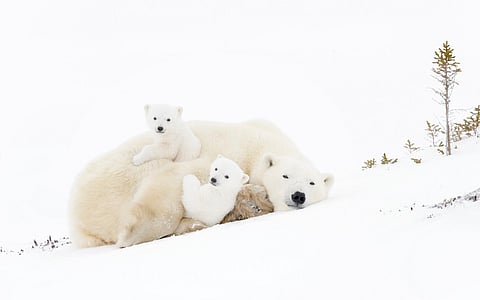


The beleaguered polar bear, the symbol of the warming Arctic, could be putting up a fight to survive in its changing environment. A subset of bears in the southeastern part of Greenland is changing its DNA to survive as its home warms, according to a new study by the University of East Anglia in the United Kingdom.
The study analysed blood samples taken from polar bears in northeastern (12 bears) and southeastern (five bears) Greenland to compare the activity of so-called ‘jumping genes’ — small, mobile pieces of the genome that can influence how other genes work — their relationship with temperatures in the two regions and associated changes in gene expression.
According to the scientists, while temperatures in northeastern Greenland were colder and less variable, it was a significantly warmer, less-icy environment in the southeast, creating many challenges and changes to the habitat there, and one similar to future conditions predicted for the species.
The scientists found some genes related to heat-stress, aging and metabolism were behaving differently in polar bears living in southeastern Greenland.
They also found changes in gene expression areas of DNA linked to fat processing, which is important when food is scarce. This could mean the southeastern bears are slowly adapting to the rougher plant-based diets that can be found in the warmer regions, compared to the mainly fatty, seal-based diets of the northern population.
The authors used a technique called RNA sequencing to look at RNA expression, the molecules that act like messengers, showing which genes are active. This gave them a detailed picture of gene activity, including the behaviour of jumping genes.
“We identified several genetic hotspots where these jumping genes were highly active, with some located in the protein-coding regions of the genome, suggesting that the bears are undergoing rapid, fundamental genetic changes as they adapt to their disappearing sea ice habitat,” lead researcher Dr Alice Godden, from UEA’s School of Biological Sciences observed in a statement released by the University.
According to the university statement, the current research builds on a previous study by the University of Washington, which discovered the southeastern population of Greenland polar bears was genetically different to the northeastern group, after becoming separated about 200 years ago.
Over two-thirds of polar bears are predicted to be extinct by 2050, with total extinction expected by the end of this century. The Arctic Ocean is also at its warmest with temperatures continuing to rise, reducing vital sea ice platforms that the bears use to hunt seals, leading to isolation and food scarcity.
Godden said the next step would be to look at other polar bear populations. There are some 20 sub-populations around the world. “I also hope this work will highlight the urgent need to analyse the genomes of this precious and enigmatic species before it is too late.”
Diverging transposon activity among polar bear sub-populations inhabiting different climate zones, by Alice Godden, Benjamin Rix and Simone Immler, is published in the journal Mobile DNA on December 12, 2025.
