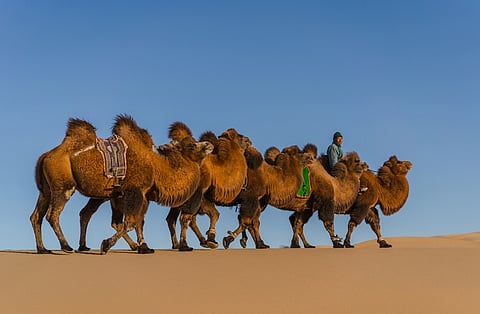


This year, crowds in the national capital will be treated to a visual treat as two majestic Bactrian camels (Camelus bactrianus) named ‘Galwan’ and ‘Nubra’, will walk down Kartavya Path in the Republic Day Parade.
The camels will be part of the ‘Animal Contingent’ and will march along with Zanskar ponies, an indigenous pony from Ladakh’s Zanskar region, raptors & Army dogs (mostly indigenous breeds like Rajapalayam, Chippiparai, Mudhol, Kombai and Rampur) led by the Remount & Veterinary Corps.
‘Galwan’ and ‘Nubra’ are named after places in the cold desert of Ladakh, the only place in India where this species is found.
The connection with Ladakh is not surprising as for most of its history, the cold desert was an independent kingdom connected to the Silk Road, the collection of trade routes that connected China with India, Persia, West Asia and Europe.
Pack animals like camels are not important in today’s mechanised world as they were once. But before going into the human encounter with the Bactrian camel, let us first delve into how it evolved on this planet.
Animal Science and Veterinary researcher Bernard Faye explained how various types of camels and ‘camelids’ evolved in his 2022 work, Is the camel conquering the world?
“The current family of large camelids includes three genera and seven species. The genus Camelus includes two domestic species which are the dromedary (Camelus dromedarius) also called the Arabian camel or single-humped camel, the Bactrian (Camelus bactrianus) or double-humped camel, sometimes called the Asian or Mongolian camel. The wild camel (Camelus ferus), long regarded as Bactrian camel that remained wild (ancestor of present Bactrian camel) has recently been recognized as a different species through genetic studies showing a clear divergence in the full genotype. C. ferus is therefore a “cousin” and not a direct ancestor of the Bactrian camel,” he writes.
While the Bactrian is found only in Ladakh in India, other parts of the country, especially western and northwestern states like Gujarat and Rajasthan, are home to the dromedary or single-humped camel.
While the dromedary has been associated with North and sub-Saharan Africa, West Asia and Pakistan and India, the Bactrian camel is associated strongly with Central Asia, the very heart of the continent.
Faye adds that the Bactrian was domesticated between 5,000 and 6,000 years ago, “likely in an area more western than previously thought, toward Uzbekistan and present West Kazakhstan, rather than toward Mongolia”.
He adds: “The name “Bactrian” comes from a region (former kingdom conquered by Alexander the Great) located between Afghanistan, Iran, and Kazakhstan.” Today, Bactria is identified with modern-day Balkh in northern Afghanistan. It was known in the Middle Ages as ‘Tokharistan’ and in ancient Sanskrit sources as ‘Bahlika’ or ‘Tushara/Tukhara’.
In their 2019 paper, Old World camels in a modern world – a balancing act between conservation and genetic improvement, Faye, along with P A Burger and E Ciani note that these camels are today distributed mainly in Central Asian countries, including Mongolia, China, Kazakhstan, northeastern Afghanistan, Russia, Crimea and Uzbekistan.
“A few populations can also be found in Northern Pakistan, Iran, Turkey and India (Vyas et al. 2015). China harbours the largest number of domestic Bactrian camels, which are located mainly in Inner Mongolia, Xinjiang, Qinghai and Gansu.”
It was in its role of crossing the routes in the vast, wild heart of Asia that became the Silk Road, that the Bactrian camel became most famous.
In their 2025 paper, Information collection and classification of ancient Bactrian camel shaped cultural relics, H Wurihan and T Batsaikhan, Mongolian University of Science and Technology, Ulaanbaatar, Mongolia, observe that the species “has played a vital role in the historical and cultural landscape of the Eurasian Steppe and its surrounding regions”.
The animal is well-equipped to traverse the inhospitable parts of Asia, consisting of snow-capped mountain ranges like the Pamir and the Tian Shan and deserts like the Gobi and the Taklamakan.

“Renowned for its adaptability to both extreme cold and heat, the Bactrian camel is capable of withstanding thirst and hunger for extended periods. It prefers to feed on bitter, thorny and saline plants and has been observed to possess a remarkable sensitivity to impending sandstorms,” write Wurihan and Batsaikhan.
In her 2019 review of Ships of the Silk Road: The Bactrian Camel in Chinese Jade by Angus Forsyth, Edith Terry wrote that, “From the fifth millennium BCE, to the 18th century when China under the Manchus began to bring Xinjiang under its control, jade was the principal import into China along the trade routes that led to the aptly named Jade Gate, or Yumen, in the oasis town of Dunhuang, on the eastern edge of the brutal Taklamakan desert. Together with Buddhist teachers, horses, exotic fruit such as watermelon (still referred to as xigua or western melons), and foreigners, especially Sogdians, loads of jade were carried by the double-humped Bactrian camel, a sturdy, hairy beast that was capable of quenching thirst with saline water and traveling 40 miles per day with a full load.”
The ‘Buddhist teachers’ referred to by Terry include two of the most famous Chinese to have ever visited India, the monks Faxian (also known as Fahien) and Xuanzang (also known as Hiuen Tsang).
Both travelled from China to India on caravans of Bactrian camels as well as other pack animals.
In The Silk Road: Afro-Eurasian connectivity across the ages, Alfred J. Andrea from The University of Vermont, USA and Scott Cameron Levi from The University of Louisville, USA, write:
“The dangers of Silk Road travel were ameliorated and the journey was made possible by oasis caravanserais, towns, and cities that allowed travelers to progress from refuge point to refuge point at the pace of about 35 to 40 kilometers a day with a variety of pack animals: Bactrian camels, oxen, yaks, horses, Arabian camels, donkeys, and even elephants. Of these, the slow but strong Bactrian, or double-humped, camel, which could carry average loads of about 180 kilos, did the bulk of transport across the pathways of Central Asia.”
In his famous Record of Buddhistic kingdoms, Faxian writes that “Le Hao, the prefect of T'un-hwang, had supplied them with the means of crossing the desert (before them), in which there are many evil demons and hot winds. (Travellers) who encounter them perish all to a man. There is not a bird to be seen in the air above, nor an animal on the ground below. Though you look all round most earnestly to find where you can cross, you know not where to make your choice, the only mark and indication being the dry bones of the dead (left upon the sand).”
T'un-hwang or Dunhuang, today in China’s Gansu province, was a major stopover on the Silk Road. While the ‘means of crossing the desert’ is not specified, it could only have been pack animals like camels, horses or mules, without which the formidable desert could not be crossed alive.
In his own famous travel record, The great Tang dynasty record of the western regions, Xuanzang even notes the difference between dromedary and Bactrian camels. He travelled to Sindh (today in Pakistan), where he made the observation.
“From there I returned to the country of Gürjara and going northward again, through wilderness and dangerous desert for more than one thousand and nine hundred li and crossing the great Sindhu River, I reached the country of Sindhu (in the domain of West India). The country of Sindhu is more than seven thousand li in circuit and its capital city, Vichavapura, is over thirty li in circuit. The land is good for growing cereals and millet and wheat are abundant. It produces gold, silver, and brass and it is suitable for rearing cattle, sheep, camels, mules, and other domestic animals. The camels are small in size and have only one hump.”
People, animals, goods and ideas flowed along the Silk Road. The Bactrian camel led the effort to make this flow possible. It thus connected peoples, cultures, kingdoms and continents.
In the words of Terry, “The Bactrian camel was the Mack truck of the trade routes, and in Chinese eyes, it became a symbol of the ecosystem that linked China with Central Asia, and beyond that, to the less interesting and more distant countries of the Mediterranean.”