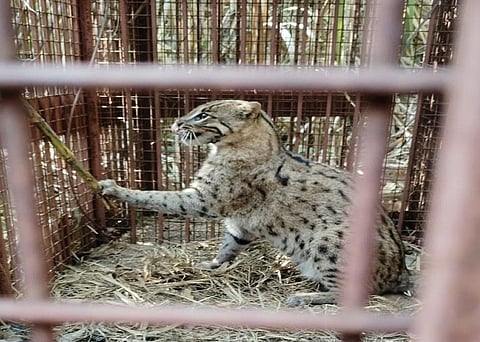


At daybreak, after tracking the pugmarks of a tiger through an agricultural field in the Terai, we received an urgent call from the Forest Department. A “leopard cub” had reportedly been trapped in a cage inside a village. Such calls are not uncommon in this landscape, where large carnivores regularly move through farmlands and sugarcane fields. On reaching the site, however, it became clear that the animal in the cage was not a leopard cub.
It was a fishing cat.
Surrounded by anxious villagers, the cat had been forcibly fed pieces of sugarcane, a desperate attempt by people who believed they were dealing with a young leopard. Fear had spread quickly, fueled by the animal’s spotted coat and proximity to human settlements. Forest Department staff intervened, safely rescued the cat and released it into a nearby forest patch. This incident was not an isolated event. Similar cases have been repeatedly reported from villages across the Terai region of Uttar Pradesh, where fishing cats persist in densely populated human landscapes. Far from protected forests, the species survives in reed beds along canals and rivers, wetlands embedded within agricultural mosaics, and crop fields such as sugarcane. Nocturnal and elusive, fishing cats often go unnoticed until a chance encounter triggers panic, misidentification and emergency rescue.
Protected under Schedule I of the Indian Wildlife (Protection) Act, 1972, and listed as Vulnerable on the IUCN Red List, the fishing cat remains largely invisible in India’s conservation planning outside protected areas. Its presence in human-dominated landscapes highlights both the species’ ecological adaptability and a critical gap in current conservation priorities.
The fishing cat is uniquely adapted to life at the water’s edge. A robust skull, powerful limbs and partially webbed feet allow it to hunt with remarkable efficiency in wet, unstable terrain. Unlike most small cats, it is an accomplished swimmer, using stealth and sudden bursts of movement to ambush prey along the margins of rivers, ponds, paddy fields and marshes. Fish form the core of its diet, but amphibians, crustaceans and other aquatic organisms are also frequently taken, underscoring its close ecological association with freshwater systems.
While breeding populations persist within well-known tiger reserves such as Dudhwa, Valmiki and Pilibhit, these protected areas represent only a fraction of the species’ functional landscape. Much of the fishing cat’s range lies beyond reserve boundaries, embedded within canal networks, floodplains, village wetlands and agricultural fields. These overlooked habitats act as critical foraging grounds and movement corridors, enabling the species to persist across fragmented landscapes. However, this reliance on a dispersed network of small water bodies also places the fishing cat at considerable risk. As wetlands are drained, encroached upon or converted for agriculture and infrastructure, the species loses not just habitat, but the ecological connectivity that sustains its populations. In regions where wetland loss now outpaces forest degradation, the fishing cat’s survival increasingly depends on conservation attention extending beyond protected areas and into everyday human landscapes.
Fishing cats rarely announce their presence. Outside protected areas, they appear in news reports through accidents and emergencies: a roadkill on a highway, an animal trapped in a well, another cornered in a village after being mistaken for a leopard. Taken individually, such incidents appear anecdotal. Viewed together, they reveal a much larger pattern. To understand where fishing cats persist beyond reserves, we examined a decade of newspaper reports from Uttar Pradesh and Bihar, published between 2015 and 2024. This analysis formed the basis of our recently published study in CATnews, titled “Elusive and unprotected: Fishing cat occurrence and conservation challenges in India”. The study used verified media reports as entry points into landscapes that formal wildlife monitoring rarely reaches, particularly agricultural belts, canal networks and village wetlands. By retaining only records verified by photographs or Forest Department confirmation, we filtered out speculation and misidentification, leaving behind a conservative but credible dataset.
What emerged was not a scattering of isolated events, but a map of persistence. Fishing cats were repeatedly reported from the same districts, often along rivers, canals and wetland-rich agricultural belts. Twenty-two districts in Uttar Pradesh and five in Bihar showed confirmed occurrences, most of them far from protected forests. These locations were neither wilderness nor accidental refuges, but working landscapes shaped by irrigation, farming and dense human settlement.
Three such landscapes stood out. The Hastinapur-Bijnor belt, criss-crossed by rivers and canals and dominated by sugarcane cultivation, recorded frequent encounters. The Dudhwa landscape revealed fishing cats moving through villages bordering the reserve. Further east, the Suhelwa–Sohagi Barwa region highlighted the importance of seasonal wetlands and village ponds—locally known as taals.
Equally revealing were the circumstances under which fishing cats were detected. Many were discovered only after fatal road accidents or emergency rescues, often triggered by fear and misidentification. These encounters expose a fundamental contradiction: fishing cats are surviving in close proximity to people, yet their presence is acknowledged only when something goes wrong.
By piecing together these fragments, the study shifts the narrative from rarity to resilience and from absence to neglect. Fishing cats are not confined to protected areas; they are embedded in human landscapes that fall outside the conventional focus of conservation. Recognising these spaces as priority habitats is not optional. It is central to the species’ survival.
The patterns emerging from these records point to a conservation crisis unfolding largely out of sight. Over the ten-year period examined, 25 fishing cats were reported dead outside protected areas, 20 of them killed in road collisions. Most of these incidents occurred during the winter months, when dense fog and poor visibility on rural roads sharply increase the risk of wildlife vehicle collisions.
Roads, however, represent only one layer of risk. Misidentification remains a persistent and underappreciated threat. Fishing cats are frequently mistaken for leopard cubs, a confusion that can rapidly escalate fear within villages. In at least six documented cases, this misperception led to the animal being forcibly captured or confined, not because it posed a threat, but because people believed it would grow into one.
Forest Department rescue records further illuminate the precariousness of the species’ existence in human landscapes. Thirty-three fishing cats were rescued from wells, agricultural fields, ponds, orchards and even cages set for leopards. While these interventions prevented immediate harm, they also highlight how often fishing cats encounter hazardous infrastructure in everyday environments. Rescue, in this context, becomes a response to systemic risk rather than an indicator of security.
An even less visible concern involves cubs. More than 30 media reports described the rescue of unidentified “wild cat” cubs from agricultural areas across the region. In most cases, photographs were absent or insufficient for accurate species identification, and information on post-rescue outcomes was rarely reported. This lack of documentation creates a significant conservation blind spot, raising questions about survival, rehabilitation and the long-term impacts of removing young animals from human-dominated habitats.
Together, these threats reveal a species navigating a landscape shaped by roads, fear and fragmented awareness. For fishing cats, survival outside protected areas is threatened not by direct persecution alone, but by a convergence of infrastructure expansion, misidentification and reactive management. Addressing these risks will require proactive conservation planning that extends well beyond reserve boundaries.
Taken together, these findings portray a species surviving against considerable odds in a landscape shaped by shrinking wetlands, expanding settlements and dense road networks. The fishing cat is not confined to protected forests; it occupies the liminal spaces where agriculture, hydrology and human habitation intersect. Its continued presence in such environments reflects a remarkable degree of ecological plasticity—but adaptability alone cannot offset sustained habitat loss and unmanaged risk.
Unlike wide-ranging carnivores that depend on large, contiguous forest tracts, the fishing cat relies on shared, human-modified spaces. It persists where canals, village ponds and marshy depressions overlap with paddy fields, grazing areas and rural infrastructure. In such settings, exclusionary or fortress-style conservation approaches offer little benefit. The species’ survival instead hinges on coexistence: the retention of small but functional wetlands, informed local responses, and tolerance within everyday human landscapes.
In many parts of the Terai, this coexistence already exists, albeit informally. Farmers and fishers encounter fishing cats along canals and fields, often without confrontation, guided by local norms that limit retaliatory action. These quiet, place-based practices form an unrecognised foundation for conservation and represent an opportunity that formal policy has yet to harness.
Despite this, the fishing cat remains a blind spot in India’s conservation framework. Its habitats cut across multiple administrative boundaries and fall outside the conventional focus on forests and charismatic megafauna. Wetlands embedded within agricultural and village landscapes receive limited protection, and small carnivores are rarely treated as conservation priorities. If this systemic oversight persists, the fishing cat risks a slow, unnoticed decline—not through overt persecution, but through the steady erosion of the landscapes that sustain it.
Addressing the fishing cat’s decline requires shifting conservation attention beyond protected areas and recognising human-dominated wetlands as priority habitats.
1. Prioritise research in non-protected landscapes: most fishing cats in the Terai persist outside reserves, yet these areas remain poorly studied. Systematic monitoring must focus on agricultural mosaics, canal networks, village wetlands and floodplains where the species faces the highest risk from roads, infrastructure and misidentification.
2. Close the conservation gap outside protected areas: current wildlife policies are heavily forest- and reserve-centric, leaving wetland-dependent species in human landscapes largely unaccounted for. Conservation planning must explicitly include non-protected habitats, with clear management responsibility across forest, irrigation and rural development agencies.
3. Treat wetlands as conservation infrastructure: Ponds, taals, lakes and canal-side marshes should be recognised as ecological assets, not vacant land. Protecting and restoring these small, scattered wetlands is essential for maintaining habitat connectivity and sustaining fishing cat populations beyond reserves.
4. Strengthen education and awareness at the local level: misidentification of fishing cats as leopards continues to drive fear-based responses. Targeted awareness programs, species identification materials and community engagement are critical to reducing unnecessary captures and fostering coexistence in villages where fishing cats already persist.
The fishing cat is not a creature of distant wilderness; it is a species shaped by coexistence. Its continued presence in human-dominated landscapes reflects a rare adaptability, but adaptability has limits. As wetlands disappear under pressure from agriculture, infrastructure and unplanned development, the ecological foundation that sustains this species is steadily eroding. Preventing this quiet decline requires a fundamental shift in conservation thinking. Forest-centric approaches alone cannot safeguard a species whose survival depends on canals, village ponds and floodplain wetlands. These overlooked ecosystems must be recognised as conservation priorities, supported by research that extends beyond protected areas and by policies that integrate wetland protection into everyday land-use planning.
Equally critical is awareness. Misidentification, fear and reactive responses continue to place fishing cats at risk, despite legal protection. Empowering local communities with knowledge, clear response mechanisms and institutional support can transform coexistence from an accident of circumstance into a deliberate conservation strategy.
In the water-bound margins of the Terai, fishing cats still move silently through reeds and canals. Whether they continue to do so will depend on how seriously we value wetlands, not only as resources for people, but as living ecosystems on which both human livelihoods and wildlife survival depend.
Khadija is Project Associate – I, Wildlife Institute of India, Dehradun. Shivam Chauhan is a PhD Scholar at the Department of Wildlife Sciences, Aligarh Muslim University. Kaleem Ahmed is Assistant Professor at the Department of Wildlife Sciences, Aligarh Muslim University
Views expressed are the authors’ own and don’t necessarily reflect those of Down To Earth