

Have you ever wished you could swim like a fish? How about speak like one?
In a paper recently published in the Journal of Fish Biology, our team from the University of Victoria deciphered some of the strange and unique sounds made by different fish species along the coast of British Columbia.
Researchers have known for centuries that some fish make sounds, and the ancient Greek philosopher and scientist Aristotle even mentioned fish sounds in his writings. However, our understanding of which sounds are made by which fish species is extremely limited because it is difficult to pinpoint where a sound comes from underwater.
To accurately identify which sound is made by which fish, our team deployed an underwater acoustic localization array at sites in Barkley Sound, B.C. The localization array was designed by our project collaborator, Xavier Mouy, and it allowed us to precisely triangulate sounds to specific co-ordinates.
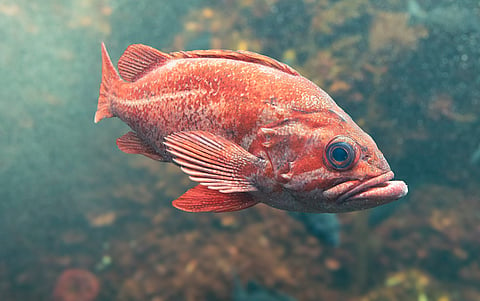
Using this triangulation and paired underwater video recordings, we were able to tie fish sounds to the correct species. We identified more than 1,000 fish sounds during our study and successfully tied those sounds to eight different rocky reef fish species: copper, quillback, black, canary and vermillion rockfish, as well as lingcod, pile perch and kelp greenling.
We were particularly excited to identify sounds for canary and vermillion rockfish since these species had never been documented making sounds.
We also wanted to investigate if different species sounds were unique enough to be differentiated from each other. We created a machine learning model using 47 different sound characteristics, like frequency (how high- or low-pitched the sound is) and duration (how long the sound is), to understand the unique differences in species calls.
For example, black rockfish make a long, growling sound similar to a frog croak, and quillback rockfish make a series of short knocks and grunts. The fish sound model was able to predict which sounds belonged to which species with up to 88 per cent accuracy. This was surprising and exciting to our team since many rocky reef fish species are very closely related.
Some fish species are known to make unique sounds during specific activities like courtship or guarding territory. Our research found that many species are also making sounds while fleeing from other fish.
For example, the copper and quillback rockfish both make significantly more grunting type sounds while being pursued by larger fish. We also documented sounds made during feeding activities and during aggressive activities like chasing.
We also used stereo cameras in our research which allowed us to measure the length of the fish. We found that smaller fish make higher frequency (pitched) sounds than larger fish, which means scientists may eventually be able to estimate how big a fish is just by listening to its sounds. This discovery could be used in conservation in the future because estimating fish size is an important tool for effectively managing fish populations.
Our team plans to apply this research to improve marine conservation efforts. Now that we understand fish species sounds can be differentiated, there are many exciting possibilities for developing these acoustic tools into monitoring methods.
We can create species-specific fish sound detectors that will tell us where fish live without disturbing them. This has important implications for future conservation efforts, and the techniques we used can be adapted by scientists all over the world to decipher other fish calls.
Going forward, our team plans to develop a method of counting fish using acoustic recordings by examining the number of calls each species makes.
We also plan to compare the fish sounds we collected in Barkley Sound to fish calls made in other areas of British Columbia to see if fish have unique accents or dialects.
Using underwater sound recordings to study fish is highly beneficial. It is minimally invasive and acoustic recorders can collect information for months or years in hard to access or low visibility locations underwater. With more development, underwater acoustic monitoring could become an important new tool for conservationists and fisheries managers.
Darienne Lancaster, PhD Candidate - Marine Ecology and Acoustics, University of Victoria
This article is republished from The Conversation under a Creative Commons license. Read the original article.