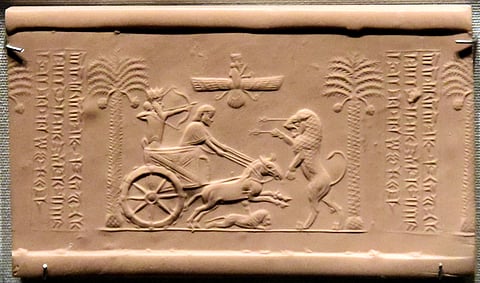


Today, lions are either identified with Africa or with India’s Gir Forest. They do occur in the history of the Roman Empire, in stories from the Bible’s Old Testament, in Mesopotamian cultures from West Asia like Babylon and Assyria. However, the lion also plays a key role in the cultures and history of what is today Iran.
Indeed, the world’s second largest cat has been Iran’s very symbol for millennia. The Lion-and-Sun symbol has been used for centuries by Iranian monarchs or Shahenshahs as symbols of their authority.
In Illuminating an empire: Solar symbolisms in Mughal Art and Architecture, Robin Thomas notes that the lion in itself was an ancient symbol of royalty in both Persia.
But first, let us understand why the lion played such a key role in Iranian history and culture. The reason is simple: the species was found in the land of Iran.
Sam Khosravifard and Aidin Niamir in their 2016 article, The lair of the lion in Iran, note that “The Asiatic lion once had an extensive distribution in Iran as well, ranging from the border of Iraq through the Khuzestan plain to the province of Fars.”
In Two Sasanian rock reliefs of the king combatting a lion (2022), Parsa Ghasemi also mentions Khuzestan and Fars. “The most-largest lion communities lived in the woodlands and jungles of Khuzestan (along the Karun River) and Fars, most particularly in the Dašt-e Aržan.”
According to Keramat Hafezi Birgani, “The Khuzestan plain is a most important part of the world with a variety of ecosystems from the Persian Gulf to the Zagros Mountains, from the sea level up to an altitude of c. 3700 meters, and also with rivers, farms, deserts and wetlands.”
The Zagros is one of two major mountain ranges in Iran, located in the south of the country, near the Persian Gulf. The other range, the Alborz, is in the north of the country, near the Caspian Sea. Between them, is the Iranian Plateau.
Khosravifard and Niamir note that the lion in Iran was found in a variety of habitats.
For instance, the big cat was found in a variety of elevations, although all were located below 2000 metres, they say.
The highest locations were reported from the surroundings of the Dasht-e Arjan (~1950 m) and the Kotal-e-Pirezan (~1700 m), both of which are in Fars. The lowest locations were in the Khuzestan Plain (~50 m).
“The eastern part of the lion’s habitat in the country is confined to the southern and western slopes of the Zagros vegetated with steppe flora such as Artemisia sp. and Astragalus sp., and pistachio-almond woodlands where parallel ridges enclosing broad valleys. Mean annual rainfall in this part is higher at about 450 mm. Deep snow and freezing is also not unusual,” notes their paper.

In the southwest and south, the lion’s habitat was more savannah like with plants suited to this biome. “This part of the habitat receives about 100 mm annual rainfall, while in summertime temperature routinely exceeds 50°C and the climate is occasionally very humid. The described habitat is not bounded to the Khuzestan and the Fars Provinces where all historical observations occurred. It continues with slight differences towards east into Hormozgan Province and a bit towards north where the Zagros Mountains meet the central plateau in the Kerman Province, and ultimately ends to the Hamoun Lakes at the border with Pakistan,” write Khosravifard and Niamir.
The Fars and Khuzestan provinces have been the heartlands of some of Iran’s earliest peoples and civilisations: The Elamites (3200-539 Before Common Era), who were succeeded by the Achaemenid Dynasty that founded the First Persian Empire (550-330 BCE).
The lion was a great symbol for the Achaemenids, who were called ‘Persians’ after their homeland of ‘Pars’, which later became ‘Fars’. In their ancient capital of Persepolis, located today near the city of Shiraz, stone reliefs often show lions in combat with ancient Iranian heroes and other animals.
And there was of course, the royal hunt, which usually involved Persian kings hunting lions.
In The Horse and the Lion in Achaemenid Persia: Representations of a Duality (2021), Eran Almagor writes that, “As successors of the Neo-Assyrian Empire, the Persians continued the practice of imperial lion hunting with its symbolic meaning of overcoming the power of dangerous chaos. Yet, in the eastern monumental representations the hunt is absent, because of ideological reasons going back to the religious significance the lion had for pre-imperial Persians; this importance is rather observable in the numerous other manifestations of the lion in monumental Persian art.”
Khosravifard and Niamir write that “The most renowned of these reliefs is the combat of the lion and a bull. The lion as a sign of heroic triumph and illumination is fighting with a bull, which was known as a symbol of darkness and ignorance.”
Some 550 years after the Achaemenid Empire had fallen to the armies of Alexander the Great of Macedon, a new empire rose from Pars. This one claimed to be the descendant of the Achaemenids and was called the Second Persian Empire. It is commonly known as the Sassanian Empire and it ruled Iran from 224-651 Common Era.
In his article, Ghasemi notes the link between the Sassanids and the Achaemenids.
“In Sasanian art and architecture, we can see a reflection of imitating the art of the Achaemenid Period in the works of the early Sasanian kings, especially in the time of Ardašīr I (224-239/40 C.E.) and Šāpur I. It may be that the Sasanians considered the Achaemenids as their real ancestors and imitated their iconography and decorative elements in their royal art and architecture.”
Hunting, he adds was a major pastime for the Sassanid emperors and their main quarry was the lion, though they also hunted leopards, boars, rams and deer using bows, lances, javelins, lassos or swords.
“The lion (‘šir’ in Persian) is among the strongest and most vicious animals that have been portrayed as fighting the king on several silver vessels and Sasanian bas-reliefs,” writes Ghasemi.
In the Sar Mašhad and Haft-Tanān Museum bas-reliefs, the Sasanian king is shown as a lion-fighter, he notes.
The lion continued to play a role in Iranian history, culture and the arts even after the Arab Muslims defeated the Sassanids and by 651 CE, conquered the whole of Greater Persia and subdued it.
By the late 900s Common Era, Iran was mostly Muslim. It was at this time that the Shahnameh (the Epic of Kings) was written by Ferdowsi.
The Shahnameh drew on old oral traditions and on ancient texts such as the Avesta. It tells of the Iranian heroes of old fighting lions or being compared to them, like the famous Rostam, in one of whose labours, a lion is killed by his loyal horse, Rakhsh.
Finally, when the Safavid Empire came to rule Iran from 1501-1736, the lion came to be associated with Hazrat Ali or Imam Ali, the son-in-law of the Prophet Muhammad. Hazrat Ali is called Asadullah or the ‘Lion of God’ for his bravery and courage and is a key figure in Shia Islam. Under the Safavids, Iran became mostly Shia, which it remains to this day.
Ultimately though, the lion itself died out in Iran.
“The last known sighting of a Persian lion was recorded by an Indian cartographer who worked for the British army on the 22nd of May 1942 near the city of Dezful. The lions likely continued to live for a few more years in Iran,” writes Ghasemi.
But the spirit of this animal lives on in Iran and Persian-derived cultures. Iran’s millennia-long association with the lion shows the immense impact that wildlife and charismatic megafauna can have on humans who live alongside them, long after they are gone.