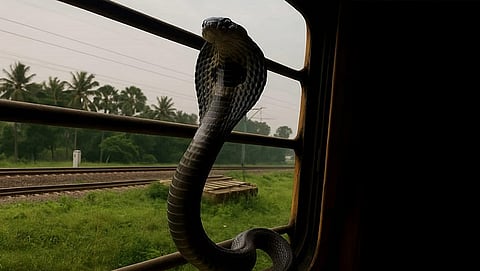


King cobras are increasingly being found in railway stations and trains or in their vicinity in Goa, prompting conservation concerns.
According to a new study published in the journal Biotropica, Ophiophagus kaalinga, the vulnerable king cobra species endemic to the Western Ghats, was caught aboard many trains in Goa on multiple occasions.
These findings prompted the researchers to initiate a study to understand their presence in unsuitable reptile habitats.
Dikansh Parmar, lead author of the study, said that a snake rescue with a local animal rescue group at Chandor railway station in July 2023 made him curious about the presence of king cobras in unsuitable and unexpected habitats. “Interactions with locals and other instances of rescues near railway tracks motivated me to identify the distribution of the king cobra species in the region,” he told Down To Earth (DTE).
The king cobra at Chandor was found beneath a pile of railway tracks stored at the site for ongoing railway maintenance and repair.
The study noted that while this village is not particularly remote in terms of its position vis-à-vis more suitable habitat, it is at a point where trains from the excellent king cobra habitat at Castle Rock in neighbouring Karnataka, stop before they enter Goa’s low-lying, more arid coastal areas. Castle Rock is a village surrounded by dense forests within the Dandeli Tiger Reserve.
“A second instance that aroused our curiosity was recorded in September 2021, when a king cobra was rescued from Vasco da Gama. This snake was found about. 200 m from the railway station, in a habitat well outside of areas predicted by our mode,” the authors noted.
The study said that three additional king cobra rescues fell outside the predictions of their model — Loliem, Patnem Cancona, and Palolem.
The authors also learned about similar instances such as a train rescue in 2019 in Uttarakhand and another in 2023 from Gujarat.
The researchers assessed 22 years of king cobra rescue records stretching between 2002 and 2024 to find 47 geo-referenced localities for O. Kaalinga in Goa. Of them, 18 were recorded in North Goa, while 29 were in South Goa.
Of the total records, five were observed near busy railway corridors raising questions about their presence in unsuitable habitat.
The authors note that, “Our model identified the eastern, inland part of Goa as highly suitable for king cobras, with areas along the coast, a narrow southern east-west gap, and some areas in the southeast unsuitable.”
But the five locations of snake rescue, like the Chandor railway station for instance, fell outside the predicted suitable habitat.
“Thus, a combination of prey availability (snakes, rodents), shelter, and serendipity would allow a king cobra to enter a goods train at a location with suitable habitat (such as Castle Rock) to travel 85 km to Chandor, 120 km to Vasco, or to the other three localities in unsuitable habitat,” the authors concluded.
However, the study noted that king cobras may disperse via the railway system in India placing their ecology firmly into a context of human-mediated dispersal.
“The dispersal of king cobras into villages or towns where the species may be unknown poses a serious threat to both snakes and humans. Unlike for other land elapids, there is no specific antivenom available for king cobras in India, and a bite can be fatal within 15 min. Conversely, threatened humans may attempt to kill the snake, leading to risky exposure,” the study noted.
Parmar said that Ophiophagus Hannah, a species of king cobra, is Red Listed as a ‘Species of Concern’. But little is known about the population of the Ophiophagus Kaalinga endemic to the Western Ghats.
“The conservation of the species requires attention given the disturbing pattern documented in the study and human pressures including urbanisation and proximity to tourist hotspots,” he added.
