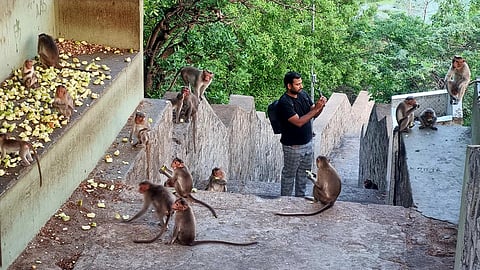


High-ranking Roman officers owned pets from India, a new study has claimed, after researchers uncovered burials of Indian macaques in an ancient cemetery in what used to be a famous Red Sea port two thousand years ago.
The authors of the study analysed 35 monkey burials in an animal cemetery in Berenike on the east coast of Egypt. They were dated to be from the first and second centuries Common Era, a time when high-ranking Roman military officers lived in the region.
According to the researchers, the primates were found buried among other companion animals like cats and dogs. Their special status is suggested given that they had restraining collars, apparent status markers like iridescent shells and food delicacies buried along with them.
Even more interestingly, these monkeys also had their ‘own pets’ — kittens and a piglet.
The special status of these primates among other buried companion animals, mainly cats and some dogs, is suggested by grave goods including restraining collars, apparent status markers like iridescent shells and food delicacies, and kittens and a piglet as the monkey’s own pets.
Wealthy Romans have been known to keep Barbary macaques as exotic pets, again ascertained from simian skeletons found in archaeological remains.
“The Berenike material is the most comprehensive source to date for the socio-cultural context of keeping exotic pets. It suggests a resident Roman elite, possibly associated with Roman legionary officers posted at the harbor. The monkey burials from Berenike also provide the first zooarchaeological evidence of trade in live animals from India,” the authors wrote.
The port of Berenike was founded by Ptolemy II Philadelphus, the second Ptolemaic king of Egypt.
From the 1st century BCE until the 2nd century CE, the port was an important stopover for trade between the Indian subcontinent, Arabia, and Egypt.
A centurion’s monkey? Companion animals for the social elite in an Egyptian port on the fringes of the Roman Empire in the 1st and 2nd c. CE has been published in the Journal of Roman Archaeology.
