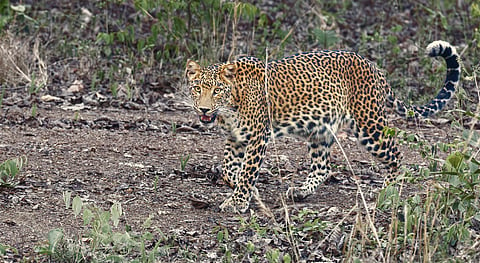


After Maharashtra Forest Minister Ganesh Naik announced plans to reclassify the leopard from Schedule I to Schedule II of the Wildlife Protection Act, pending the Centre’s approval, there was a huge uproar. The state has also attracted attention for plans to transfer 50 leopards to Reliance-owned Vantara.
The ongoing crisis of human-leopard interactions in Maharashtra highlights two concerns: the long-term effects of relying on short-term, reactive mitigation strategies, and the growing narrative that justifies building more rescue centres as the main response to rising human-wildlife encounters.
After years of relying on temporary solutions, state-endorsed wildlife rescue centres are emerging across India as long-term measures. This shift raises concerns about the future of conservation in the country.
Maharashtra’s sugarcane belt, including Pune district and Nashik, has been in the news for decades for human-leopard interactions. There were 113 human deaths from 2017 to 2022. The situation worsened in later years, with 14 deaths in 2 months in 2025. Meanwhile, 675 leopard deaths (47 per cent from natural causes) were reported from 2021 to 2026.
Leopards have inhabited central India, especially Maharashtra, for centuries, as shown by the longstanding reverence for the big cat deity among the Indigenous Warli community. This shared landscape has seen periods of coexistence, but negative interactions have increased since the early 2000s.
Several studies and management proposals have aimed to address these interactions. Yet, since the early 2000s, dominant measures have mostly been reactionary.
Sixty-nine leopards were trapped in the Ahmednagar forest division between 1999 and 2005 (Maharashtra Forest Department records). Between 2001 and 2003, 103 leopard trapping events took place in Junnar. A report notes that some of these were likely recaptures, since the animals were released at the administrative boundary of Junnar Forest Division. Although this did not improve the crisis, in a two-month period in 2025, more than 150 leopards were captured across three districts in Maharashtra.
In 2001, 29 leopards were captured from human-dominated areas in Junnar and released in nearby forests. A study found that, before the large-scale translocation program, there were an average of 4 leopard attacks each year between 1993 and 2001. After the program, the average rose to 17 attacks.
In 2002, 22 leopards from the same area were released into distant protected areas within the state and were marked with microchips. According to the report, “Three of these were recaptured at their new sites of release after casualties on humans in areas with no prior instances of human-leopard conflict in the memory of the people.”
Despite earlier unsuccessful outcomes, in 2024 a proposal to translocate 75 leopards from Junnar was made.
A recent social media post showing more than 21 leopards in poor condition, caged at forest nurseries in Ahilyanagar, highlights a longstanding issue. Since its launch in 2002, the Manikdoh Leopard Rescue Centre, set up to host captured leopards, has faced persistent overcrowding, even after a 2024 expansion that added 100 cages. The centre faced a severe space crisis in 2025.
Proposals for an additional facility to accommodate 200 leopards are currently under consideration in Ahilyanagar.
While these interventions were widely implemented, several studies and reports were published. One study showed that large-scale trapping may impact the species’ population if done ad hoc. Removing a small number of leopards did not reduce livestock depredation or the number of leopards trapped in the conflict area.
Studies on leopard translocation found that attacks persisted in capture areas and increased in release areas, spreading into areas experiencing conflict for the first time. Younger leopards often colonised areas where individuals had been removed.
The state submitted multiple proposals and solutions in 2025 alone. More trap cages were being set up across landscapes, with requests for 500 cages and equipment worth Rs 15.81 crore. A Rs 560-crore mitigation plan was proposed that included new rescue centres, rapid response units, and solar fencing. Chief Minister Devendra Fadnavis directed the forest department to set up two leopard rescue centres in Nashik with a capacity for 1,000 big cats. The department was also setting up two transit treatment centres to provide medical care for captured or injured leopards. Spike collars were distributed to farmers, along with sound-making sticks. In December 2025, the forest minister proposed releasing goats (worth Rs 1 crore) into the forests. AI-based early-detection and alarm systems, and drones for surveillance, are being used. A proposal for a leopard safari conservation project in Nashik was pitched. The forest minister spoke of a plan to propose to the Centre that industrialists, aka Ambani, be allowed to open a Vantara-like rescue centre in the state. Permission was sought and granted by the Centre on an experimental basis for the sterilisation of leopards. Leopard attacks were officially declared as a “state disaster” by the chief minister.
In 2026, proposals were made to move the leopard to a less protected category and transfer 50 leopards to Vantara; 20 are reported to have been transferred.
Most of these solutions are short-term, reactionary and a few, highly unscientific. Some, such as sterilisation, have not undergone scientific review or been implemented in India, yet are still promoted as successful interventions.
Do these proposed measures address the real reasons why human-leopard interactions are rising? Will they reduce future threats to human lives and livelihoods? Will they impact the future survival of the species?
However, several reports on long-term mitigation measures were proposed and published by scientists during this period.
Some reports have highlighted leopards in areas like Ahmednagar’s near total dependence on domestic animals as prey in croplands. This shows the need for better livestock protection and husbandry, improved waste management and sanitation, and stronger rural infrastructure, such as better toilets. Other proposed measures include long-term telemetric studies of leopards at the edges of human populations and addressing challenges such as expanding sugarcane cultivation, habitat fragmentation, and poor land-use planning. There is also a critical need for scientific monitoring and protection of corridors, which could help naturally supplement prey in low-density areas. Most importantly, engaging local communities in mitigation efforts and awareness initiatives has been essential for sustainable scientific outcomes. The forest department has faced staff and veterinary shortages for years. Was this resolved?
In recent years, many states have relied on capture and translocation as the primary response to increasing human-wildlife interactions. However, this approach has often led to more interactions and new cases in previously unaffected regions. As a result, most states have stopped this practice and now rely on capture for permanent captivity in rescue centres. Not surprisingly, in most states, rescue centres are full, and demand for new centres is high.
Uttar Pradesh is rolling out plans for leopard immunocontraception and building four new rescue centres. In Jharkhand, a dedicated rescue centre is on the horizon in Ranchi for what the forest department calls ‘rogue elephants.’ Andhra Pradesh has already set up four wildlife rescue and treatment centres, while Karnataka has plans for multiple centres for leopards, tigers and elephants.
We urgently need to support locals facing interactions, but is removing wildlife the only solution? Do these actions even constitute conservation?
Wildlife Conservation: The practice of protecting wild species and their habitats
Rescue: Save (someone/something) from a dangerous or difficult situation
Captivity: The condition of being imprisoned or confined (forcefully)
Rescue centre: A place where wild animals are held captive
Private rescue centre: A private place where wild animals are held captive
Wild animals are being sent to rescue centres (public and private) to rescue humans. That’s the solution we are proposing, applying at scale, and calling it wildlife conservation.
Gana Kedlaya is an independent journalist based in Bengaluru
Views expressed are the author’s own and don’t necessarily reflect those of Down To Earth
