

If the Earth’s history were squeezed into a single hour, cats would stroll in only during the last five seconds. They arrived late on the evolutionary stage, when seas were rising and falling, and land bridges briefly stitched continents together before severing them again. Early cat ancestors, specialised meat-eaters, rushed into the niche this churn created. As continents joined and split, populations were split and evolved into new species: lions on African savannahs, pumas in the Americas and fishing cats in Asian wetlands. Because this evolutionary burst was short and intense, all cats still look like close relatives.
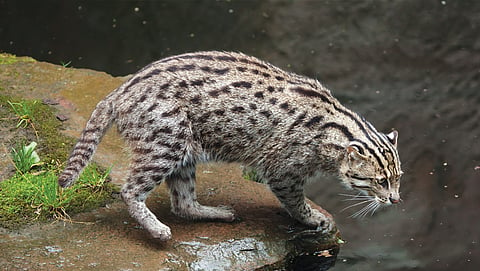
Most of these relatives want nothing to do with water. The fishing cat is the misfit. Built for mud and water, it has semi-webbed feet for wading through slush, a water-resistant coat, a thick tail that works like a rudder, and half-retractile claws that grip in slippery wetlands. Even its ears are adapted: inner ear lobules plug the ear openings when the animal dives, keeping water out as it stalks fish below the surface. Evolution has quite literally tuned this cat to wetlands.
In India, its westernmost limit lies in the Indus basin. From there it follows the Ganga river system through the Terai of India and Nepal; spreads across the vast Ganga–Brahmaputra plains and delta of West Bengal and Bangladesh; and extends south along the Mahanadi, Godavari and Krishna basins, which mark the southern edge of its distribution in the country. These floodplains and deltas have mothered civilisations; fed agriculture and fisheries. Today, more than four-fifths of the fishing cat’s range lies in such human-dominated terrain. The species survives in leftover wetlands: the marsh behind a factory, the swamp along a highway, the reed-beds between shrimp ponds and paddy fields. But while people across these regions have multiplied, fishing cats have not.
Globally, it is now listed as Vulnerable on the International Union for Conservation of Nature (IUCN) Red List of Threatened Species. The main reason is simple but brutal: its habitat is disappearing or being degraded beyond use.

Wetlands, the cat’s home, are neither clearly land nor clearly water. Sitting in between, they act as transition zones—making them the first casualties when humans alter land use or disrupt natural hydrology. Dams and barrages reduce the flows that once spilled over riverbanks to recharge floodplain wetlands. Elsewhere, swamps are drained and filled for real estate, industrial estates, highways, intensive farming and aquaculture. The wetlands that remain are chopped into fragments, isolated by roads, embankments and concrete. Genetic studies show that fishing-cat populations in India were once connected from the Ganga floodplains down to the Mahanadi and Krishna basins. This suggests that the cat could disperse through a continuous web of wetlands, maintaining gene flow. Today those corridors are frayed or broken. Along India’s east coast, shrimp farms are advancing into marshes and mangroves. Inland, freshwater marshes and swamps are being filled and paved over.
This is bad news not only for a mid-sized wild cat. Marshes and swamps are living sponges: they trap heavy metals and other pollutants, filter water and store carbon. When they are sliced into isolated patches, pollutants concentrate in fewer, smaller sinks while tainted water flows downstream. Recent studies already detect heavy metals in fish—the same fish hunted by fishing cats and eaten by people. Meanwhile, the loss of wetlands reduces a landscape’s capacity to buffer floods. Water that once slowed and spread across marshes now barrels through, causing more sudden and destructive inundations.
The fishing cat’s decline, then, is not an isolated conservation woe. It is a symptom. Its shrinking habitat signals collapsing wetland systems, toxic waterways and rising climate risks for the people who share the same floodplains and deltas. Saving this elusive cat is not merely about rescuing a charismatic species lurking in the reeds. It is about ensuring healthy wetlands, which are crucial for human sustenance and adapting to climate change impacts.
This article was originally published as part of the December 16-31, 2025 print edition of Down To Earth