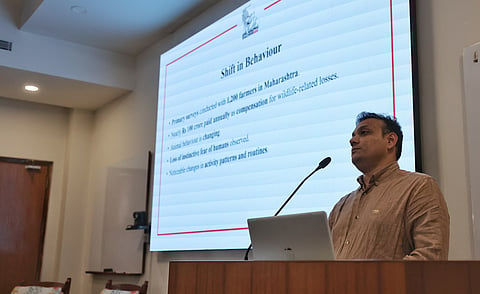


Are tigers more actively preying on human beings for sustenance? The 2026 State of India’s Environment (SOE 2026) report, released at Nimli near Alwar on February 25, 2026, by the Centre for Science and Environment (CSE) and Down To Earth magazine, has analysed available reports and studies and come to the conclusion that they are.
“The big cat is changing its stripes. Ecological changes in and degradation of their habitats, human interventions, and skewed conservation strategies are leading to some subtle and not-so-subtle behavior changes among India’s tigers,” a statement by CSE quoted Himanshu Nitnaware, Senior Correspondent, Down To Earth, who has done a part of the analysis for SOE 2026.
The SOE 2026 says that across India, at least 43 people have been killed near tiger reserves during the period January-June 2025. In 2024, in the same months, 44 had lost their lives in tiger attacks. In four of the 43 attacks in 2025, tigers ate at least parts of their prey.
Tigers rarely turn into compulsive human-eaters; tiger attacks on and consumption of humans increase when the big cats grow old or suffer from injuries and are unable to hunt for food, or when their natural prey base disappears. According to experts and wildlife observers, one of the reasons why tigers seem to be increasingly targeting humans is due to proximity of humans to tiger territory. Another reason — the report quotes Bengaluru-based conservation biologist K Ullas Karanth here — could be because of the “big cats losing their fear of humans”.
Tiger numbers are on the rise, and so are the human populations that inhabit the areas near forests. The report quotes a recent study which says that in 20 states with tiger populations, about 40 per cent of the tiger’s territory is shared by 60 million people. Tiger populations inside reserve areas are at a saturation point: as a result, the big cats are venturing outside protected areas. The overcrowding, habitat loss and human activities near tiger habitats are the reasons behind behavioural changes in tigers, says SOE 2026, quoting another expert.
The SOE 2026 also presents another new interesting twist in the tiger story. Tigers have now moved out from open forests and grasslands, where they used to hunt their prey, into thickets of Lantana camara, an ornamental hedge plant that came into India in the 19th century. Today, this plant has become one of India’s most invasive species, and occupies 50 per cent of areas of forests, scrublands and village commons.
Wherever lantana grows, it suppresses native grasses and plants, which form the food of wild herbivores; animals like cheetal, sambhar etc do not venture into these areas. Since these areas are often part of pastoral-agricultural landscapes, these become favoured spots of grazing for domestic cattle.
Ninad Mungi, Assistant Professor at the Department of Biology in Arrhus University, Denmark and one of the speakers at Anil Agarwal Dialogue 2026, said: “For the tiger, lantana-rich areas offer near-perfect cover, with low visibility and limited escape routes for their prey – besides an abundance of cattle. What lantana has done is to create predator-friendly habitat structures in prey-poor landscapes.”
The report points out that cattle have been always preyed upon by tigers, and because of their larger size (than cheetal, for instance) are a source of high-calorie food. Tigers in places like Bandhavgarh and Tadoba are increasingly using lantana-dominated patches outside the reserves as their daytime refuge and hunting grounds.
When a tiger kills cattle, the owner of the livestock often gets substantial compensation. This creates a paradox: in some areas, livestock loss to tigers is not, therefore, resented very strongly. The tiger becomes an unspoken part of the village economy, converting surplus cattle into some cash. But, said Mungi, “this can distort tiger behaviour, bringing a predator closer to people, and enhancing its dependence on human subsidies.”
Experts recommend local community-based conservation strategies and discouraging human interventions in tiger-dominated areas as ways to control these actual and potential human-tiger conflict scenarios.
The State of India’s Environment 2026 report is available on sale here:
https://csestore.cse.org.in/default/books/state-of-india-s-environment-2026.html
To access the proceedings and presentations of AAD 2026:
