
Subscribe

A unique effort is on to revive wild habitat in the Aral Sea, once one of the great inland water bodies of the world and now decimated as a result of decisions taken by the erstwhile Soviets.
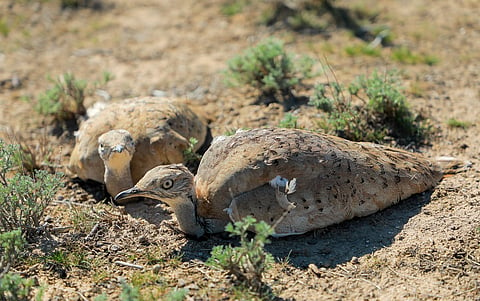
Uzbekistan and its partners are reintroducing hundreds of individuals of the houbara bustard species — a vulnerable migratory bird reliant on cross‑border habitats.
“The June 2026 release in Karakalpakstan reflects a wider regional shift: countries pooling expertise, resources and scientific capacity to restore landscapes and safeguard biodiversity. Environmental recovery in Central Asia will be collaborative, long‑term and underpinned by shared responsibility,” a statement by the National Committee of the Republic of Uzbekistan on Ecology and Climate Change noted.
The Aral Sea was once sustained by the Amu Darya river. The area endured decades of environmental decline, culminating in the near‑disappearance of the endorheic lake and the creation of the Aralkum Desert, as the Soviet Union directed water from the river for cultivating cotton in Central Asia.
Today, the Aral Sea is only about 10 per cent of its size in the 1960s, and its loss — which has altered the region’s hydrological cycle and changed the reflective characteristics of the landscape – has further accelerated environmental change and threatened species such as the houbara bustard.
Today, efforts are being accelerated across Central Asia to rebuild ecological stability and protect threatened species.
The houbara bustard is classified as Vulnerable by the International Union for Conservation of Nature (IUCN) and is listed under CITES, as well as Appendix I of the Convention on Migratory Species (CMS). It will be included in the forthcoming Central Asian Red Data Book being developed by the IUCN’s regional office, hosted on the campus of the Green University; Uzbekistan’s specialist environmental teaching and research institution in Tashkent.
Systematic efforts to conserve biodiversity and restore habitats for rare wildlife are ongoing in the Aral Sea region, a cross‑border landscape shared by Uzbekistan and Kazakhstan. In June 2026, 672 houbara bustards (Chlamydotis macqueenii) were released in Karakalpakstan, the autonomous republic in western Uzbekistan.
An autonomous republic in the arid northwest of Uzbekistan, Karakalpakstan is home to around two million people spread across nearly 167,000 square kilometres. Its capital, Nukus, sits in a region once known in antiquity as the kingdom of Khwarazm — the fertile delta of the Amu Darya (River Oxus) that fed the Aral Sea. Karakalpakstan became part of Uzbekistan in 1993 after the breakup of the Soviet Union, though its culture and language remain closely aligned with those of the Kazakhs.
Bred at a specialised centre operated by the Representative Office of Sheikh Mansour bin Zayed Al Nahyan in Kazakhstan, the birds underwent full pre‑release preparation before being transported to the Aral Sea region and released into the wild.
The operation was supervised by specialists from the National Committee of the Republic of Uzbekistan on Ecology and Climate Change and international experts, including representatives of the CITES Management Authority, ensuring compliance with global standards for endangered‑species conservation.
The collaboration between Uzbekistan, Kazakhstan, the United Arab Emirates and Karakalpakstan reflects a growing regional trend: environmental initiatives that are cross‑border, coordinated and shaped by shared ecological realities. Many species — including the migratory houbara — depend on habitats that span national boundaries; a principle reinforced when Uzbekistan hosted COP14 of the Convention on Migratory Species in 2024.
“Like so many other species, the wild Houbara bustard population has declined signficantly since the 1960s. But working with international partners, Uzbekistan’s scientists are reversing the birds’ fortunes. Breeding, release, and conservation programmes of this kind are vital for ecosystem restoration, and seeing the bustards' return to the Ustyurt Plateau and Kyzylkum is a cause for celebration,” said Sophie Ibbotson, Uzbekistan's Ambassador for Ecology.
“Focusing on a headline species such as the houbara helps to understand, protect and restore the wider ecosystem it represents. When countries pool resources and expertise — and when biofinancing gaps are filled through shared investment — entire landscapes and the communities that depend on them stand to benefit. This release is one element of a long‑term regional effort to rebuild ecological stability and safeguard endangered species and their habitats,” noted the statement
