

A transfer to a distant place is often perceived as a social disruption. When I was recently posted to the Manasbal Forest Range in Ganderbal district, farther from my previous station, the sense of distance weighed heavily on me. Yet it did not take long for the landscape itself to offer consolation and an unexpected sense of belonging.
The Manasbal Forest Range, lies within one of Kashmir’s most ecologically diverse landscapes, where alpine heights descend into wetlands, scrub forests merge into freshwater systems and life flows seamlessly across elevations. From the cold high-altitude alpine waters of Gangbal lake to Mansbal — the deepest freshwater lake in Kashmir — and along the restless course of the Sindh nallah, this landscape quietly breathes biodiversity.
My official residence came up at Preng village, perched along the banks of the Sindh nallah. Nearby flows the Sindh canal, feeding the Ganderbal Hydel project — an engineered waterway, yet one still connected to the rhythms of wildlife.
Barely a week into my posting, that connection revealed itself and nature uncovered one of its quiet surprises.
On a cold January morning during Chilai Kalan — Kashmir’s harshest winter spell — I set out for a walk along the canal with a local beat guard. Frost clung to the air, and the landscape lay hushed in cold restraint. As we moved a few yards ahead, I suddenly froze by disbelief and awe. What unfolded before my eyes was something every wildlife enthusiast hopes for yet rarely expects.
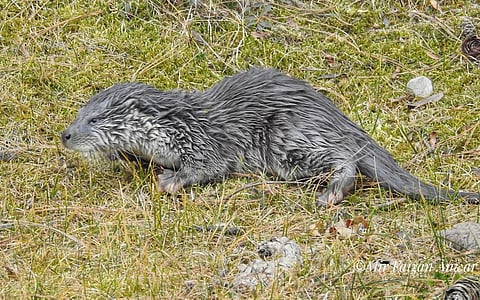
Resting quietly on the canal bank was a Eurasian Otter. The animal appeared solitary and unperturbed, pausing briefly before slipping back into the canal waters with effortless grace. I managed to photograph it, capturing what senior officers, later described as a significant scientific record — the first direct photographic documentation of the Eurasian Otter from Kashmir valley in the Sindh nallah.
Soon, a small group locals gathered, mistaking it for a crocodile — a misunderstanding born not of ignorance, but of unfamiliarity. Like me, this was the first time they had ever seen an otter. A few speculated that this ‘alien’ species had been deliberately introduced, much like the wild boar, which many people in Kashmir believe was intentionally introduced. It took patient explanation to reassure them that this animal was neither foreign nor invasive but a rare gift — one that thrives only in clean, healthy waters.
Ironically, the Eurasian Otter is no stranger to Kashmir. Scientifically known as Lutra lutra, this semi aquatic carnivorous mammal is locally called Wadur in Kashmiri.
Once considered locally extinct in parts of the Kashmir Valley, sporadic sightings in recent years suggest a silent return. Recent scientific observations from other parts of Kashmir suggest that such encounters are not isolated incidents, but fragments of a wider, fragile persistence — small populations holding on in overlooked stretches of water.

Globally, the species is classified as Near Threatened on the IUCN Red List, listed under Appendix I of CITES and Schedule II of the Wildlife (Protection) Act, 1972, reflecting widespread population decline driven by habitat loss, water pollution and disturbance.
Across the Himalayan region, the Eurasian Otter is recognised as a sensitive barometer of freshwater health, often disappearing long before rivers show visible signs of collapse. As an apex predator of freshwater ecosystems, the otter speaks silently of balance. Its presence is a strong indicator of improving aquatic health — cleaner water, stable prey populations and functional riparian habitats.
The fact that this individual was recorded in a canal highlights the often-overlooked role such waterways play in sustaining biodiversity — especially where natural rivers are modified. Such canals though created for power generation, often function as linear freshwater habitats, linking rivers, wetlands and lakes. For many species, they act as ecological corridors, providing shelter, prey and passage through human-dominated landscapes.
Yet this return remains fragile. Wetland degradation, water pollution, canalisation, disturbance and misidentification pose serious threats. An otter mistaken for a crocodile can easily become an animal at risk.
That the otter was recorded during the depth of winter is telling; survival through freezing months demands not just water, but stability — quiet banks, undisturbed flows, and a dependable food base.
This brief encounter within a canal — so close to the human habitation — served as a reminder that conservation does not always announce itself loudly. It does not always arrive with fanfare or official declarations. Sometimes it slips past unnoticed, leaving only ripples behind.
Perhaps the otter’s quiet return is not merely a biological event, but a reminder whispered by the water itself — that even in landscapes reshaped by concrete canals, life finds narrow passages back. If science tells us where the otter survives, lived encounters reveal how close it remains to disappearance — and between the two lies our responsibility to notice, and to protect.
Mir Faizan Anwar is a Range Officer with the J&K Forest Department and a wildlife enthusiast.
Views expressed are the author’s own and don’t necessarily reflect those of Down To Earth