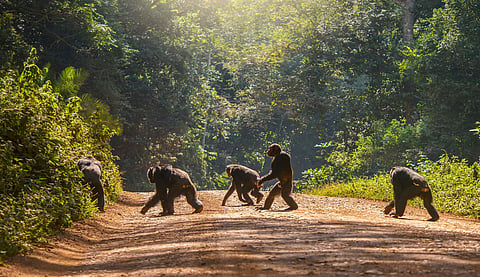


A rare split in a large chimpanzee community led to years of lethal conflict between former group members
Researchers tracked the Ngogo chimpanzees in Uganda over three decades, documenting a permanent division after 2015
The groups carried out repeated attacks, killing adults and infants over several years
Study suggests conflict can emerge from breakdowns in social relationships, without cultural or ideological divides
Findings challenge assumptions about the origins of war in both human and non-human societies
A rare and permanent split in one of the world’s largest known groups of wild chimpanzees, followed by years of lethal violence between former group members, is offering new insight into how conflict, even “civil war,” can emerge without ideology, identity, or cultural divides, researchers say.
The findings come from a study based on more than 30 years of observation of the Ngogo chimpanzee community in Kibale National Park in Uganda.
The Ngogo community, one of the largest ever recorded, once comprised nearly 200 individuals living in relative cohesion. Within the group, social clusters — broadly described as Western and Central — coexisted, with fluid relationships. Members groomed, patrolled and mated across clusters, maintaining a stable social structure.
Between 1998 and 2014, the group remained largely unified, even expanding in size. The number of mature males, aged 12 years and above, fluctuated around 40.
From 2015, however, researchers observed a marked change. Interactions between the two clusters became increasingly polarised. “A split occurred on June 24, 2015, when members of the Western and Central clusters approached each other near the centre of their territory. Rather than reuniting in typical fission-fusion fashion, the Western chimpanzees ran away, and the Central chimpanzees chased them,” the authors wrote.
This encounter was followed by an unusual six-week period of avoidance — behaviour not previously observed in the group. Researchers suggest the unusually large size of the Ngogo community may have strained its capacity to maintain social bonds.
During this period, spatial overlap declined and reproductive isolation began. No offspring were conceived between the two clusters after March 2015.
Model analysis of the networks showed that male social connections, once part of a single network, began to fragment in 2015 and stabilised into two distinct groups by 2018.
By that year, the community had formally split. The Western group comprised 10 mature males, while the Central group had around 30.
Over the following seven years, the two groups engaged in repeated violent encounters. Researchers recorded 24 attacks, resulting in the deaths of at least seven mature males and 17 infants.
The findings suggest that group identities can shift and escalate into lethal hostility in one of our closest living relatives, even in the absence of the cultural markers often associated with human conflict.
The study points to a combination of ecological and social pressures.
Although the Ngogo territory contains abundant food, fruit availability varies across time and space, potentially increasing competition. Reproductive isolation, which began before the complete split, may have further intensified male competition.
“Feeding competition exacerbated by large group size plays a role in permanent fissions in many other primate species. Although the Ngogo territory contains abundant food, fruit production varies across time and space, and the chimpanzees may have experienced heightened feeding competition,” the study said. “Additionally, reproductive isolation preceded complete separation into two groups. This likely exacerbated male- male competition, implicating reproductive competition as a contributing factor to the split.”
Three key factors may have accelerated the division by acting as a catalyst.
The first was the death of several individuals — five adult males and one adult female — in 2014 and 2015. These losses, representing more than 10 per cent of the adult population, may have weakened the ties that helped bridge the two clusters.
The second factor was a change in leadership, as a new alpha male emerged in 2015. Changes in dominance hierarchy can increase aggression and avoidance in chimpanzee groups.
At Ngogo, both the old and new alpha males came from the Central group, though the new alpha had earlier belonged to the Western group before becoming dominant. “Although an alpha male change alone does not explain why the Ngogo group split, it may have amplified tensions between the two clusters,” the authors noted.
A third factor was a respiratory epidemic in January 2017 that killed 25 chimpanzees, including four adult males and 10 adult females. Two of the adult males who died were part of the Western cluster, including one of the last individuals maintaining links between the two groups.
Taken together, these events appear to have weakened social networks and hastened the final split. “Taken together, these events suggest how networks may fracture in the face of multiple demographic and social changes,” the paper said.
Researchers estimate that such a permanent fission, followed by sustained lethal conflict, may occur only once every 500 years. The findings contribute to a long-standing debate about the origins of conflict. Human warfare is often linked to cultural factors like religion, politics, or ethnicity, which are thought to be necessary for it to develop and resemble “human-style” warfare.
But the Ngogo case suggests that such markers may not be necessary. Former group members who had once lived, groomed, and cooperated together later engaged in prolonged violence, proving that shifting relationships and local rivalries are enough to spark war, the research noted.
“If chimpanzee groups can polarise, split, and engage in lethal aggression without human-type cultural markers, then relational dynamics may play a larger causal role in human conflict than often assumed,” the authors said. “Cultural traits remain essential for large- scale cooperation, but many conflicts may originate in the breakdown of interpersonal relationships rather than in entrenched ethnic or ideological divisions.”
The study concludes that the best path to peace — for both humans and our closest relatives — may lie in the “small, daily acts of reconciliation and reunion” that keep a community whole.
