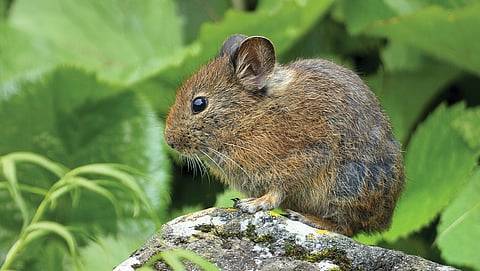


Remember Pikachu—the beloved companion of Ash Ketchum in the television animation series Pokémon? A real-life analogue exists, though it is far less famous and far more vulnerable. High in the Himalayas, this small, round, tawny creature, barely the size of a tennis ball, goes about its life unaware that scientists now view it as a sentinel of climate change.
This is the Royle’s pika (Ochotona roylei), a hardy denizen of the alpine zone. It is found in open rocky landscapes and rhododendron forests at 2,400–5,000 m elevation in the Himalayan region—from northwestern Pakistan to Jammu and Kashmir, Himachal Pradesh, Uttarakhand, Sikkim and Arunachal Pradesh in India to Nepal and Tibet. A relative of rabbits and hares, the pika does not hibernate. Instead, it relies on a thick winter snowpack to act as an insulating blanket, shielding it from brutal sub-zero temperatures. As a key prey species, it sustains several predators such as snow leopards, marten, stoat, weasel and red fox, forming an essential link in the high-altitude food web, especially during unforgiving winters when larger prey grows scarce. Yet despite its ecological importance, the Royle’s pika remained largely overlooked by researchers until recently, with detailed, long-term studies beginning in the late 2000s. And those studies already paint a worrying picture.
Royle’s pika is a highly picky eater. It uses a combination of multiple cues, such as plants with large leaf area, low fibre and low tanin content, to make forage selection decisions. These cues are influenced by constraints such as energy and nutritional demands and predation risk. Its primary food plants include alpine herbs and forbs, particularly moisture-loving Himalayan plants efficient at photosynthesis in cool wet climates.
But as temperatures rise and monsoon patterns shift, these plants may see significant shrinkage in their distribution range. Evidence are already mounting that the flowering times, growth patterns and seasonal cycle of these plants are altering due to rising temperatures and carbon-dioxide leels. Climate models suggest that the pika’s preferred foods could become far less abundant, leaving these selective foragers with dwindling options in an already harsh landscape.
Population genetic research highlights another concern: Royle’s pikas in the western Himalayas do not form one continuous population. Deep valleys and fast-flowing rivers fragment them into isolated groups with little genetic exchange. Such separation means that if a local population disappears, it may not be replenished from neighbouring areas. Such isolation heightens the species’ vulnerability to environmental changes that could hit different populations at once, and put its existence at risk. Perhaps most troubling is the pika’s poor tolerance for heat. While deep snow protects it in winter, it has few defences against rising summer temperatures. As cooler microhabitats shrink and heatwaves intensify, these cold-adapted scientists find themselves with nowhere to go. By 2050 and 2070, scientists fear a steep decline in suitable habitat for the Royle’s pika across the Himalayan Arc.
The consequences extend beyond this single species. A drop in pika numbers could reverberate throughout the alpine ecosystem, affecting predators that depend on them and shifting the delicate balance of high-mountain habitats. The story of the Royle’s pika is a stark reminder that climate change reaches even the world’s most remote summits, threatening creatures that have weathered extreme environments for thousands of years.
This article was originally published as part of the December 16-31, 2025 print edition of Down To Earth