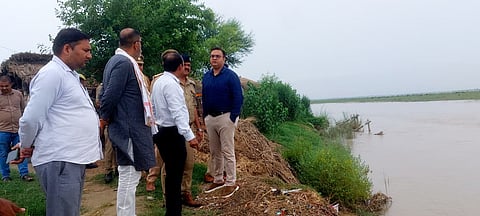


The horrifying death of a young boy, Sunil Singh, in a mugger crocodile attack in Bahraich, Uttar Pradesh left many saddened but also intrigued.
Just two years ago, national headlines were abuzz with news of wolf attacks in... you guessed it right, Bahraich.
From Indian wolves to mugger crocodiles, what makes Bahraich such a rich repository of the country’s wildlife?
The answer is geography. Bahraich lies in the heart of the Terai, those marshy lowlands that straddle southern Nepal and northern India. They stretch right along the Himalayan border of the country, from the Yamuna in the west to the Brahmaputra in the east.
It is the water and moisture in the Terai (itself meaning ‘moist land’) that is responsible for its lush forests and, in turn, abundant wildlife.
Bahraich has been a hunting ground for nobility through history. Travellers like Faxian, Xuanzang and Ibn Batuta passed through the area. Emperor Babur hunted rhino here, along the same Ghaghara River where the mugger crocodile thrashed about Sunil Singh's corpse this past week. For the residents of Bahraich, attacks by tigers, leopards, wolves, bears, elephants, rhino and mugger crocodiles are commonplace.
Vivek Mishra, a Delhi-based journalist and a native of Bahraich explains that Bahraich’s geography which was supposed to be a boon, has now become a curse.
“Bahraich is in the heart of the Terai and is riverine marshy land which is also very fertile. Most of the forests in the district are still quite pristine as are the riverine floodplains. Now, an increasing human population, having nowhere to go, is moving into these areas, where forests, woodland or floodplains of rivers. These are actually the haunt of wildlife which is abundant due to the rich supply of plants for herbivores and prey animals for carnivores. In such a situation, conflict is a natural conclusion.”
The district is also well connected with protected areas in northern India and southern Nepal like Katarniaghat Wildlife Sanctuary, Dudhwa National Park and Bardia National Park. All these together form one giant wilderness.
According to Mishra, the practices of indigenous groups in the Terai like the Tharu were sustainable and did not result in conflict with wildlife. “But the Tharu have been overtaken by other, non-subaltern groups and have been largely assimilated and their traditional knowledge mostly lost.”
And while our heart goes out to the family of Singh, his death highlights a truth that many of us in the country’s urban areas are often oblivious about: for so many rural communities across India, wildlife attacks are part and parcel of life. And death.
“Whether it is the case of Singh, who was working in the paddy fields of his uncle or victims of attacks by wolves, leopards, tigers and elephants, most instances of wildlife attacks in Bahraich have been of people engaged in farming activities. Perhaps that is all it boils down to: people looking to farm for their livelihood coming into conflict with wildlife when they encroach upon their home. It is a story that is similar to others across India,” says Mishra.
