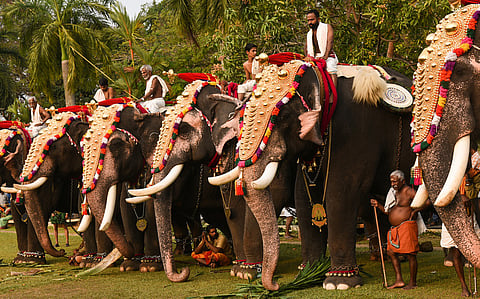


For Kerala, elephants hold a special place. Be it in any religious festivals, the presence of the giant pachyderm flapping its ears and sporadic jostle is a sight to behold for the masses. But occasionally, these giants turn berserk, turning frolicking into sheer terror for the spectators. Captive elephant rampages and the resulting public outcry is a recurring issue in the State. The situation is so severe that from 2018 to 2024, around 159 elephants have died in captivity, prompting alarm from animal rights groups.
The Kerala Captive Elephants (Management and Maintenance) Rules, 2012 is India’s first state level legislation on systematically regulating around 389 of captive elephants residing in Kerala. The rules contain various provisions on the housing, upkeep, duties of owners and even on the retirement of elephants. But as the government is now planning to replace the 2012 rules with a Draft Rules, I argue that reducing captive elephant deaths and their suffering requires a radical policy shift from the current property-based approach to a Sentience-Rights Based approach.
What does one mean by a sentience-rights based approach in the first place? According to its proponent, Alasdair Cochrane, it assigns “fundamental legal rights on the basis of sentience—that is the capacity of an individual to experience the world and their place in it”. So simply speaking, laws should not merely serve human beings, but all non-human beings capable of suffering and feeling. Although this approach seems too radical, I argue that for governing captive elephants, a sentience-rights based approach could be the most appropriate one.
Firstly, various studies have consistently and categorically proved that elephants exhibit higher order cognition and are routinely ranked alongside dolphins and chimpanzees for their intelligence. Secondly, dolphins and cetaceans in general are already recognised by the Government of India as “highly intelligent and sensitive” and banned their use for any purpose whatsoever. As it is conclusive that elephants are indeed self-aware and is on par with dolphins and great apes for their intelligence, the same reasoning applied in the case of dolphins have to be applied for elephants.
The Supreme Court of India came close—twice—to recognising rights for sentient animals. Yet both times, it stopped at acknowledging sentient rights, leaving the question of animal rights unresolved. In Animal Welfare Board of India v. A. Nagaraja (2014), the Supreme Court acknowledged that animals are entitled to legal protection under Sections 3 and 11 of the Prevention of Cruelty to Animals Act, 1960. But it refrained from recognising animals as holders of fundamental rights on par with humans. The Court hoped Parliament to finally take the call on elevating the rights of animals from statutory to constitutional.
When the question of recognising sentient rights again came for the second time in Animal Welfare Board of India v. Union of India (2023), the Court firmly stopped short of what it termed as -judicial adventurism and ultimately shifted the duty of recognising sentient rights to the appropriate law-making authority. Thus, for the second time also, and perhaps for the last time in the near future, the jurisprudential debate on sentient animal rights was quietly buried. Though it is true that sentience-rights as a judicial exercise has now halted, later events have shown that the courts are actively treating the welfare of captive elephants as a top priority, by issuing warning, guidelines and even threatening criminal prosecution against violators.
Now as the ball is in the legislature’s court to grant rights, how should the law-making body move ahead? As a legal researcher, I would recommend a cautious and phased approach. One way of realising this is to first grant captive elephants a ‘right to be free from human captivity’. As the 2012 rules mandate that an elephant shall normally be allowed to retire from its work on attaining an age of 65 years, a modification can be made to ensure that elephants shall be free from human captivity on attaining 65 years. Although this is not a long-term viable solution, as most of the elephants will be physically weak to be integrated back into the wild, this can provide a headstart. Then over time, the legislature, in consultation with all the stakeholders can call for an early retirement and a future absolute prohibition on work.
On preventing cruelty, the current rules mandate the establishment of a District Committee only before a festival season. The simple question is why not create a permanent committee, which can monitor throughout the year. Lastly, the UK Animal Welfare (Sentience) Act, 2022 can help our legislators in turning captive elephant management from a property based to a sentience-rights based approach. A captive elephant sentience committee could act as a guardrail in vetting all the policies concerning the welfare of elephants as sentient beings. As laws continue to evolve, animal rights will also naturally follow suit and in governing captive elephants, any future rules must reflect that its subjects are not tradable commodities, but non-human beings who can think, feel and suffer.
Sachin Menon is Assistant Professor of Law at the School of Law, Christ (Deemed to be University), Bengaluru
Views expressed are the author’s own and don’t necessarily reflect those of Down To Earth