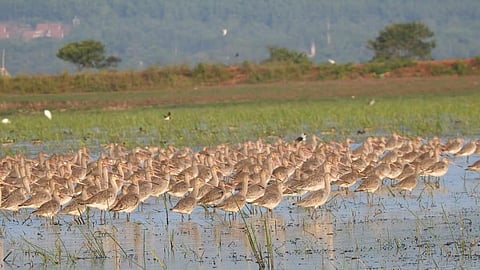


Reports from Chilika this week say its winged migratory guests have already begun arriving in the first weeks of October.
The Odisha Forest Department has intensified patrolling, 22 temporary bird-protection camps are in operation, and northern pintails, Eurasian wigeons, gadwalls, shovelers, glossy ibises and several other species are already being spotted around the lake and Nalabana. For many newspapers, this is a feel-good winter story.
For anyone who has watched Chilika for three or four decades, however, it is also an ecological signal worth watching carefully.
We must be cautious here. October arrival is not entirely new. Historical reports show migratory birds reaching Chilika in the second half of October, and sometimes even earlier. So I would not describe this year’s October arrival, by itself, as an unprecedented shift of two or three weeks.
What is changing, however, is the variability of the migration calendar — and the climatic conditions into which these birds are arriving and from which they eventually depart. That deserves our attention.
The Chilika Wildlife Division broadly describes the migratory season as lasting from October to March. Numbers generally build through winter, with large congregations during November, December and January, while many birds begin their return journey from March onwards.
But the climate at both ends of this journey is changing. So is the journey itself.
In February 2021, reports from Chilika and neighbouring Bhitarkanika noted that migratory birds had begun leaving earlier than usual. Rising temperatures and declining water levels were cited among the factors. Maximum temperatures in Bhubaneswar during February had also been unusually high in the preceding years.
This is consistent with a larger climatic trend.
Studies of Odisha’s temperature record show a clear warming tendency. Research covering 1981-2010 found about 0.3°C warming over three decades, with a particularly sharp rise in surface temperatures during 2001-2010. More recent analyses of the 1980-2020 period also show predominantly positive temperature trends across Odisha.
India, too, has warmed substantially. The India Meteorological Department estimates a long-term warming trend of about 0.62°C per century in annual mean temperature during 1901-2020.
These numbers may appear small. But ecological systems do not experience climate change as a single annual average. A shift of even a fraction of a degree can alter the timing of flowering, insect emergence, fish breeding, water availability and, for migratory birds, the availability of food along an entire flyway.
The climatic character of Chilika’s winter is changing. It is becoming warmer and more unpredictable. That matters to birds that have evolved around seasonal cues.
Chilika’s winter visitors do not simply decide one morning to fly south.
Many come from the vast Central Asian and Palaearctic region, including Siberia and areas around the Caspian and Arctic regions. Their migration is shaped by a complex combination of temperature, snow, ice, food availability, daylight, water conditions and ecological cues along the flyway.
Those cues are changing rapidly.
The Arctic is warming much faster than the global average. Earlier snowmelt and changing spring conditions are altering the ecological calendars of Arctic-breeding birds. Recent research published in Nature Climate Change, examining GPS and body-mass data from several Arctic-breeding waterfowl populations, found that some birds are advancing their spring migration by reducing the time they spend refuelling and by travelling faster.
In other words, birds are not merely responding to a warmer world by changing where they go. They are changing when and how they travel.
This does not mean we can say climate change alone caused this year’s early arrival at Chilika. Migration is far too complex for such a simple conclusion. Conditions at breeding grounds, staging areas, food availability, winds, temperature and wetlands along the flyway all matter.
But it does mean that early arrival deserves to be viewed as one signal within a much larger climate-driven ecological transformation.
The birds are caught between two changing worlds: an increasingly warmer north and a warming wintering ground in the south.
A migratory bird does not need Chilika merely to be beautiful. It needs Chilika to function.
It needs adequate water, suitable salinity, aquatic vegetation, fish and invertebrates, mudflats, roosting grounds and relatively predictable seasonal conditions. If these ecological conditions change, the consequences can extend far beyond the birds.
We already know that changes in Chilika’s hydrology affect its fish, aquatic food web and water quality. A decline in fish populations, for example, is not simply a livelihood problem for fisherfolk. It can disturb predator-prey relationships and destabilise the wider lake ecosystem.
This is why counting birds once a year is not enough. We need to understand what the birds are telling us about the lake itself.
Here is where I believe conservation is making a fundamental mistake.
We count birds. We count fish. We count tourists. But we rarely count the knowledge of the people who have lived with Chilika for generations.
During my recent interactions with traditional fisherfolk from places such as Arakhakuda, Satapada and Mahisa along the Magarmukh channel, I was reminded again of how much ecological intelligence exists outside our formal monitoring systems. They can read the lake in ways no mobile application can fully reproduce.
They know when the pani begins changing from sweet to saline, when the wind shifts from uttara to dakshina, how tides alter fishing conditions, when fish begin appearing in particular stretches and how the character of the water changes with the season.
They remember when the birds arrive. They remember where they used to congregate. They notice when particular fish breed earlier or disappear. They notice changes in fog, wind, rainfall, water depth and salinity.
This is not merely folklore. It is local ecological knowledge — a living climate record built over generations. We should institutionalise it.
Imagine a community-based Chilika climate and biodiversity monitoring system in which fisher youth and women are trained as para-ecologists. Their observations of water levels, salinity, temperature, wind, fish breeding, first bird arrivals and unusual ecological events could be recorded alongside satellite observations, India Meteorological Department data and scientific surveys.
That would give us something extremely valuable: a living early-warning system for the lake.
Protecting Chilika is not merely about preventing poaching or removing plastic. It is about protecting the ecological processes that make Chilika a living wetland.
That means maintaining healthy freshwater flows from its catchments, protecting its connections with the sea, keeping its channels and mouths functioning naturally, monitoring salinity and water quality, regulating ecologically damaging aquaculture and other pressures, and ensuring that fisher communities have both a stake and a voice in the management of the lake.
A healthy Chilika is not created by protecting birds from people. It is created by protecting the ecosystem on which both birds and people depend.
This is where climate change makes the challenge more complicated. The lake is not an isolated ecosystem. It is connected to rivers, the sea, catchments, agriculture, aquaculture, settlements, fisheries and the atmosphere.
Climate change therefore becomes a water story, a biodiversity story and a livelihood story at the same time.
So, should we celebrate the arrival of the winged guests? Of course.
But perhaps we should also pause. An early or unusually timed arrival should not become just another photograph for the annual winter tourism calendar. It should trigger a question: what has changed along the flyway, and what is changing inside Chilika?
The answer will not come from one bird count, one satellite image or one temperature reading. It will come from putting together the memories of fisherfolk, the observations of birdwatchers, the measurements of scientists, satellite data and long-term climate records.
The birds are not climate scientists. But they are remarkably sensitive ecological indicators. They respond to changes that we may notice only much later.
That is why we should listen carefully when they arrive. Because the warning may not be that the birds are coming early. The warning may be that the seasons on which both birds and people have depended for generations are becoming less predictable.
If we fail to understand that change, we may eventually have a Chilika that is still beautiful, still famous and still full of birds in photographs — but no longer capable of supporting the ecological abundance that made it famous in the first place.
The winged guests are here. Let us not merely count them. Let us listen to what they are telling us.
