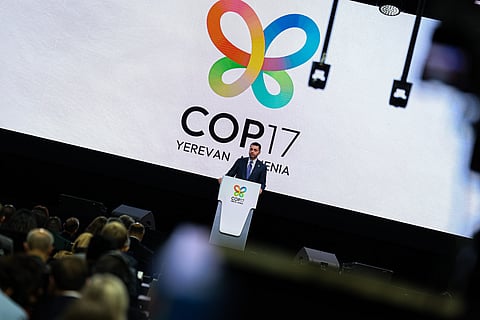


The 17th Conference of the Parties (COP17) to the Convention on Biological Diversity opened in Yerevan, Armenia, on October 19, 2026, with more than 10,000 delegates attending.
COP17 marks the halfway checkpoint for the Kunming-Montreal Global Biodiversity Framework, which sets 23 targets to be achieved by 2030.
The State of Biodiversity Action report, released on October 15, found that fewer than half of the assessed biodiversity targets are on track.
Delegates will seek to finalise the Yerevan Pathway, a set of decisions aimed at accelerating implementation, addressing gaps in biodiversity finance and getting global conservation commitments back on track.
It is going to be about promises not kept.
The 17th Conference of the Parties (COP17) to the Convention on Biological Diversity (CBD) formally began on October 19, 2026, in Yerevan, Armenia. More than 10,000 delegates have gathered in the city.
Over the next 11 days, parties to the CBD will examine how and why progress towards the targets set under the Kunming-Montreal Global Biodiversity Framework (KMGBF) in 2022 has fallen short. The framework has 23 targets to be met by 2030. COP17 marks the halfway checkpoint for the framework.
Progress has been poor, as indicated by the State of Biodiversity Action report released on October 15, 2026 by United Nations Secretary-General António Guterres. The report showed that fewer than half of the assessed targets are on track.
At the opening ceremony on October 18, Armenian Prime Minister Nikol Pashinyan highlighted that the meeting was an opportunity to direct efforts towards tangible results, accelerate the implementation of existing commitments and create new opportunities for cooperation.
Over the next 11 days, delegates will review progress towards the targets and try to find ways to get them back on track. If discussions go well, they could finalise the Yerevan Pathway, a set of decisions aimed at addressing the gaps highlighted in the global review.
“Yerevan is about accelerating action to protect nature,” said Astrid Schomaker, Executive Secretary of the Convention on Biological Diversity, at the launch. “Commitments must be honoured,” she added.
The COP17 presidency will need to work with governments to agree on interim measures that can help bring progress back on track over the next four years.
The commitments made in 2022 were crucial for biodiversity protection. They included protecting 30 per cent of land, inland waters and seas; mobilising $200 billion annually from all sources, including $30 billion in international public finance; and increasing the sharing of benefits, including financial benefits, arising from the use of nature's genetic information.
Instead of improvements, however, data suggest that the situation has worsened, as civil society organisations have pointed out in recent weeks.
Armenia’s own commitment to biodiversity protection is also under scrutiny. The government recently gave the go-ahead for operations at the Amulsar gold mine, despite years of environmental and human rights concerns.
The Global Forest Coalition has called on Armenia, the CBD and governments attending COP17 to confront these contradictions.
Ahead of the negotiations, Greenpeace activists deployed a hot-air balloon in the historic village of Garni, Armenia, carrying the message ‘Delay is Destruction’.
Greenpeace is calling on governments at COP17 to address gaps in the implementation of the KMGBF through concrete, forward-looking action.
Alongside COP17, delegates will also participate in negotiations under the Cartagena Protocol on Biosafety and the Nagoya Protocol on Access and Benefit-sharing, which are being held simultaneously in Armenia.
