

This article has been updated.
Scientist Dr Milind Watve says decades-long hunting ban has reduced animals’ avoidance behaviour around humans
Maharashtra may be losing Rs 10,000–40,000 crore annually to wildlife-linked agricultural damage
Study finds losses include both visible crop destruction and indirect impacts such as farmers abandoning rabi cultivation
Scientist calls for a “behaviour optimised” wildlife policy focusing on changing both animal and human behaviour
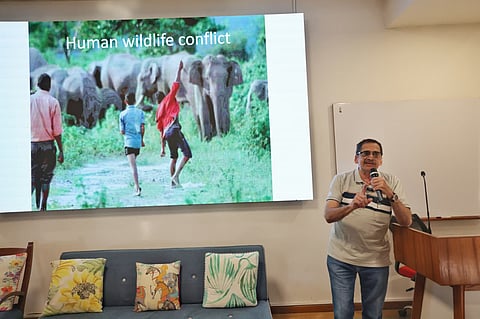
A complete ban on hunting in India has led to wildlife losing its avoidance behaviour around humans, pushing crop raids and farm losses higher, biologist Dr Milind Watve told an audience at the Anil Agarwal Dialogue (AAD) 2026.
AAD 2026 is the annual media conclave organised by Delhi-based think tank Centre for Science and Environment at the AAETI campus in Nimli, Rajasthan February 24-27.
Watve, formerly a professor at the Indian Institute of Science Education and Research, Pune, said the shift is altering where animals choose to live and feed, with more sightings reported near human settlements and along forest buffers. He linked the change to decades of legal protection that has reduced “fear of humans” among several species.
Watve argued that one of the biggest gaps in global human–wildlife conflict debates is the absence of credible methods to quantify crop losses. He cited a 2023 IUCN conflict-focused report, saying it did not even address “how much is the damage, or how to estimate the damage”.
While conservation science has built toolkits to estimate animal populations and study behaviour and reproduction, he said, crop damage assessment has remained rudimentary: “There are no methods. No guidelines. Nobody knows how to do that.”
Watve presented what he described as an early attempt to estimate total agricultural losses due to wildlife across Maharashtra, including both direct and indirect impacts, using “triangulation” across multiple datasets and estimation methods to compensate for data gaps and biases.
Maharashtra alone loses between Rs 10,000 crore and Rs 40,000 crore in agricultural product each year because of wildlife, including downstream value addition that would have followed from farm output, the researcher has estimated. He said the losses are rising and have been doubling every five to seven years over the past few decades.
The estimate goes beyond visible destruction. Indirect losses include farmers abandoning rabi cultivation, switching away from higher-value crops, or leaving land fallow in places where repeated raids make farming feel like a losing bet.
Watve said current assessment systems often capture only a small fraction of what farmers actually lose. Official panchanama inspections typically document damage that can be seen immediately like trampled plants, flattened fields, but miss subtler impacts that reduce yield without obvious signs.
He gave examples such as wild boar chewing young cotton buds or squirrels hollowing out coconuts that remain hanging on trees, leaving farmers unaware until harvest. In one district, he said, damage by giant squirrels and bonnet macaques has been severe enough that farmers gave up “acres of coconut gardens”.
Watve urged closer attention to causality, arguing that popular explanations — especially habitat loss and fragmentation — are often repeated without rigorous causal inference. He distinguished between “push” factors (food scarcity in forests) and “pull” factors (crops offering denser nutrients), noting observations from India and Africa that crop-feeding animals can appear “more robust” and stronger.
But he returned to what he called the most important driver: disappearing human fear. With hunting banned for decades, he argued, wildlife is learning that proximity to humans can be safer than remote interiors, especially where enforcement reaches more easily.
Watve said mitigation debates focus on habitat restoration, compensation and contraception-based population control — but talk too little about changing animal behaviour and human behaviour .
He described a pilot run for three years in two villages near Tadoba, built around a redesigned monitoring-and-payment system he likened to UPI: damage and productivity would be assessed and farmers paid more automatically, reducing reliance on government “panchanamas”. Under a “Support cum Reward” model, farmers were incentivised to keep investing in inputs because returns were insured, and productivity rose for crops including rice, wheat and chana, even though wildlife presence did not change, he said.
Watve said he has published a draft “citizens” policy for human–wildlife mitigation and invited public feedback .
To access the proceedings and presentations of AAD 2026: