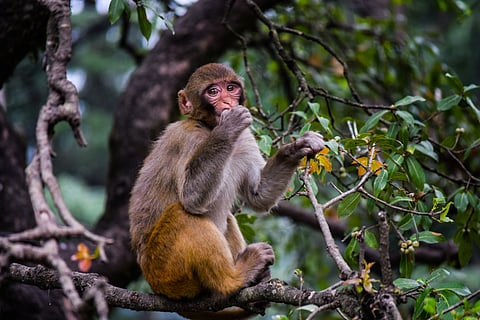


Farmers and orchardists in Himachal Pradesh say crop losses from wild animals now exceed damage caused by natural disasters in many parts of the state.
Monkeys, wild boars, nilgai, bears, peacocks and parrots are damaging crops and orchards, forcing farmers to guard fields or leave land fallow.
Studies have linked wildlife attacks to declining cropped area, shifting crop choices and annual losses running into thousands of crores.
Farmer groups are calling for scientific wildlife management, better compensation and support for crop protection under schemes such as MGNREGA.
Agriculture in Himachal Pradesh is heavily dependent on weather, with most farmers relying on timely rainfall and favourable temperatures for a good harvest. But while climate change has made farming and horticulture increasingly uncertain, farmers say the growing menace of wild animals has created an even deeper crisis in many parts of the state.
According to farmers and orchardists, crop losses caused by wild animals have become several times greater in some areas than losses caused by extreme weather events and other natural disasters. As a result, people in many villages across the state have started moving away from agriculture.
During the monsoon season of 2025, between June 20 and September 18, natural disasters caused an estimated loss of Rs 79 crore to the agriculture and horticulture sectors. By comparison, a 2011 impact assessment study conducted by Gyan Vigyan Samiti estimated that wild animals and birds cause annual crop and fruit losses worth nearly Rs 2,300 crore in Himachal Pradesh.
The scale of the problem led organisations including Himachal Kisan Sabha, Gyan Vigyan Samiti and other farming groups to launch long-running “Save Farming” campaigns.
As a result of sustained pressure, the state government launched the Chief Minister Agricultural Produce Protection Scheme. The central government also amended provisions under the Wild Life Protection Act, 1972, declaring monkeys as “vermin” in Himachal Pradesh for one-year periods on three separate occasions to permit culling for crop protection. Orders were also issued removing monkeys from Schedule V wildlife protections in the state.
According to monkey population estimates conducted by the Forest Department, Himachal Pradesh’s monkey population stood at 2,051,167 in 2015 and declined to 136,443 by 2019. To control the population, the Himachal Pradesh Forest Department launched a monkey sterilisation programme. Since its introduction in 2006, around 186,448 monkeys have been sterilised.
Despite these efforts, farmers say they have not received meaningful relief and the problem continues. The main wild animals affecting agriculture include monkeys, nilgai, wild boars, bears, peacocks and parrots. Together, farmers say, they cause crop losses worth crores of rupees every year.
According to the Gyan Vigyan Samiti study, more than 70 per cent of gram panchayats in the state were affected by wild animal attacks. The report also estimated that if farmers and labourers spent their time on productive work instead of guarding crops, their potential income could amount to nearly Rs 1,200 crore.
The study estimated total annual economic losses at around Rs 2,300 crore. This included horticulture losses of Rs 100 crore, agricultural crop losses of Rs 200 crore and Rs 500 crore in losses from abandoned fallow land.
Despite years of interventions, the crisis remains largely unchanged, and many farmers and orchardists say they are approaching a point where they may give up agriculture altogether.
According to Himachal Pradesh Agriculture Department data, around 80.23 per cent of the state’s agriculture is rain-fed, and nearly 88.86 per cent of farmers fall under the small and marginal categories. Only about 5.47 lakh hectares of land are cultivable, representing roughly 11 per cent of the state’s total land area.
Agriculture and horticulture together contribute around 13 per cent to the state’s GDP. This means wildlife-related losses directly affect sectors that support nearly 60 per cent of the state’s population.
Ajay Thakur, a farmer from Mandi district, says the problem has multiplied over the past two decades. “We have almost stopped cultivating maize, soya bean, black gram and many vegetables because monkeys and wild boars create so much destruction that leaving land fallow feels less risky,” he says.
Scientists from the Department of Agricultural Economics at Chaudhary Sarwan Kumar Agriculture University, Palampur, published research three years ago in the Indian Journal of Animal Sciences titled Economic Assessment of Crop Damages by Animal Menace in Mid-Hill Region of Himachal Pradesh.
The study found a 17.35 per cent decline in gross cropped area and a 12.66 per cent decline in net sown area. It also found a significant shift in cropping patterns, as farmers increasingly prefer crops that suffer relatively lower damage. Many farmers are now shifting towards crops such as turmeric, colocasia, okra and ginger.
According to orchardist Sanjay Chauhan from Shimla district, climate change is also affecting wildlife food sources. “Many wild fruit and flowering species found in forests have declined due to changing weather patterns. As a result, animals that previously stayed inside forests are now entering villages, farms and orchards,” he says.
He estimates that monkeys, bears, parrots and bats alone destroy nearly 20 per cent of fruits and crops. Across the state, he says, total losses could reach Rs 500-600 crore annually. Around one million people are directly or indirectly associated with Himachal Pradesh’s horticulture sector.
Horticulture Department data show rapid expansion over the past 35 years. In 1991-92, the total area under horticulture was 116,338 hectares, of which apple orchards covered 62,828 hectares. By 2024-25, the total horticulture area had expanded to 237,368 hectares, with apple orchards covering 163,330 hectares. The annual apple economy alone is estimated to be worth around Rs 5,000 crore.
This means orchardists already struggling with weather-related uncertainty now face additional risks from monkeys, langurs, bears and parrots, increasing both production costs and vulnerability.
Rohit Sharma, an apple grower from Theog in Shimla district, says parrots have emerged as a new challenge for horticulture. “When apples and other fruits reach the size of tennis balls, parrot attacks increase sharply. We have to guard orchards continuously for nearly one-and-a-half months before harvesting,” he says.
According to Sharma, parrots alone damage around 5-7 per cent of crops. He says attacks peak in the mornings and evenings, forcing orchardists to hire additional labour for protection and increasing production costs.
Former Indian Forest Service officer and Himachal Kisan Sabha president Kuldeep Singh Tanwar, who conducted the impact assessment study for Gyan Vigyan Samiti, says populations of langurs, monkeys, wild boars, nilgai, parrots and peacocks have risen abnormally in recent years.
“We launched the Kheti Bachao Abhiyaan and formed the Kheti Bachao Sangharsh Samiti, and we will continue to work on this issue,” Tanwar says. “Our demand is that wildlife populations exceeding carrying capacity should be scientifically managed and that farmers and orchardists should receive proper compensation for losses. That is still not happening.”
He says the government should prioritise the issue and recognise crop protection activities and fencing under schemes such as the Mahatma Gandhi National Rural Employment Guarantee Act (MGNREGA), to provide meaningful relief.
Without timely scientific, policy-driven and community-based interventions, he adds, Himachal Pradesh’s agriculture, food security and rural economy could face a severe crisis in the coming years.
This article is part of the series Conflict in the Backyard. A version of it was published in the cover story, Conflict in the Backyard, in the May 16-31, 2026 print issue of Down To Earth.
