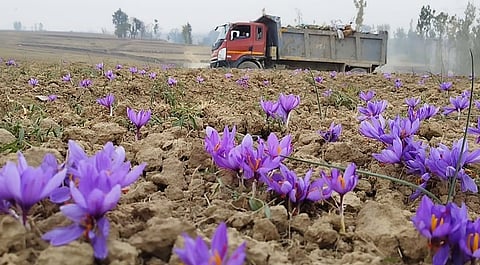


NGT orders investigation into municipal waste dumping near Kashmir's saffron fields.
Residents allege that around 50 mini-truckloads of waste arrive daily at the site.
Rodent infestations and stray dogs have reportedly damaged crops and disrupted farming.
Petitioners estimate that 200–250 acres of saffron fields have been destroyed.
Farmers demand closure of the dumping site and compensation for crop losses.
The National Green Tribunal (NGT) has ordered the formation of a joint committee to investigate allegations of municipal waste dumping near saffron fields in Pampore, Jammu and Kashmir, and directed it to submit a report within eight weeks.
The order came during the first hearing of a petition filed by 37 farmers and environmentalist Raja Muzaffar Bhat, who have sought the closure of the dumping site and compensation for affected farmers.
Saurabh Sharma, the petitioners' lawyer, told Down To Earth that the petition included an inspection report by the Jammu and Kashmir Pollution Control Committee (JKPCC), which confirmed the presence of mixed waste and leachate — contaminated liquid that seeps from accumulated waste.
According to Sharma, the tribunal took note of the findings and observed that there was prima facie evidence of environmental damage.
Residents of Patalbag village in Pampore allege that the municipal authorities have been dumping waste on around eight acres (3.2 hectares) of land near their saffron fields since 2022. They say around 50 mini-truckloads of rubbish arrive from Pampore town every day.
During a visit to Patalbag in August 2026, Down To Earth found that several farmers had abandoned saffron cultivation because of rodent infestations. Some had switched to apples and other horticultural crops but continued to face problems with pests.
"This landfill is illegal. We are investigating it and taking action for environmental compensation," Safir Hussain Shah, regional director of the JKPCC, told Down To Earth.

Bhat, founder of the Jammu and Kashmir Right to Information Movement and Climate Action Group, said residents had repeatedly raised the issue with government officials before approaching the tribunal.
"Before going to the NGT, we repeatedly raised the issue with government officials, but no one did anything. The Agriculture Department, the Pollution Control Committee, and even the Chief Secretary did not intervene. We were forced to approach the NGT," he said.
According to Bhat, the tribunal has included a scientist from the Sher-e-Kashmir University of Agricultural Sciences and Technology (SKUAST) in the joint committee.
He estimated that between 200 and 250 acres (81–101 hectares) of saffron fields had been destroyed and said the increase in stray dog numbers around the dumping site had made it difficult for farmers to access their fields.
The next hearing is scheduled for February 3, 2027.
Patalbag resident Rahil Rasheed said the dumping site had attracted rodents, stray dogs and birds, damaging crops and creating unsanitary conditions.
"We want this landfill site completely closed because this dumping yard has caused extensive damage to agricultural land and the livelihoods of local saffron farmers," he said.
Saffron cultivation requires careful field management. Its delicate underground corms, from which the plants grow, are particularly vulnerable to damage.
According to Rasheed, rodents burrowing into the soil and animals roaming through the fields are affecting two crucial stages of saffron cultivation: corm development and flowering. Residents said they fear that continued waste dumping could jeopardise the future of saffron cultivation in the village