

India has told the Bonn SB64 climate talks that no “new issues and obligations beyond agreed mandates” should be added to the UN climate negotiations.
The statement comes as civil society groups push for stronger UN-led action on transitioning away from fossil fuels.
India said the international climate agenda should focus on implementation, including greater prominence for the Article 9.1 work programme on climate finance.
The country raised concerns over declining climate finance from developed countries and the widening adaptation finance gap.
India also stressed equity, historical responsibility and the need for developed countries to lead through faster emissions reductions.
India has said that no “new issues and obligations beyond agreed mandates” should be added to the United Nations climate negotiations, as pressure grows from civil society groups for stronger action on fossil fuels. The statement was made on June 8, 2026 during the opening plenary of the 64th session of the Subsidiary Bodies (SB64), also known as the June climate meet, under the UN Framework Convention on Climate Change in Bonn, Germany.
India also reaffirmed its commitment to climate multilateralism and effective implementation of existing climate agreements.
The statement was read by Harkeerat Singh Randhawa, a Union Ministry of External Affairs official posted as second secretary at the Consulate General of India in Berlin. India also used the statement to raise concern over what it described as declining levels of climate finance from developed countries.
“No new issues or obligations beyond agreed mandates should be considered. Initiatives outside the UNFCCC process should remain voluntary in nature,” India said in its statement. Several climate analysts in Bonn said the position appeared to respond to growing civil society demands for 31st Conference of the Parties (COP31) to the UNFCCC to include more pointed UN-led action on reducing fossil fuel use.
Those demands have gained momentum after the Santa Marta fossil fuel treaty meeting in Colombia in April. The meeting, co-hosted by Colombia and the Netherlands, was described as the first international conference on transitioning away from fossil fuels.
It was attended by 57 countries and focused on legal, financial and economic pathways to phase out coal, oil and gas. India did not participate in the Santa Marta meeting.
Türkiye and Australia, the designated presidency and designated head of negotiation respectively for COP31, took part in the meeting.
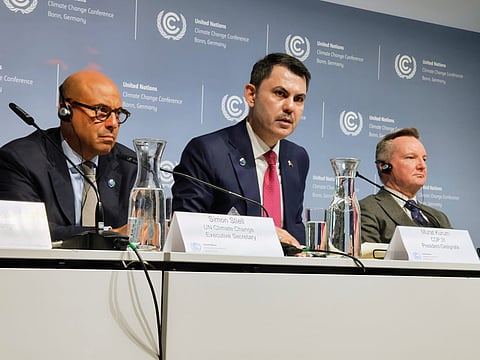
While the UNFCCC highly values all key voluntary initiatives, the decision on whether any particular initiative should be included in the formal UN discourse would have to be made by the negotiating parties under the leadership of the COP Presidency, UNFCCC Executive Secretary Simon Stiell said on June 9, 2026 in response to a query from this correspondent.
India’s statement added that the country believes that the “international climate agenda must now focus on implementation.” It also called for the Article 9.1 work programme to receive the “prominence and dedicated agenda space it deserves”.
Article 9.1 of the Paris Agreement states developed countries shall provide financial resources to help developing countries with mitigation and adaptation, continuing their obligations under the UNFCCC.
India said it was concerned by declining levels of climate finance, including replenishment of funds and support for the growing adaptation finance gap. Global climate finance reached an all-time high of $1.9 trillion in 2023, with private investment dominating, but this remains far below the estimated $6 trillion to $7.4 trillion required annually to avoid the worst economic impacts of global warming.
More than 90 per cent of climate finance goes towards mitigation efforts such as renewable energy and electric vehicles, partly because these projects can offer quicker financial returns. Only about 3.4 per cent currently goes towards adaptation. India’s climate-vulnerable populations need substantial adaptation finance to cope with worsening climate impacts.
India also brought climate equity and historical responsibility back into the discourse — principles that were widely considered to have been diluted or sacrificed in the Paris Agreement — appearing to push back against criticism of India’s continued dependence on coal in its energy mix.
“Equity and historical responsibility must continue to guide this phase,” said the statement. “Developing countries need adequate carbon space to eradicate poverty, expand energy access, and meet their sustainable development goal.” Developed countries must therefore lead through accelerated emissions reductions, India said.
India also emphasised that the Just Transition mechanism should be operationalised on the basis of equity and common but differentiated responsibilities and respective capabilities, or CBDR-RC. CBDR-RC is a core principle in climate negotiations that recognises that countries have different responsibilities and capacities, based partly on their historical contribution to emissions and their levels of development.
India also referred to climate-linked trade measures in its submission, pointing out that “the dialogue on unilateral trade measures should address its negative impact on climate actions of developed countries”.
