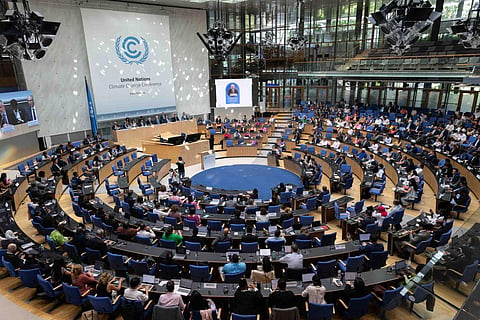


The Bonn climate talks, or SB64, have begun in Germany, marking the first major multilateral climate meeting since COP30 in Belém.
Adaptation, climate finance, fossil fuel transition and implementation are expected to be key priorities ahead of COP31 in Türkiye.
UNFCCC Executive Secretary Simon Stiell called for faster access to climate finance, progress on adaptation indicators and delivery of the Global Stocktake outcome on transitioning away from fossil fuels.
Civil society groups said the talks must address adaptation finance, debt burdens and equitable pathways for the Global South in an increasingly fractured geopolitical context.
The June climate meetings, formally the 64th session of the Subsidiary Bodies, or SB64, under the United Nations Framework Convention on Climate Change (UNFCCC), have begun in Bonn, Germany from June 8, 2026 and are expected to run until June 18, 2026.
This is the first multilateral climate conference since the 30th Conference of the Parties to the UNFCCC (COP30), held in Belém, Brazil, last November. Country delegates, civil society organisations and technical experts have gathered to begin work on texts and ideas that will take shape at COP31 in Antalya, Türkiye later this year.
The session opened with remarks from Simon Stiell, Executive Secretary of the UNFCCC. He began by acknowledging that the present moment calls for a review of UNFCCC mandates and highlighted priority areas for the year.
First, he called on the secretariat to support access to climate finance, improve coordination among providers and simplify country application processes. Second, he said negotiations remain central to accelerating implementation, reflecting the COP30 narrative shift towards prioritising implementation over negotiation.
He further emphasised that the Global Goal on Adaptation and the finalisation of the 59 Belém Adaptation indicators are high priorities this year. He added that the focus is now on how to deliver the first outcome of the Global Stocktake, including the decision on transitioning away from fossil fuels agreed at COP28 in the United Arab Emirates. He also highlighted the need to finalise a Just Transition mechanism to support people globally.
He closed by saying that climate goals must be taken into real economies, referring to the “Global Climate Action Agenda”, a five-year initiative launched by the Brazilian COP30 Presidency to accelerate implementation.
This year’s COP31 conference is being co-hosted by Türkiye, which is expected to carry forward and lead on the Action Agenda, and Australia, which is heading the negotiations.
Both co-hosts signalled that adaptation, the fossil fuel transition and climate finance are likely to take centre stage this year. However, the West Asian crisis also shaped the opening.
“Paris catalysed the biggest change of our energy systems since industrialisation. But now, Hormuz forces us to do more,” said Australian Climate Change and Energy Minister Chris Bowen. He pointed to how the Paris Agreement charted the path for global efforts to achieve the 1.5°C goal, while the current West Asian crisis is prompting calls for much faster action.
Bowen also emphasised the need to shift towards electrification, in line with statements by both countries and the International Renewable Energy Agency before the Bonn talks on the need to bring global electrification efforts to the fore.
COP31 President-designate Murat Kurum added that the challenging year had exposed the vulnerabilities associated with reliance on fossil fuel imports. He said it had also demonstrated the need for countries to act collectively to accelerate the transition towards cleaner, more secure and more resilient energy systems, beginning with the talks in Bonn.
Bowen argued that recent energy shocks have exposed the risks of dependence on fossil fuels and vulnerable supply chains in an increasingly unstable geopolitical environment, where disruptions are likely to become more frequent. Pointing to record levels of investment in clean energy and rapid growth in batteries and electrification, he said the transition should not be seen as a risk, but as the pathway to more resilient energy systems and long-term economic stability.
At a press conference organised by Climate Action Network, a global network of more than 2,000 civil society organisations, panellists emphasised that high ambition from all actors in Bonn was essential to meet the current geopolitical moment.
The world today appears increasingly fractured, marked by wars, genocide, energy crises, and intensifying climate impacts driven by events like a supercharged El Niño, highlighted Avantika Goswami, head of the Climate Change and Green Economy Programme at Delhi-based think tank Centre for Science and Environment.
She noted that while some countries are retreating from climate ambition, the Global South continues to drive key parts of the transition despite severe structural constraints. “This is a time of disruption, but also one where the rules can be rewritten through international financial architecture reform, debt relief, and rethinking trade rules towards climate-linked developmentalism. This is precisely why platforms such as this are crucial,” she stressed.
Co-panellists also highlighted the need to improve adaptation finance, make progress on the Just Transition Work Programme and identify equitable pathways for transitioning away from fossil fuels. There was broad agreement on the need to lay the groundwork for implementation across themes at the mid-year talks.
Marlene Achoki, Global Policy Lead at CARE International, drew attention to the adaptation agenda in Bonn. “Only around 15 per cent of adaptation finance comes as grants, while the majority is delivered as loans, leaving developing countries exposed to rising debt burdens, inflation risks and deepening poverty. How do we ensure finance is actually flowing to the local level — that is the strongest signal we want from SB64,” she stated.
While the focus on implementation from presidencies and civil society is clear, how these commitments will take shape remains to be seen. Speaking at a side event titled “An assessment of the Belém outcomes and challenges on the road to Antalya”, organised by Third World Network, Ambassador Pedro Pedroso from Cuba articulated this challenge on the road to COP31.
He said Belém should be viewed positively for reinforcing real dialogue and multilateralism, even in a difficult geopolitical context where other global systems have struggled to deliver outcomes, including the UN plastics treaty negotiations, which ended in deadlock in Geneva last year.
He noted that developing countries nevertheless demonstrated unity and cohesion and secured some concrete outcomes, including elements of the climate finance work programme at COP30 in Belem.
Looking ahead to Antalya, he stressed that the key challenge will be operationalising these outcomes and translating discussions, including those under the climate finance work programme, into meaningful action. This will be particularly important amid setbacks in official development assistance and the scaling back of support by major donors despite climate pledges.
More broadly, he warned that the geopolitical context is unlikely to ease, making it critical to ensure multilateral discussions translate into implementable outcomes.
