

Climate disasters triggered 29.9 million internal displacement movements worldwide in 2025, according to the Internal Displacement Monitoring Centre.
Nearly 90 million forcibly displaced people live in countries facing high to extreme exposure to climate hazards, according to UNHCR.
Emergency relief alone cannot address displacement where rising seas, coastal erosion and extreme weather make returning home increasingly difficult.
Planned relocation must protect livelihoods, customary land rights and access to traditional ecosystems, rather than merely provide alternative housing.
At COP31, Ranjan Panda calls for greater adaptation finance, community-led relocation and stronger legal protections for climate-displaced people.
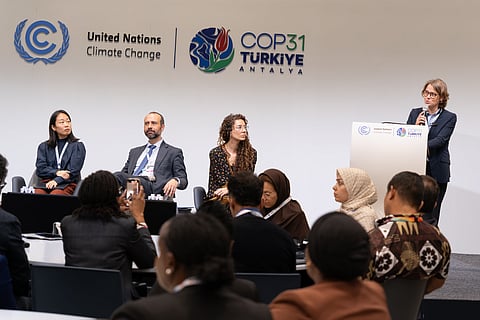
Speaking on a panel on climate displacement and planned relocation at 31st Conference of the Parties (COP 31) to the United Nations Framework Convention on Climate Change (UNFCCC) in Antalya, Türkiye, one truth was impossible to ignore: climate migration is no longer a distant, hypothetical crisis. While negotiators debate emissions targets and carbon markets, millions across the Global South are already losing their homes, livelihoods and ancestral lands to an accelerating climate emergency.
The figures presented in Antalya underline the urgency.
According to the Internal Displacement Monitoring Centre's (IDMC) 2026 Global Report on Internal Displacement, disasters triggered 29.9 million internal displacement movements worldwide in 2025, 13% above the annual average of the previous decade. By the end of the year, 13.6 million people remained displaced by disasters.
Even as a relatively milder monsoon season halved disaster-related displacement movements in South Asia to 4.6 million, recurring floods, cyclones and riverbank erosion continued to uproot vulnerable communities. The International Organization for Migration (IOM) warned at COP31 that more than 200 million people live in communities highly vulnerable to climate impacts.
Climate shocks are also compounding existing crises. A report released by the UN Refugee Agency (UNHCR) ahead of the summit found that nearly 90 million forcibly displaced people, roughly three-quarters of the global total, live in countries facing high to extreme exposure to climate hazards. People who have already fled conflict and violence face the additional threat of extreme weather.
UN Secretary-General António Guterres warned that climate disasters were erasing decades of development gains, worsening hunger and intensifying competition over dwindling land and water resources.
Yet international adaptation finance remains woefully inadequate. Even tripling funding for developing countries would meet less than 30% of their estimated adaptation needs.
We cannot continue responding to a structural crisis with temporary emergency relief. Tents and food supplies are essential after a cyclone, but they cannot rebuild communities where rising seas, coastal erosion and salinised soil make returning home impossible.
We must shift from reactive disaster management to long-term resilience and dignified, planned relocation.
First, adaptation finance must increase substantially to help communities remain where they are wherever possible.
This requires combining resilient infrastructure with ecosystem restoration. Concrete seawalls are expensive and inflexible, and can worsen erosion elsewhere along a coastline.
Hybrid coastal defences, combining engineered structures with restored mangrove forests, offer an alternative. Research suggests that mangroves can significantly reduce flood impacts, with some assessments estimating reductions in flood depths of up to 70% and avoided damages worth several times the cost of restoration.
Mangroves also support fisheries, protect biodiversity and sustain coastal livelihoods.
Investing in such natural defences, alongside resilient housing and early warning systems, can reduce the need for repeated disaster recovery and displacement.
Second, where sinking deltas, eroding coastlines and disappearing islands make continued habitation impossible, planned relocation must go far beyond providing houses.
Our work with climate-displaced communities repeatedly shows how poorly designed resettlement projects can deepen poverty. Moving families into concrete shelters far from their traditional workplaces may provide physical safety while stripping them of economic security and independence.
Dignified relocation requires secure land tenure, reliable public services and opportunities to rebuild livelihoods. Where people must enter new occupations, governments should provide skills training and employment support.
Workers forced to migrate in search of employment also need legal protections, including safeguards against wage theft and exploitation in the informal sector.
Crucially, relocation policies must recognise communities' customary and historical rights to the ecosystems on which they depend.
For artisanal fishers, forest dwellers and delta farmers, livelihoods, local economies and cultural identities are inseparable from the landscapes they have protected and managed for generations.
Separating communities from these ecosystems through poorly planned housing colonies or exclusionary conservation policies can undermine both social cohesion and environmental protection.
Communities must therefore have a meaningful say in relocation decisions, including where they move, how their livelihoods are restored and whether they can retain access to traditional resources.
Protecting people from climate hazards should not mean depriving them of the rights and resources that sustain their lives.
Third, international legal frameworks must better address climate-related human mobility.
People crossing international borders because of climate impacts do not automatically qualify for refugee protection under existing international law. Many therefore face significant gaps in legal protection and access to safe migration pathways.
Governments must expand lawful migration options and integrate human mobility into national adaptation plans.
These measures should recognise that migration can be both a response to climate harm and a strategy for adapting to it. The priority must be to ensure that people can move safely and voluntarily wherever possible, rather than being forced into dangerous or exploitative circumstances.
The moral and political responsibility is clear. Wealthy, industrialised countries have contributed disproportionately to historical greenhouse gas emissions, while many communities facing the greatest climate risks have contributed relatively little.
Delaying action will not prevent displacement. It will make future movements of people more difficult to manage and increase the risks to those already vulnerable.
COP31 must therefore deliver accessible adaptation finance, stronger protection for customary rights and relocation policies that place communities at the centre of decision-making.
