

Fossil-fuel-driven industrialisation has pushed the world’s annual CO2 emissions to nearly 40 billion tonnes per year and warmed the planet by about 1.3-1.4oC above pre-industrial levels.
Had all humanity lived like the American, warming would have reached at about 3.7°C. Following the average Luxembourger's lifestyle would have produced nearly 4°C of warming; living like the average Qatari would have pushed warming to a staggering 5°C or more.
By contrast, scaling the historical Chinese lifestyle to all of humanity would have led to warming of only about 1.2°C — no higher than the Earth’s actual warming today. If everyone had lived like the average Indian, warming would have been lower still, at about 0.8°C.
In 1928, Mahatma Gandhi wrote in Young India with remarkable prescience: “God forbid that India should ever take to industrialism after the manner of the West. If an entire nation of 300 million took to similar economic exploitation, it would strip the world bare like locusts.”
A century later, Gandhi’s fears are being realised. Fossil-fuel-driven industrialisation has pushed the world’s annual CO2 emissions to nearly 40 billion tonnes per year and warmed the planet by about 1.3-1.4oC above pre-industrial levels. In September, the UN Environment Programme’s (UNEP’s) ‘Limiting Overshoot’ report warned that overshooting the 1.5oC threshold is inevitable within the next three to four years.
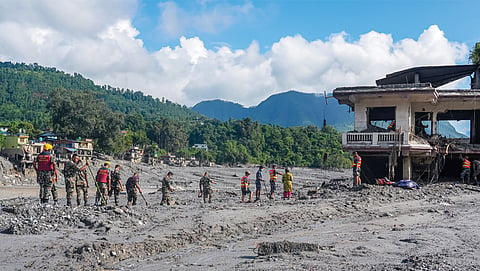
Climate disasters have mounted as the Earth has warmed. The “Himalayan tsunami” that struck Nepal this August sent millions of tonnes of rock and ice crashing into towns and villages, killing nearly 1,500 people, with over 5,000 still missing. The “Godzilla El Niño”, already the strongest on record and still intensifying, has compounded climate-related pressures across the world, including a weakening of the South Asian summer monsoon. Vast parts of India are reeling from drought, raising fears of water, energy and food shortages that could stretch into next year. Through it all, the US war on Iran has disrupted global supply chains, inflating household while delivering nearly US $200 billion war-time profits to the world’s largest oil companies.
As Nepal’s Prime Minister Balendra Shah poignantly noted at the UN General Assembly a month after the Himalayan disaster: “We have built a world with flawless logistics for war and broken logistics for food … [We are] hit by the climate we did not warm and by the wars we did not start.”
This week, policymakers from around the world have gathered in Antalya, Türkiye for COP31. The goal of the COP is the implementation of climate pledges and solutions: turning the promises of earlier summits into results.
The solutions are well-known. The UNEP report proposes expanding renewable energy, cutting methane emissions, improving energy efficiency, shifting to plant-based diets and conserving nature. These are considered technically and financially feasible, even if their implementation involves practical challenges and trade-offs.
Less settled are the questions of responsibility and justice: which countries should lead in implementing these solutions, and which arrangements would be just and equitable? Who must compensate, for example, the tremendous loss and damage suffered by small farmers in developing countries, hit by the climate they did not warm?
The conventional answer rests on the “cumulative emissions” framework, in which the responsibility of countries rises in proportion with their cumulative carbon emissions since 1850, since the warming caused by CO2 depends on the total quantity released. Endorsed by the International Court of Justice in its landmark 2025 judgement, this framework places the US, EU, China, Russia, Japan, and India as those most historically responsible for climate change. However, as Anil Agarwal and Sunita Narain of the Centre for Science and Environment (CSE) pointed out decades ago, approaches based on absolute emissions are unjust since they fail to distinguish between the “luxury emissions” of the rich and “subsistence emissions” of the poor. By construction, the framework of “cumulative emissions” designates the largest economies as those most responsible for the climate crisis irrespective of their stage of development. The same logic implicitly deems small, super-affluent countries such as Singapore or Switzerland as “too small to matter,” effectively granting them reprieve from stringent climate action.
Our recent peer-reviewed research, soon to be published in the journal Climate Policy, complements this framework with a justice-centric “scalability-of-lifestyles” approach. It turns Gandhi’s insight into a thought experiment where we ask: how much would the world have (counterfactually) warmed had all of humanity historically lived after the manner of the average American or European? What if, instead, the whole world had lived after the manner of the average Indian, Nepalese, or Nigerian?
Using FaIR, a widely used climate model emulator, we examined this question for every country in the world, extending each country’s historical per-capita CO2 emissions to the entire global population. Because it asks what the climate impacts of a country’s lifestyle would be if all humanity shared it, the approach is able to hold small, super-affluent countries accountable for their role in the climate crisis just as much as the large economies.
The results are striking. Had all humanity lived like the average German or Briton, the planet would already have warmed by about 2.5°C. Had everyone lived like the average American, warming would have reached considerably higher levels, at about 3.7°C.
But the most revealing findings concern not the large affluent economies but the small, super-affluent ones. Had everyone lived as Singaporeans, warming would have reached about 2°C. Following the average Luxembourger's lifestyle would have produced nearly 4°C of warming, more than the American counterfactual. Living like the average Qatari would have pushed warming to a staggering 5°C or more.
Equally notable is the finding that, despite China’s large emissions in recent decades, scaling the historical Chinese lifestyle to all of humanity would have led to warming of only about 1.2°C — no higher than the Earth’s actual warming today. If everyone had lived like the average Indian, warming would have been lower still, at about 0.8°C.
The contrast with the affluent North is stark. Had the historical lifestyles of the Least Developed Countries (LDCs) and Small Island Developing States (SIDS) been universal, warming would have amounted to a mere 0.6-0.8°C, roughly half the warming the planet has actually experienced.
This approach offers a different way of understanding the 1.5oC overshoot expected within the next three to four years — as the net outcome of two opposing counterfactuals. If affluent lifestyles had been universal, the threshold would have been breached as early as the 1970s; non-affluent lifestyles would plausibly have delayed it to the 2070s or beyond. The actual overshoot falls between the two.
By this logic, the world’s non-affluent populations have unwittingly subsidised climate stability and created a decades-long window for scientific discovery, policy development and solution implementation. This is not an argument for celebrating deprivation. It exposes a deeper injustice: carbon-intensive development enriched a minority, while the low emissions of the majority limited the damage to the planet. It also reveals the dual injustice:thosewho have helped preserve climate stability are also rendered most vulnerable to the impacts of a changing climate.
These findings have important implications for COP31. The most stringent reading of our findings would oblige the roughly 50 countries in counterfactual overshoot of 1.5°C to achieve net-negative emissions today rather than decades from now as UNEP’s report suggests. However, technological and financial limits put this out of reach even for the world’s richest.
In the meantime, alternative mechanisms would include a massive increase in contributions to the UN Loss and Damage fund; scraping intellectual-property rules to facilitate access to technologies for climate action; democratising institutions of global economic governance such as the World Bank and the World Trade Organization (WTO); transferring technologies for climate mitigation; and expanding grant-based climate finance.
The critical point is that such obligations must not be framed as charity, but as compensation owed to the non-affluent majority for their role in offsetting the climate damaging lifestyles of the affluent minority.
Can such far-reaching conclusions legitimately be drawn from counterfactuals, which are, by definition, alternatives that never occurred? We argue that they can, and that they must be. Imagining the world that is not can be as instructive as analysing the world that is, and it can expose injustices that would otherwise remain shrouded.
Consider a child caught in war. The trauma she suffers is an overt injustice, plain to see. Less visible is the injustice of the future she has lost: the life she might have had, and the hope that was extinguished by war. This covert injustice becomes apparent when we imagine a counterfactual world without war. Nations, too, can be denied futures. In The Great Derangement, Amitav Ghosh makes a related argument about how European imperialism suppressed the historical trajectories of Asian countries.
Our approach to climate responsibility rests on the same insight. It offers countries of the Global South a new baseline for negotiation at COP31. If just climate settlement must account not only for the overt injustices of the history that unfolded, but also for the covert injustices embedded in the histories that never came to pass.
Views expressed are the author’s own and don’t necessarily reflect those of Down To Earth.