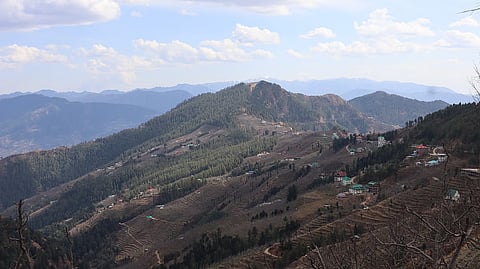


Himachal Pradesh sees little snowfall and below-normal rainfall this winter
Residents say winters are shorter, milder and no longer as harsh as before
Temperatures in early March hit their highest levels in over a decade
Dry conditions and rising heat are already affecting crops and livelihoods
Experts warn this could signal a deeper, long-term climate shift
Deshbandhu Sood, a 79-year-old resident of Shimla, recalls why the British once chose the hill town as their summer capital — its famously cool climate. Winters, he says, were once so snowy that summers barely registered. But that, he believes, is now changing.
He says the shift is not limited to Shimla. Across Himachal Pradesh, winters have become noticeably shorter. Two decades ago, people would wear woollens well into March and April. Now, many put them away by the second week of March. Snowfall has reduced, and the cold season no longer lingers as it once did.
Shimla resident Sudesh Kumari, 70, shares a similar experience. Winters in the city, she says, used to be harsh. Water would freeze, roads remained closed for days, and power cuts were common. Many residents would leave for the plains to escape the cold.
“This time it has snowed only once,” she says. “The weather now feels like what we used to experience in May or June three decades ago.”
Data from the Meteorological Centre in Shimla appears to support these observations.
Maximum temperatures recorded between March 1 and 12 this year were the highest in the past 11 years. While March temperatures typically stay below 20 degrees Celsius (°C), this year they consistently exceeded that mark.
On March 1, the maximum temperature reached 18.5°C, rising to 19°C the next day. In the following days, it hovered between 20°C and 25°C. The India Meteorological Department issued a heatwave warning for the region during this period.
Long-term data also points to a steady decline in winter rainfall and snowfall. Rainfall was 46 per cent below normal in 2010, 28 per cent below in 2011, 70 per cent below in 2016 and 71 per cent below in 2018.
The deficit remained significant in recent years — 70 per cent in 2021, 38 per cent in 2023, 42 per cent in 2024 and 26 per cent in 2025. By January 2026, rainfall was already 11 per cent below normal.
Since 2010, January has recorded below-normal rainfall in 11 years, directly affecting snowfall patterns and the stability of winter, shows long-term weather data.
Sandeep Sharma, a meteorologist at the Shimla meteorological centre, says temperatures in the city have been around 7°C above normal, while higher altitude areas have recorded increases of 5°C to 7°C.
He notes that such spikes are not entirely unprecedented — similar patterns were seen in 2021. A western disturbance is expected to become active in the coming days, which may bring some relief.
However, he warns that summer temperatures could remain above normal this year.
According to Shobhit Katiyar, chief scientist at the centre, a combination of anticyclonic activity and warm air advection is driving the current conditions across north-west India.
Anticyclonic activity causes descending air, limiting cloud formation and reducing the chances of rain or snowfall. At the same time, warm air from neighbouring regions, including Pakistan, has been flowing into north-west India, resulting in dry and warmer weather.
The prolonged dry spell and rising temperatures are already affecting agriculture and horticulture in the state.
Dr Ravindra Singh Jasrotia, director of the agriculture department, says crop losses this year have reached around Rs 11 crore so far. Teams have been sent to assess damage, and farmers are being advised on coping strategies.
Horticulture experts say that while fruit crops have not yet suffered widespread damage, continued heat and dryness could stress plants, affecting yields and increasing vulnerability to pests and disease.
Sushil Kumar Singla, secretary of the state’s Department of Environment and Climate Change, says the government is taking the climate trend seriously. Efforts are underway to increase green cover and promote sustainable development to reduce carbon emissions.
The IMD has issued a yellow alert for heatwave to severe heatwave conditions in Mandi, Kangra and Solan districts for March 13 and 14.
Forecasts suggest that summer temperatures could be significantly higher than normal this year, with summer temperatures are projected to be about 45 per cent above normal, raising concerns over water shortages and extreme heat in mountainous regions.
Experts say the shortening of winter in Himachal Pradesh may not simply be a seasonal variation, but part of a broader climate shift. If winter rainfall and snowfall continue to decline, the strain on the state’s water supply, agriculture, horticulture, and tourism—already being felt—could intensify significantly in the years ahead.
