

Flash floods and landslides struck Jammu and Kashmir’s Chenab Valley on July 6, hitting parts of Doda, Kishtwar and Ramban districts.
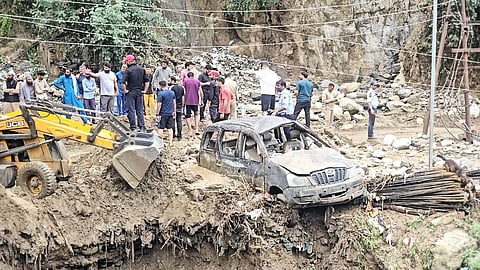
Debris flows entered the 540MW Kwar Hydroelectric Power Project site in Kishtwar and buried several parked vehicles, though officials reported no casualties.
The Doda-Kishtwar stretch of NH-244 was blocked near Prem Nagar after flood debris covered the road, disrupting movement between the two districts.
Less than a year after a cloudburst in Chisoti village of Kishtwar district in Jammu and Kashmir killed dozens of people, the wider Chenab Valley has been hit by another spell of intense rainfall, flash floods and landslides.
On July 6, 2026, fresh flash floods struck parts of the Chenab Valley, comprising Doda, Kishtwar and Ramban districts, damaging infrastructure, disrupting transport and reviving concerns over disaster preparedness in one of the Himalayas’ most fragile regions.
The most significant impact was reported at the Tail Race Tunnel area of the 540 megawatt Kwar Hydroelectric Power Project in Kishtwar district. Torrents of water carrying mud, boulders and debris entered the project premises and buried several parked vehicles. Officials said no deaths or injuries were reported so far.
The power project, located on the Chenab River in Kishtwar, is being developed by Chenab Valley Power Projects Limited (CVPPL).
Project authorities have deployed heavy earth-moving machinery to clear debris and retrieve the vehicles. Restoration work continued through the day. The Doda-Kishtwar stretch of National Highway-244 was also blocked near Prem Nagar after flash floods deposited large quantities of debris on the road, leaving vehicles stranded and disrupting movement between the two districts.
National Highways authorities and the district administration deployed teams and machinery to restore traffic.
The Chishoti cloudburst on August 14, 2025 caused major devastation during the Machail Mata Yatra. Sixty-two people were confirmed dead, 41 remained missing and presumed dead under the rubble, and more than 100 others were injured.
It is not yet clear whether the latest event was a cloudburst. Data from the India Meteorological Department is awaited. The landslides and flash floods in Kishtwar may have been linked to the activity of a low-pressure monsoon trough, which was in its normal position from southwest Rajasthan to the east-central Bay of Bengal on July 6, along with an active western disturbance over the region on July 5 and 6.
Western disturbances are usually not active during the southwest monsoon season. But climate scientists have observed that, in recent years, they have been appearing more frequently and abnormally during the monsoon. Their interaction with the monsoon trough or monsoon low-pressure systems can lead to extreme rainfall, cloudbursts, flash floods and landslides.
The latest spell has added to fears among residents that extreme weather events in the Chenab Valley are becoming more frequent and more destructive.
The landslides have reignited a debate over whether environmental degradation, unplanned infrastructure expansion and large-scale construction are worsening the impact of natural disasters in the region.
Residents, environmental activists and civil society members say cloudbursts and intense rainfall are natural events, but their consequences are being amplified by changes to mountain slopes, dumping of excavated material into rivers and streams, extensive hill cutting and weak enforcement of environmental safeguards.
Kishtwar, often described as the “Power House of Jammu and Kashmir”, is witnessing construction of several major hydroelectric projects, including Kwar, Pakal Dul, Kiru and Ratle. Large-scale road widening on NH-244 and construction of several Pradhan Mantri Gram Sadak Yojana roads are also under way across the mountainous districts.
Local residents allege that muck generated during excavation is often dumped near natural drainage channels and riverbanks, despite environmental norms requiring designated dumping sites with proper retaining structures. They fear that during intense rainfall, this loose material is washed downstream, aggravating flash floods and increasing sediment flow.
People living along vulnerable slopes also point to hill cutting during road construction. They say poor drainage planning and inadequate slope stabilisation have increased the risk of landslides during the monsoon.
The Chenab Valley has witnessed several severe weather-related disasters in recent years. The Chishoti cloudburst in 2025 damaged homes, agricultural land, roads and public infrastructure, and left a deep impact on communities in Kishtwar district.
In July 2021, cloudbursts in the Honzar area of Dachhan in Kishtwar caused widespread destruction, washing away roads, bridges and homes and causing loss of life and property. Ramban district has repeatedly faced landslides and flash floods, especially along the Jammu-Srinagar National Highway, where heavy rainfall often disrupts connectivity between Kashmir and the rest of the country.
Doda district has also seen repeated landslides, slope failures and flash floods affecting remote habitations, road links and agricultural fields.
Many elderly residents say heavy rainfall has always been part of life in the mountains, but the intensity and frequency of cloudbursts, flash floods and landslides appear to have increased over the past decade.