

The Green Climate Fund has responded to questions about the seven-year timeline for approving Nepal’s $49.9 million glacier flood resilience project, but did not directly explain the delay.
The fund said the project was approved in July 2025, entered implementation in March 2026 and has so far received $9.2m in disbursement through UNDP.
GCF objected to Down To Earth’s earlier headline, saying it conflated the project with hydropower reporting in the disaster-hit area, while acknowledging that the project geography did not overlap with the site of the floods.
Separately, 14 members of the Fund for responding to Loss and Damage board have sought an urgent meeting to consider financial support for Nepal after the August 26 floods.
The Green Climate Fund has responded to this correspondent’s email query, and to Down To Earth’s September 1, 2026 story, on the seven-year delay in clearing Nepal’s $49.9 million proposal to reduce risks from Glacial Lake Outburst Floods.
However, in two emails sent on September 2, the fund did not directly answer the central question: why did the project take seven years to move from concept note to approval?
The September 1 story, Nepal floods expose climate finance delay: GCF took seven years to approve glacier-risk project while lenders backed hydropower in vulnerable basin, had reported that the financial agency received a concept note from the Nepal government in 2018, but approved the project only in 2025.
Meanwhile, on September 2, several board members of the UN’s Fund for responding to Loss and Damage wrote to the fund’s co-chairs and executive director, asking them to “convene an extraordinary meeting of the Board to consider the Fund’s response to the catastrophic floods in Nepal”.
The FRLD, set up under the financial mechanism of the UN Framework Convention on Climate Change, is intended to address the needs of vulnerable communities in developing countries facing the irreversible impacts of climate change.
The GCF sent two emails on the morning of September 2, Indian time, responding to this correspondent’s query about the delay in approving Nepal’s Glacial Lake Outburst Floods proposal. The project’s concept note was submitted in 2018 and sanctioned in 2025.
On August 31, this correspondent wrote to the GCF’s communications department asking: “Is it possible to know why it took such a long time to clear a project that is so important in context to safety of so many people?”
In its statement, the Green Climate Fund expressed support for “families, communities, and everyone impacted by this tragedy”.
But in response to the central question on why sanctioning took so long, the fund only said that GCF’s project, “Protecting livelihoods and assets at risk from Glacial Lake Outburst Floods (GLOFs) and climate change-induced flooding in glacial river basins of Nepal”, was approved in July 2025 and entered implementation in March 2026.
The GCF’s own website records the timeline. It says the concept note was received on February 14, 2018, while approval was granted on July 3, 2025.
The fund also said that $9.2 million had been disbursed to the Accredited Entity, the United Nations Development Programme, which is the implementing partner for the project.
The money, it said, would support activities aimed at strengthening early warning systems, reducing disaster risks and improving the resilience of vulnerable communities.
The GCF also objected to the headline of the September 1 story, saying it regarded it as “mis-leading at best”. It said the headline “conflates the project with reporting on hydropower projects within the disaster-affected area”.
However, the fund acknowledged that the article had clearly said the GCF project was not specifically focused on the area where the disaster occurred.
It also said: “Though the project geography does not overlap with the disaster, this catastrophe does highlight the need for increased climate finance to scale up scientific and technical solutions to support the people of Nepal and other countries around the world.”
“GCF has a thorough appreciation of the growing glacier-induced risks and has developed an extensive portfolio focused on the protection and resilience of vulnerable communities living in glacial river basins,” the fund said.
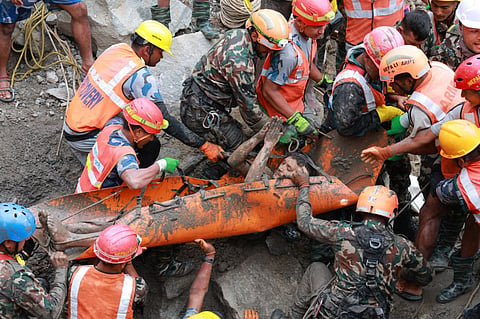
On September 2, 14 members of the global Loss and Damage Fund board wrote to the fund’s leadership, requesting an extraordinary meeting to consider a response to the catastrophic floods in Nepal.
“We write on behalf of the Board and Alternate Members from Africa States, Asia Pacific States and the Least Developed Countries to request that you, acting jointly as Co-Chairs, convene an extraordinary meeting of the Board of the Fund for responding to Loss and Damage to consider an urgent and appropriate response to the event that struck Nepal on 26 August 2026,” said the letter, a copy of which is with this correspondent.
The letter said Nepal is a least developed country under the UNFCCC and the Paris Agreement.
It said the August 26 disaster was “precisely the kind of climate-related extreme weather events the Fund was established to address”.
“The scale of loss of life, displacement, and destruction of energy, transport, and economic infrastructure warrants the Board’s urgent consideration of how the Fund’s existing instruments should be mobilised to support Nepal’s government and affected communities,” the letter said.
The letter also referred to a communication from Nepal’s Minister of Finance and Minister of Agriculture, Forests and Environment, dated August 31, 2026, seeking an urgent response from the Board.
Nepal’s Finance Minister Swarnim Wagle and Agriculture, Forests and Environment Minister Gita Chaudhary jointly wrote to the FRLD board co-chairs seeking urgent financial support after the catastrophic flash floods.
They said the economic and non-economic losses caused by the August 26 event in the Bhotekoshi River basin had gone far beyond Nepal’s national capacity to manage alone.
“Given the magnitude of the event, we urge that this request be acted upon as swiftly as possible, so the Board and Fund can provide predictability and support to the government and people of Nepal,” the signatories said.
