

The Green Climate Fund took seven years to approve Nepal’s $49.9m glacier flood resilience project, which aims to protect about 2.4 million people from Glacial Lake Outburst Flood risks.
The delay has come under scrutiny after the August 26 floods in Nepal, which damaged settlements, infrastructure and hydropower projects in the Bhote Koshi and Trishuli river systems.
Campaigners say international lenders financed major hydropower projects in the Trishuli basin despite known climate and disaster risks.
Experts say the disaster raises urgent questions about whether climate adaptation finance is reaching high-risk Himalayan communities quickly enough.
The Green Climate Fund, the international financial institution mandated to support climate action in developing countries, took seven years to approve a Nepal project aimed at protecting vulnerable communities from increasingly dangerous Glacial Lake Outburst Floods, according to documents seen by Down To Earth.
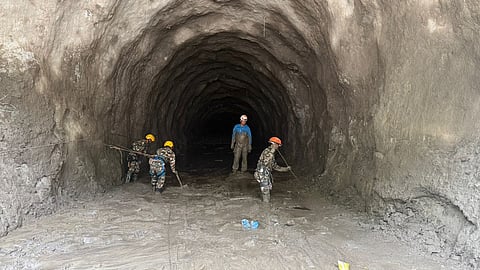
The delay is under renewed scrutiny after the August 26 devastation in Nepal, where a cascading flood of ice, rock, mud and debris tore through the Bhote Koshi and Trishuli river basins, damaging settlements, infrastructure and hydropower projects.
Experts point out that the GCF-funded project did not specifically include the Bhote Koshi and Trishuli river basins in northern Nepal, where the latest disaster occurred. But they say the project had a broader national objective: to strengthen Nepal’s capacity to monitor GLOFs and other extreme hazards, improve early-warning systems and carry out multi-hazard risk assessments.
“Where did the ‘capacity’ go when the cascading hazard swelled Bhote Koshi and turned the flood into a watery grave filled with sludge, mud and debris?” asked a representative of Friends of the Earth Nepal.
The Green Climate Fund is the world’s largest dedicated climate fund. It was set up to support low-emission, climate-resilient development in developing countries.
At the same time, questions are also being raised about multilateral and bilateral lenders that financed hydropower projects in the affected region despite known risks, like the Asian Development Bank and the World Bank Group’s International Finance Corporation, which financed the Upper Trishuli-1 hydropower project, and China’s Export-Import Bank, which provided a concessional loan for the Trishuli 3A project.
Glacier melting in Nepal has accelerated sharply in recent years, driven primarily by fossil fuel-driven climate change. Reports by the International Centre for Integrated Mountain Development have found that glaciers across the Hindu Kush Himalaya melted 65 per cent faster in the last decade than in the preceding one.
The GCF project, known as FP272, was aimed at reducing the risks and impacts of GLOFs in Nepal. According to GCF data accessed by this correspondent, the concept note was in the Fund’s pipeline from February 14, 2018, but the project was approved only on July 3, 2025. Implementation began on March 12, 2026, and the project is scheduled to run until March 12, 2033. The project, valued at $49.9 million (Rs 473.83 crore approximately), is intended to improve safety for about 2.4 million people.
This correspondent emailed the GCF to ask about the reasons for the delay, but had not received a response by the time this story was filed.
Nepal’s funding proposal, a copy of which is with this correspondent, was explicit about the glacier avalanche threat.
“The Representative Concentration Pathway 4.5 and 8.5 scenarios (moderate and extreme climate change possibilities) project that temperatures and monsoon rainfall will continue to rise in the future, both increasing lake water volumes and the probability of avalanches, rockfalls and dam wall collapse, which trigger GLOFs in particular,” the proposal said.
The proposal also said: “Since the 1970s, 26 GLOF events have been recorded across 47 potentially dangerous glacial lakes, resulting in catastrophic consequences.”
It warned that GLOFs can cause severe flooding, landslides and mudflows that damage infrastructure and private assets, and disrupt transport networks, agricultural production, hydropower supplies and tourism.
Campaigners say parts of the proposal now read like a warning of the devastation Nepal experienced on August 26. GCF documents accessed by this correspondent also acknowledged the threat.
“Nepal is experiencing accelerated glacial retreat due to climate change, intensifying the risk of Glacial Lake Outburst Floods, which threaten the safety, livelihoods and critical infrastructure of downstream communities,” the document said.
It further warned that “damages from GLOFs are often irreparable for decades, with considerable economic costs, particularly to downstream populations”.
“As per the UNDP report, the UN agency implementing the GCF-funded project in collaboration with Nepal’s Department of Hydrology and Meteorology, Lhende-Bhote Koshi was not an FP272 intervention site,” said a representative of Friends of the Earth Nepal. “But FP272 carried a broader national mandate for GLOF monitoring, early warning and multi-hazard risk assessment.”
The South Asia Network on Dams, Rivers and People said in an August 29 analysis that the disaster could become “a watershed moment” for South Asia’s hydropower boom, which has been backed by international financial corporations, multilateral banks such as the ADB and World Bank, and China’s Exim Bank.
It said hundreds of hydropower labourers, engineers and local residents were trapped inside tunnels of projects such as Upper Trishuli-1 and Trishuli 3A, the latter funded by a loan from China’s Exim Bank.
More than 350 people have been rescued by the Nepal Army, SANDRP said, but many more were still trapped inside tunnels, including Indian nationals.
The 214 megawatt Upper Trishuli-1 is one of Nepal’s largest hydropower projects. The near-complete project now lies badly damaged by the recent floods, according to campaigners and media reports.
The wider Trishuli basin has dense hydropower development, with more than 36 hydropower projects.
SANDRP alleged that multilateral development banks, including the ADB and the World Bank Group’s IFC, which financed and promoted the Upper Trishuli-1 project and conducted a cumulative impact assessment of the Trishuli basin, were aware of the extreme risks to labourers, officials, residents, rivers, infrastructure and the landscape.“Their own reports repeatedly highlighted it,” SANDRP said.
The organisation alleged that the lenders did not take adequate preventive steps, did not demand stringent checks and balances, and were not prepared for a calamity they knew could occur.
The $647.4 million Upper Trishuli-1 hydropower project is one of the largest foreign direct investments in Nepal’s history. The IFC, a member of the World Bank Group, announced on November 1, 2019, that a consortium of lenders had finalised a $453 million debt financing package to support construction of the project.
The IFC said at the time that the plant would increase Nepal’s electricity supply by one-third from existing levels.
The Asian Development Bank and Asian Infrastructure Investment Bank provided a combined $150 million in loans for the project. The remainder of the debt package came from a group of development finance institutions, including the UK’s CDC Group, now British International Investment, South Korea’s Korea Development Bank and Export-Import Bank of Korea, the Netherlands’ FMO and the OPEC Fund.
ADB had said at the beginning of the project that a climate change risk assessment had previously concluded that the risks of climate change impacts on the project were low. But the same report also noted that extreme rainfall in previous years and a glacial lake outburst flood event in 2025 had damaged some project facilities while they were under construction and significantly altered river morphology along the Trishuli river.
An Independent Panel of Experts report in June 2025 specifically recommended a Climate Resilience Assessment for the project. Campaigners say this has not yet been done. SANDRP also alleged that the IFC and World Bank did not adequately examine upstream risks or assess Tibetan impacts in the 2020 cumulative impact assessment of the Trishuli basin, carried out to meet lending conditions.
The organisation also pointed to China’s Exim Bank, which provided a $149 illion concessional loan for the Trishuli 3A hydropower project.
It alleged that the bank did not ensure independent, binding environmental safeguards and relied instead on host-country rules or voluntary action, despite China and Nepal sharing some of the most fragile and disaster-prone parts of the transboundary Himalayan basin.
Climate campaigners and experts criticised what they described as a failure of international climate finance to move quickly enough.
“It is absolutely shocking that the Green Climate Fund took seven years to approve a project aimed at protecting communities, infrastructure and ecosystems from increasing Glacial Lake Outburst Flood risks caused by human-induced climate change,” said Meena Raman from Friends of the Earth Asia Pacific.
Sanjay Vashist, director of Climate Action Network South Asia, said the delay in glacier adaptation funding, alongside large-scale financing for hydropower projects, amounted to resilience being denied to vulnerable communities facing “imminent death”.
“What we are witnessing in Nepal is the deadly consequence of a rigged financial system,” alleged Harjeet Singh, global convenor of the Fill The Fund campaign and founding director of Satat Sampada Climate Foundation.
“The GCF delay to provide vital support against glacial floods is a feature of how international climate finance has been structured by the industrialised rich countries. Developed countries have intentionally designed institutions like the GCF to remain inefficient and difficult to access,” he said.
“I am wondering what type of Cumulative Impact Assessment has been conducted. Ideally, an integrated cost-benefit analysis should take into consideration the probability of seismic activity, GLOFs, cloudbursts and other possible extreme events, as well as the impact on ecosystem services. All these factors need to be valued and incorporated as costs in the benefit-cost matrix. In that case, such projects would have been proven economically, socially and financially unviable.
This shows the very reductionist lens through which project viability is assessed,” said ecological economist Nilanjan Ghosh, who heads the Observer Research Foundation’s Kolkata chapter and works with the rivers of the region.
Anjal Prakash, a climate scientist and author of a UN climate report, said the delay in Nepal’s GLOF project raised serious questions about climate finance delivery.
“When a response to an urgent hazard takes seven years to move from concept to approval, the problem is not just paperwork; it is whether vulnerable communities get protection before disaster strikes,” he said.
He added that a stronger system should shorten the pipeline, simplify approvals and track whether funds reach high-risk mountain areas fast enough to matter. “Otherwise, climate finance risks becoming too slow for the climate risks it is meant to address,” the expert added.
