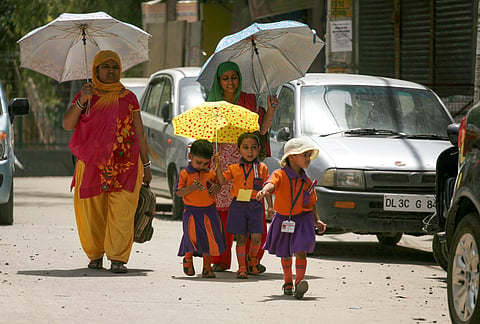


Nearly seven in 10 children in India missed school or routine activities last summer because of heat-related distress, according to a CRY report.
The survey of more than 3,000 children across 27 states and Union Territories found that 76% said heat affected their concentration.
Children reported a range of health impacts, including dehydration, headaches, extreme tiredness, dizziness and difficulty sleeping.
The report says poorer children were disproportionately affected, with those from daily-wage and manual labourer families reporting higher heat-related distress.
Nearly seven in 10 children in India missed school or routine activities last summer because of heat-related distress, while 76 per cent said acute heat affected their concentration, according to a new report by CRY — Child Rights and You.
The rapid survey, Feeling the Heat: Children’s Voices on Heat, Well-Being and Learning in India, covered more than 3,000 children aged 10 to 17 across 27 states and Union Territories. It found that rising temperatures are affecting school attendance, learning, health and well-being across much of the country.
The findings come after India experienced repeated heatwave conditions during the summer of 2026, with temperatures crossing 45 degrees Celsius (°C) in northern and central parts of the country. At its peak, several of the world’s hottest cities were in India. In many regions, schools revised timings, curtailed outdoor activities or temporarily suspended classes.
“The most valuable aspect of this rapid assessment is that it places children’s voices at the centre of the conversation on climate change,” said Puja Marwaha, chief executive officer of CRY.
“While temperature records tell us how hot it is becoming, children tell us how that heat impacts their lives — how it affects their learning, health, and overall well-being,” she said, urging policymakers to consider the findings while preparing heat action plans and climate adaptation strategies.
The trend could intensify if heat rises further in the coming summer, particularly with El Niño conditions influencing global temperatures and World Meteorological Organization predicting the warmest year ever, a climate expert told the author on July 12, 2024.
The report found that 88 per cent of children surveyed felt the 2026 summer was hotter than previous years. Nearly 68 per cent said they had missed school or routine activities because of heat-related distress, while 76 per cent said heat affected their ability to focus on studies.
The report also found that 45 per cent of children said school hours were particularly uncomfortable during periods of high heat.
Health impacts were widely reported. Around 63 per cent of children said they experienced dehydration, 51 per cent reported headaches and 44 per cent said they suffered extreme fatigue because of heat. Other symptoms included dizziness and difficulty sleeping.
Among the states surveyed, Andhra Pradesh and West Bengal reported some of the highest levels of disruption. In Andhra Pradesh, more than 88 per cent of surveyed children reported missing school or routine activities because of extreme heat. In West Bengal, the figure was nearly 72 per cent, higher than the national average.
About 65 per cent of children surveyed in West Bengal said this year’s heat was “much higher” than last year. More than 53 per cent said school hours were the hardest part of the day — among the highest figures reported in the survey.
West Bengal’s Minister of School Education Dipak Barman acknowledged the problem. “In this age of climate change, it is a major problem,” he said after hearing the study findings. “It has been decided primarily that we will organise fans in all state-run schools — around 81,000 — and we are also planning to explore what needs to be done in the long run to counter the problem.”
West Bengal experienced prolonged spells of hot and humid weather during the summer. While actual maximum temperatures were often between 34°C and 38°C, high humidity pushed the “feels like” heat index to around 51°C in some areas.
The report also found that children from economically vulnerable households were disproportionately affected. Among children from daily-wage or manual labourer families, 71 per cent reported severe heat-related distress, compared with 46 per cent from other households.
The survey found that nearly 63 per cent of children experienced dehydration because of heat exposure. Around 44 per cent reported extreme tiredness, 39 per cent dizziness and 41 per cent difficulty sleeping.
Dehydration was most commonly reported in Uttar Pradesh, where 75 per cent of surveyed children said they had experienced it, said Anupama Muhuri, general manager (national lead), volunteer engagement of CRY. Extreme tiredness was highest among children in Andhra Pradesh, at 52 per cent, followed by Delhi at 49 per cent.
Dizziness was most reported by children in Andhra Pradesh, at 66 per cent. Heat-related sleeplessness was highest among children in Uttar Pradesh, at 45 per cent, followed by West Bengal and Andhra Pradesh, both at 42 per cent.
“Definitely children are suffering much more than before due to exposure to this acute and sweltering heat,” said Apurba Ghosh, a paediatrician at the Institute of Child Health, Kolkata. “Tiredness is the most common and tell-tale symptom we find, though other heat-related symptoms are also reported,” he said.
